Pink-tongued skink (Hemisphaeriodon gerrardii)
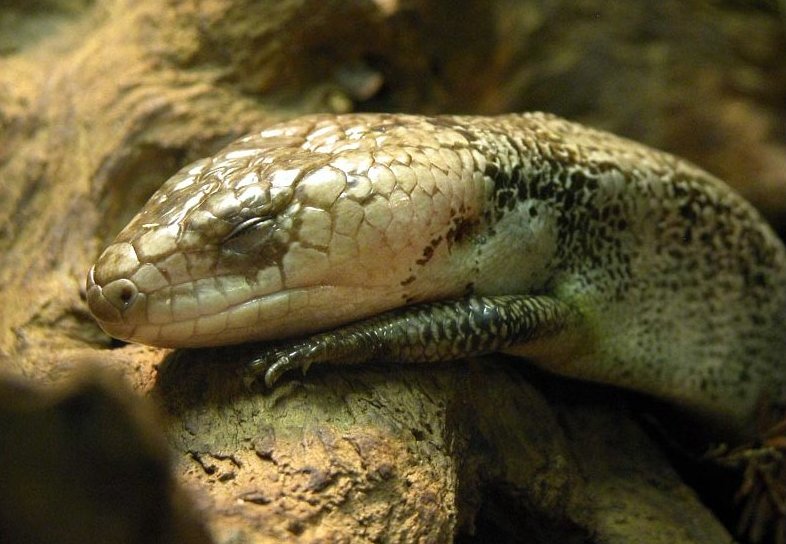
Skinks · Difficulty: Intermediate
Key facts and care guidance for Pink-tongued skink (Hemisphaeriodon gerrardii) (origin: Eastern Australia (NSW north of Sydney to Cape York, QLD); humid subtropical forest, a ground dweller, crepuscular and nocturnal). Adult size around approx. 40 cm total length (the tail ~half, prehensile). Life expectancy up to ~20 years. The values below are carefully researched guidance.
Short answers
Pink-tongued skink: How big does the enclosure need to be?
90×45×60 cm for one animal (semi-arboreal, height and climbing branches matter).
Pink-tongued skink: What temperature does it need?
Daytime 22–28 °C, basking spot 32–35 °C (a moderate basking spot is enough), at night 18–22 °C.
Pink-tongued skink: Does it need UVB lighting?
UVB: Low UVB (a crepuscular/nocturnal forest dweller, Ferguson zone 1, UV index 0–1); no strong basking spot needed.
Pink-tongued skink: How long do they live?
Life expectancy: up to ~20 years.
Pink-tongued skink: Is it suitable for beginners?
Rather not – it is considered an intermediate species (difficulty: Intermediate).
Climate
- Daytime temperature
- 22–28 °C
- Night temperature
- 18–22 °C
- Basking spot
- 32–35 °C (a moderate basking spot is enough)
- Humidity
- 70–80 % (up to 90 %), humid but well ventilated – no stuffy waterlogging
- UVB
- Low UVB (a crepuscular/nocturnal forest dweller, Ferguson zone 1, UV index 0–1); no strong basking spot needed
Enclosure
- Minimum size
- 90×45×60 cm for one animal (semi-arboreal, height and climbing branches matter)
- Substrate
- Moisture-retaining woodland substrate (coco humus or pine mulch, 5–8 cm) with a layer of leaf litter; climbing branches and floor hides
Feeding
- Food
- A specialised snail-eater (shelled snails and slugs as the staple), supplemented with earthworms, silk or hornworms and insects. Only use wild snails that are free of pesticides and parasites; otherwise farmed, frozen or tinned snails
- Feeding interval
- adults every other day (~4–10 snails); juveniles daily; a calcium and D3 supplement
Key facts
- Adult size
- approx. 40 cm total length (the tail ~half, prehensile)
- Life expectancy
- up to ~20 years
- Origin
- Eastern Australia (NSW north of Sydney to Cape York, QLD); humid subtropical forest, a ground dweller, crepuscular and nocturnal
- Protection status
- Not listed under CITES or EU law, no registration duty in Germany. Captive-bred animals only (Australian export is prohibited)
- Brumation
- A slight winter rest encourages breeding: ~2–3 months at ~10–15 °C with reduced lighting and feeding; it is not vital for survival
- Cohabitation
- Solitary housing is the safe default and recommended by most caresheets, since housing animals together can lead to fights and injuries. Pair or harem housing (one male with several females) in a large enclosure is occasionally described but remains controversial and should only be attempted with close observation and the option to separate. Never house two males together.
Notes
Taxonomy note: according to the Reptile Database, Cyclodomorphus gerrardii is the valid name and Hemisphaeriodon gerrardii the synonym. Live-bearing (a litter of about 7–25). The pink tongue distinguishes the species from the blue-tongued skinks. Common mistakes: the wrong or an insufficient supply of snails (a feeding specialist), too dry versus stuffy waterlogging (respiratory and skin problems), and internal parasites from contaminated wild snails. A prehensile tail → offer climbing opportunities.
Do you keep this species?
Add your animal to Reptoria – Reptoria reminds you about feeding and shedding. Add your animal for free →
Look for Pink-tongued skink (Hemisphaeriodon gerrardii) in the marketplace →
Related species
- Centralian blue-tongued skink (Tiliqua multifasciata) – Intermediate
- Common blue-tongued skink (Tiliqua scincoides) – Beginner
- Halmahera blue-tongued skink (Tiliqua gigas gigas) – Intermediate
- Indonesian blue-tongued skink (Tiliqua gigas) – Beginner to intermediate
- Irian Jaya blue-tongued skink (Tiliqua sp. „Irian Jaya") – Intermediate
- Mainland she-oak skink (Cyclodomorphus michaeli) – Intermediate
- Kei Island blue-tongued skink (Tiliqua gigas keyensis) – Intermediate
- Shingleback skink (Tiliqua rugosa) – Intermediate
What you need to start
To keep Pink-tongued skink (Hemisphaeriodon gerrardii) you typically need: a suitable enclosure (90×45×60 cm for one animal (semi-arboreal, height and climbing branches matter)), substrate (Moisture-retaining woodland substrate (coco humus or pine mulch, 5–8 cm) with a layer of leaf litter; climbing branches and floor hides), a heat source with a thermostat, UVB lighting, thermometer and hygrometer, a water dish and hides. You will find equipment in the Reptoria marketplace.
The complete, interactive care database is in the Reptoria app.
Last updated: 5 November 2026 · Editor: Reptoria editorial team · Sources include: https://en.wikipedia.org/wiki/Hemisphaeriodon, https://en.wikipedia.org/wiki/Pink-tongued_skink, https://reptile-database.reptarium.cz/species?genus=Cyclodomorphus&species=gerrardii, Toohey Forest Environmental Education Centre (Qld.), Pink-tongue Skink (mostly active at night); reptilesofaustralia.com C. gerrardii (nocturnal/semi-nocturnal); reptiledirect.com (crepuscular to nocturnal)
All values are non-binding guidance and do not replace expert advice. Research thoroughly from several sources before acquiring and keeping an animal, and observe the applicable law (species and animal protection in particular).