Red-bellied mud snake (Farancia abacura)
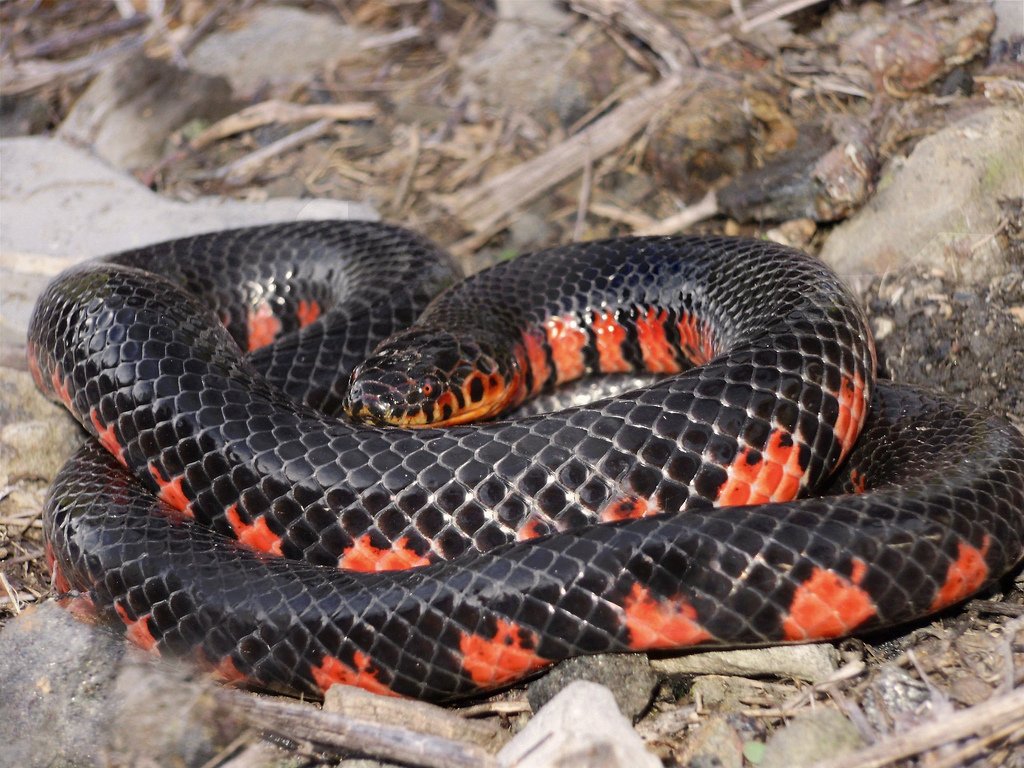
Snakes · Difficulty: Experts
Key facts and care guidance for Red-bellied mud snake (Farancia abacura) (origin: The south-eastern USA). Adult size around 100–140 cm. Life expectancy 10–15 years. The values below are carefully researched guidance.
Short answers
Red-bellied mud snake: How big does the enclosure need to be?
From 140×70×70 cm (minimum size according to the 1997 expert report, mud snakes, with a large water section).
Red-bellied mud snake: What temperature does it need?
Daytime 24–28 °C, at night 20–22 °C.
Red-bellied mud snake: Does it need UVB lighting?
UVB: Not essential.
Red-bellied mud snake: How long do they live?
Life expectancy: 10–15 years.
Red-bellied mud snake: Is it suitable for beginners?
No – better suited to experienced keepers (difficulty: Experts).
Climate
- Daytime temperature
- 24–28 °C
- Night temperature
- 20–22 °C
- Humidity
- 70–85 %
- UVB
- Not essential
Enclosure
- Minimum size
- from 140×70×70 cm (minimum size according to the 1997 expert report, mud snakes, with a large water section)
- Substrate
- Humus and sand with a large water section and leaf litter
Feeding
- Food
- Almost exclusively amphibians, above all amphiuma
- Feeding interval
- Adults 1×/week
Key facts
- Adult size
- 100–140 cm
- Life expectancy
- 10–15 years
- Origin
- The south-eastern USA
- Protection status
- —
- Brumation
- Yes, a cool spell at 14–16 °C
- Cohabitation
- Keep them singly. Snakes are solitary and do not seek company — a shared hide is competition for the best spot, not social behaviour. The concrete reason is the feeding accident: if two animals grab the same food item, one can swallow the other along with it. On top of that, once they are kept together you can no longer tell which animal has eaten and which is losing weight. For breeding, put them together under supervision and separate them again afterwards.
Notes
A feeding specialist: in the wild it eats mainly amphiuma and is correspondingly hard to provide for. Worthwhile only with a secured food source — that is where most attempts to keep it fail.
Do you keep this species?
Add your animal to Reptoria – Reptoria reminds you about feeding and shedding. Add your animal for free →
Look for Red-bellied mud snake (Farancia abacura) in the marketplace →
Related species
- Ahumada's alpine garter snake (Thamnophis ahumadai) – Expert
- Northern water snake (Nerodia sipedon) – Intermediate
- Barred grass snake (Natrix helvetica) – Intermediate
- Bogert's garter snake (Thamnophis bogerti) – Expert
- Dekay's brown snake (Storeria dekayi) – Intermediate
- Butler's garter snake (Thamnophis butleri) – Intermediate
- Cope's mountain meadow snake (Thamnophis copei) – Expert
- Fox's mountain meadow snake (Thamnophis foxi) – Expert
What you need to start
To keep Red-bellied mud snake (Farancia abacura) you typically need: a suitable enclosure (from 140×70×70 cm (minimum size according to the 1997 expert report, mud snakes, with a large water section)), substrate (Humus and sand with a large water section and leaf litter), a heat source with a thermostat, UVB lighting, thermometer and hygrometer, a water dish and hides. You will find equipment in the Reptoria marketplace.
The complete, interactive care database is in the Reptoria app.
Last updated: 5 November 2026 · Editor: Reptoria editorial team · Sources include: https://en.wikipedia.org/wiki/Mud_snake, https://reptile-database.reptarium.cz/species?genus=Farancia&species=abacura, en.wikipedia „Mud snake“ („mostly aquatic and nocturnal“); de.wikipedia „Schlammnatter“ („überwiegend nachtaktiv“)
All values are non-binding guidance and do not replace expert advice. Research thoroughly from several sources before acquiring and keeping an animal, and observe the applicable law (species and animal protection in particular).