Spiny flower mantis (Pseudocreobotra wahlbergii)
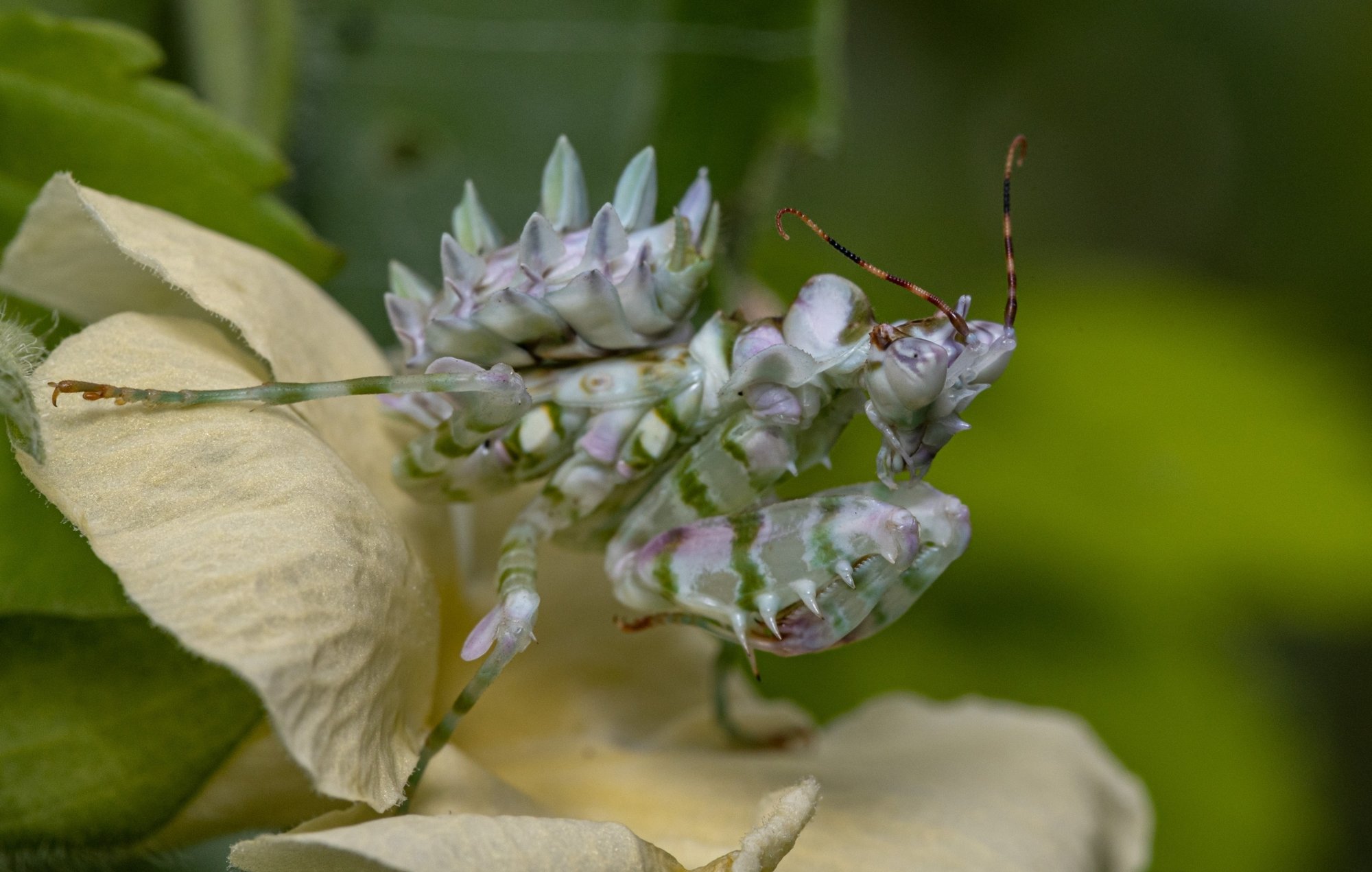
Invertebrates · Difficulty: Beginner to intermediate
Key facts and care guidance for Spiny flower mantis (Pseudocreobotra wahlbergii) (origin: Sub-Saharan Africa — from southern through eastern to central Africa). Adult size around approx. 4–5.5 cm (females 4.5–5.5 cm, males 4–5 cm). Life expectancy approx. 6–12 months. The values below are carefully researched guidance.
Short answers
Spiny flower mantis: How big does the enclosure need to be?
At least 20 × 20 × 30 cm for a single animal, better 30 × 30 × 45 cm (height at least 3 times, width at least 2 times body length).
Spiny flower mantis: What temperature does it need?
Daytime 25–30 °C, basking spot Optional warm area ~30–32 °C, at night 18–22 °C.
Spiny flower mantis: Does it need UVB lighting?
UVB: No.
Spiny flower mantis: How long do they live?
Life expectancy: approx. 6–12 months.
Spiny flower mantis: Is it suitable for beginners?
Partly – manageable with some prior knowledge (difficulty: Beginner to intermediate).
Climate
- Daytime temperature
- 25–30 °C
- Night temperature
- 18–22 °C
- Basking spot
- Optional warm area ~30–32 °C
- Humidity
- 50–60 % (day), 60–70 % at night
- UVB
- No
Enclosure
- Minimum size
- at least 20 × 20 × 30 cm for a single animal, better 30 × 30 × 45 cm (height at least 3 times, width at least 2 times body length)
- Substrate
- Coco humus, slightly damp
Feeding
- Food
- Flies and moths are the preferred food, juveniles take fruit flies; small crickets also work, large grasshoppers are too bulky for this small species
- Feeding interval
- every 2–3 days
Key facts
- Adult size
- approx. 4–5.5 cm (females 4.5–5.5 cm, males 4–5 cm)
- Life expectancy
- approx. 6–12 months
- Origin
- Sub-Saharan Africa — from southern through eastern to central Africa
- Protection status
- —
- Brumation
- None
- Cohabitation
- Keep them singly (cannibalistic and aggressive towards each other). The reason is not fighting but feeding: these animals take anything that fits in the mouth, and a second animal in the enclosure counts.
Notes
Flower mimicry with a spiral eyespot as threat behaviour. Ventilate well and do not keep it permanently wet, or shedding problems follow.
Do you keep this species?
Add your animal to Reptoria – Reptoria reminds you about feeding and shedding. Add your animal for free →
Look for Spiny flower mantis (Pseudocreobotra wahlbergii) in the marketplace →
Related species
- African giant mantis (Sphodromantis lineola) – Beginner
- African giant mantis (Sphodromantis viridis) – Beginner
- Egyptian dwarf mantis (Miomantis paykullii) – Beginner
- Asian ant mantis (Odontomantis planiceps) – Beginner
- Giant Asian mantis (Hierodula patellifera) – Beginner
- Banded flower mantis (Theopropus elegans) – Intermediate
- Boxer mantis (Ephestiasula pictipes) – Intermediate
- Brunner's boxer mantis (Hestiasula brunneriana) – Intermediate
What you need to start
To keep Spiny flower mantis (Pseudocreobotra wahlbergii) you typically need: a suitable enclosure (at least 20 × 20 × 30 cm for a single animal, better 30 × 30 × 45 cm (height at least 3 times, width at least 2 times body length)), substrate (Coco humus, slightly damp), a heat source with a thermostat, thermometer and hygrometer, a water dish and hides. You will find equipment in the Reptoria marketplace.
The complete, interactive care database is in the Reptoria app.
Last updated: 2 November 2026 · Editor: Reptoria editorial team · Sources include: keepinginsects.com, insektenliebe.com, kaiserstuhl-mantiden.de, megazoo-nord.de, einrichtungsbeispiele.de
All values are non-binding guidance and do not replace expert advice. Research thoroughly from several sources before acquiring and keeping an animal, and observe the applicable law (species and animal protection in particular).