Sun beetle (Pachnoda marginata)
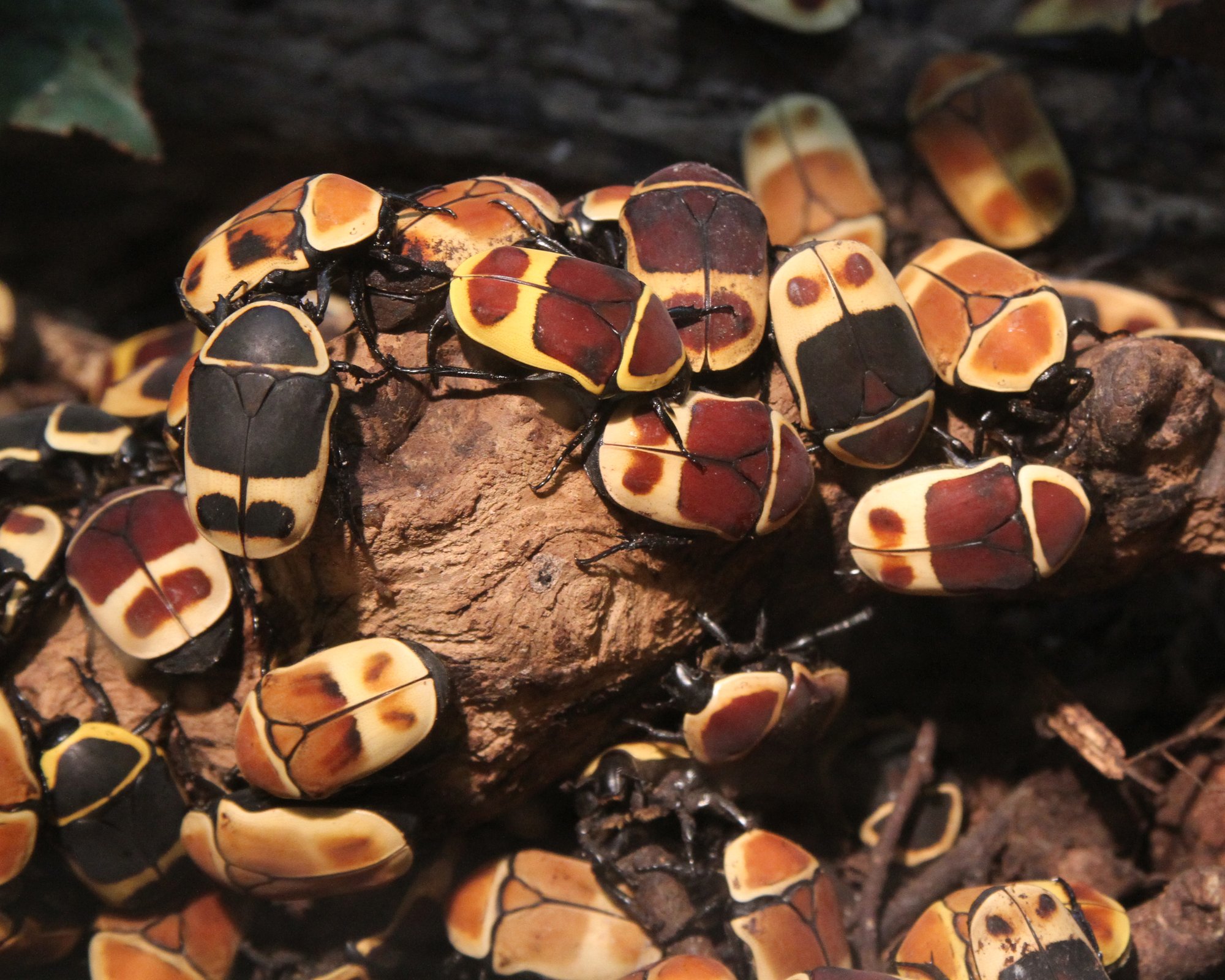
Invertebrates · Difficulty: Beginner
Key facts and care guidance for Sun beetle (Pachnoda marginata) (origin: Central and West Africa (Congo, Cameroon, Kenya, Sudan and others)). Adult size around approx. 2.0–2.5 cm. Life expectancy beetle approx. 2–6 months; the egg-to-beetle cycle takes about 5 months. The values below are carefully researched guidance.
Short answers
Sun beetle: How big does the enclosure need to be?
From approx. 30×20×20 cm for a small group (a plastic box or aquarium with a lid).
Sun beetle: What temperature does it need?
Daytime 22–28 °C, at night 20–22 °C.
Sun beetle: Does it need UVB lighting?
UVB: No UVB needed.
Sun beetle: How long do they live?
Life expectancy: beetle approx. 2–6 months; the egg-to-beetle cycle takes about 5 months.
Sun beetle: Is it suitable for beginners?
Yes – it is considered suitable for beginners (difficulty: Beginner).
Climate
- Daytime temperature
- 22–28 °C
- Night temperature
- 20–22 °C
- Basking spot
- —
- Humidity
- 60–70 % (substrate evenly damp, never drying out)
- UVB
- No UVB needed
Enclosure
- Minimum size
- from approx. 30×20×20 cm for a small group (a plastic box or aquarium with a lid)
- Substrate
- Loose humus-rich soil without fertiliser plus pine bark and white-rotted deciduous wood, about 10 cm deep, permanently slightly damp; lay leaf litter on top
Feeding
- Food
- Beetles: overripe fruit (banana, mango, pear), beetle jelly (no citrus); larvae: they eat the white-rotted wood mixed into the substrate
- Feeding interval
- beetles: top up fruit 2–3×/week; the larvae feed continuously from the substrate
Key facts
- Adult size
- approx. 2.0–2.5 cm
- Life expectancy
- beetle approx. 2–6 months; the egg-to-beetle cycle takes about 5 months
- Origin
- Central and West Africa (Congo, Cameroon, Kenya, Sudan and others)
- Protection status
- No CITES, no special protection; no registration duty
- Brumation
- None (they breed continuously)
- Cohabitation
- Group and colony housing are explicitly possible and common in this species – several beetles and larvae live together without issue given enough space, food and substrate. A classic beginner group species.
Notes
Very easy to care for, ideal for beginners and for feeder or gut-loading cultures. A common mistake is substrate that is too dry. Diurnal and fond of flying – a lid is needed.
Do you keep this species?
Add your animal to Reptoria – Reptoria reminds you about feeding and shedding. Add your animal for free →
Look for Sun beetle (Pachnoda marginata) in the marketplace →
Related species
- Garden fruit chafer (Pachnoda sinuata) – Beginner
- Actaeon beetle (Megasoma actaeon) – Intermediate
- Atlas beetle (Chalcosoma atlas) – Intermediate
- Elephant beetle (Megasoma elephas) – Intermediate
- European rhinoceros beetle (Oryctes nasicornis) – Intermediate
- Goliath beetle (Goliathus goliatus) – Expert
- Grall's flower beetle (Eudicella gralli) – Beginner
- Hercules beetle (Dynastes hercules) – Intermediate
What you need to start
To keep Sun beetle (Pachnoda marginata) you typically need: a suitable enclosure (from approx. 30×20×20 cm for a small group (a plastic box or aquarium with a lid)), substrate (Loose humus-rich soil without fertiliser plus pine bark and white-rotted deciduous wood, about 10 cm deep, permanently slightly damp; lay leaf litter on top), a heat source with a thermostat, UVB lighting, thermometer and hygrometer, a water dish and hides. You will find equipment in the Reptoria marketplace.
The complete, interactive care database is in the Reptoria app.
Last updated: 9 October 2026 · Editor: Reptoria editorial team · Sources include: https://de.wikipedia.org/wiki/Kongo-Rosenk%C3%A4fer, https://en.wikipedia.org/wiki/Pachnoda_marginata
All values are non-binding guidance and do not replace expert advice. Research thoroughly from several sources before acquiring and keeping an animal, and observe the applicable law (species and animal protection in particular).