Goliath beetle (Goliathus goliatus)
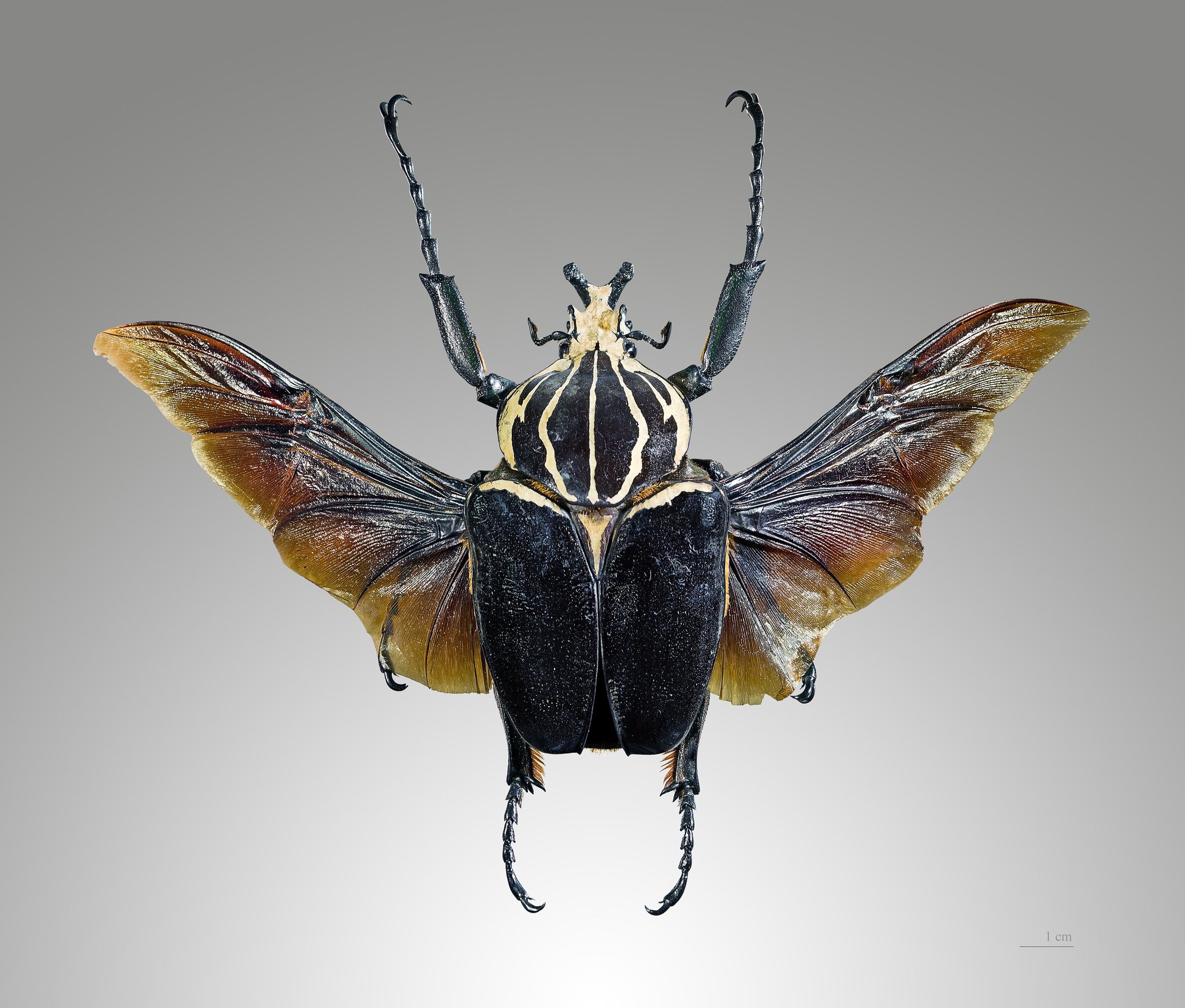
Invertebrates · Difficulty: Expert
Key facts and care guidance for Goliath beetle (Goliathus goliatus) (origin: West and Central Africa (Cameroon, Gabon, DR Congo, Nigeria)). Adult size around approx. 5–11 cm (males considerably larger). Life expectancy the beetle usually lives a few weeks to months; the larval stage lasts about a year. The values below are carefully researched guidance.
Short answers
Goliath beetle: How big does the enclosure need to be?
Beetles: approx. 40×30×40 cm with climbing structure; larvae individually in 0.25–1 l containers (moved up by instar).
Goliath beetle: What temperature does it need?
Daytime 24–28 °C, at night 20–22 °C.
Goliath beetle: Does it need UVB lighting?
UVB: No UVB needed.
Goliath beetle: How long do they live?
Life expectancy: the beetle usually lives a few weeks to months; the larval stage lasts about a year.
Goliath beetle: Is it suitable for beginners?
No – better suited to experienced keepers (difficulty: Expert).
Climate
- Daytime temperature
- 24–28 °C
- Night temperature
- 20–22 °C
- Basking spot
- —
- Humidity
- 70–85 %
- UVB
- No UVB needed
Enclosure
- Minimum size
- beetles: approx. 40×30×40 cm with climbing structure; larvae individually in 0.25–1 l containers (moved up by instar)
- Substrate
- A humus or white-rot wood substrate as the base; the (largely carnivorous) larvae additionally need protein fed to them directly
Feeding
- Food
- Beetles: ripe fruit (banana, mango), beetle jelly, plant sap; LARVAE: protein-rich – cat or dog food pellets, fish flakes, Gammarus (almost daily care)
- Feeding interval
- beetles: fruit or jelly 2–3×/week; larvae: very intensive, offer protein almost daily and remove leftovers
Key facts
- Adult size
- approx. 5–11 cm (males considerably larger)
- Life expectancy
- the beetle usually lives a few weeks to months; the larval stage lasts about a year
- Origin
- West and Central Africa (Cameroon, Gabon, DR Congo, Nigeria)
- Protection status
- No CITES, no special protection; no registration duty
- Brumation
- None (tropical)
- Cohabitation
- Housing larvae singly is mandatory (carnivorous and cannibalistic towards each other); adult male beetles are likewise incompatible and are only put together briefly and under supervision to mate, never in permanent groups.
Notes
One of the most demanding breeding projects: the larvae need protein-rich feeding (not just substrate) and intensive care, otherwise the losses are high. A common mistake: keeping the larvae in substrate alone like normal flower beetle larvae (which kills them). For experienced keepers only.
Do you keep this species?
Add your animal to Reptoria – Reptoria reminds you about feeding and shedding. Add your animal for free →
Look for Goliath beetle (Goliathus goliatus) in the marketplace →
Related species
- Actaeon beetle (Megasoma actaeon) – Intermediate
- Atlas beetle (Chalcosoma atlas) – Intermediate
- Elephant beetle (Megasoma elephas) – Intermediate
- European rhinoceros beetle (Oryctes nasicornis) – Intermediate
- Grall's flower beetle (Eudicella gralli) – Beginner
- Hercules beetle (Dynastes hercules) – Intermediate
- European stag beetle (Lucanus cervus) – Expert
- Japanese rhinoceros beetle (Trypoxylus dichotomus) – Beginner
What you need to start
To keep Goliath beetle (Goliathus goliatus) you typically need: a suitable enclosure (beetles: approx. 40×30×40 cm with climbing structure; larvae individually in 0.25–1 l containers (moved up by instar)), substrate (A humus or white-rot wood substrate as the base; the (largely carnivorous) larvae additionally need protein fed to them directly), a heat source with a thermostat, UVB lighting, thermometer and hygrometer, a water dish and hides. You will find equipment in the Reptoria marketplace.
The complete, interactive care database is in the Reptoria app.
Last updated: 30 October 2026 · Editor: Reptoria editorial team · Sources include: https://en.wikipedia.org/wiki/Goliathus, https://en.wikipedia.org/wiki/Goliathus_goliatus
All values are non-binding guidance and do not replace expert advice. Research thoroughly from several sources before acquiring and keeping an animal, and observe the applicable law (species and animal protection in particular).