Japanese rhinoceros beetle (Trypoxylus dichotomus)
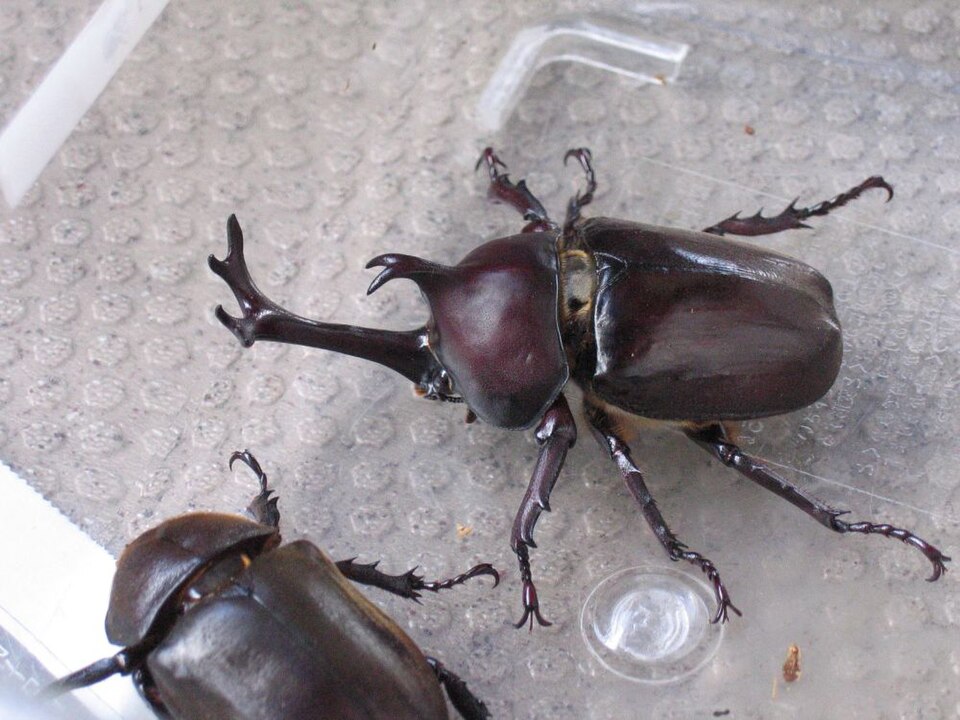
Invertebrates · Difficulty: Beginner
Key facts and care guidance for Japanese rhinoceros beetle (Trypoxylus dichotomus) (origin: East Asia (Japan, Taiwan, Korea, China)). Adult size around males approx. 40–80 mm (including the forked horn), females approx. 35–55 mm. Life expectancy beetle approx. 2–4 (up to 6) months; the whole cycle approx. 10–12 months (one generation a year). The values below are carefully researched guidance.
Short answers
Japanese rhinoceros beetle: How big does the enclosure need to be?
Beetles (a pair): approx. 30×20×25 cm; a breeding box from 40 l; larvae individually or together at 2–5 l per larva.
Japanese rhinoceros beetle: What temperature does it need?
Daytime 22–26 °C, at night 18–22 °C.
Japanese rhinoceros beetle: Does it need UVB lighting?
UVB: No UVB needed.
Japanese rhinoceros beetle: How long do they live?
Life expectancy: beetle approx. 2–4 (up to 6) months; the whole cycle approx. 10–12 months (one generation a year).
Japanese rhinoceros beetle: Is it suitable for beginners?
Yes – it is considered suitable for beginners (difficulty: Beginner).
Climate
- Daytime temperature
- 22–26 °C
- Night temperature
- 18–22 °C
- Basking spot
- —
- Humidity
- 60–80 % (substrate damp, not dripping wet)
- UVB
- No UVB needed
Enclosure
- Minimum size
- beetles (a pair): approx. 30×20×25 cm; a breeding box from 40 l; larvae individually or together at 2–5 l per larva
- Substrate
- Flake soil or a fermented deciduous-wood humus substrate, at least 15 cm deep for egg-laying, damp; lay branches or bark on top to help them right themselves
Feeding
- Food
- Beetles: beetle jelly, overripe fruit (banana); larvae: a humus or white-rot wood substrate (flake soil)
- Feeding interval
- beetles: jelly or fruit 2–3×/week; the larvae feed continuously from the substrate
Key facts
- Adult size
- males approx. 40–80 mm (including the forked horn), females approx. 35–55 mm
- Life expectancy
- beetle approx. 2–4 (up to 6) months; the whole cycle approx. 10–12 months (one generation a year)
- Origin
- East Asia (Japan, Taiwan, Korea, China)
- Protection status
- No CITES, no special protection; no registration duty
- Brumation
- The larvae naturally go through a cool overwintering; kept warm they can usually be bred without a separate rest period
- Cohabitation
- Group housing works well for this species: beetles tolerate each other in pairs or small groups, even though males occasionally compete over females or feeding spots. From the second instar onward larvae are not cannibalistic and can be raised communally without issue given enough substrate; only very young larvae may occasionally attack each other.
Notes
Beginner-friendly, robust, and no cannibalism problems among the larvae. Branches and bark are needed so the beetle can turn itself off its back. Nocturnal. A common mistake is substrate that is too wet.
Do you keep this species?
Add your animal to Reptoria – Reptoria reminds you about feeding and shedding. Add your animal for free →
Look for Japanese rhinoceros beetle (Trypoxylus dichotomus) in the marketplace →
Related species
- Actaeon beetle (Megasoma actaeon) – Intermediate
- Atlas beetle (Chalcosoma atlas) – Intermediate
- Elephant beetle (Megasoma elephas) – Intermediate
- European rhinoceros beetle (Oryctes nasicornis) – Intermediate
- Goliath beetle (Goliathus goliatus) – Expert
- Grall's flower beetle (Eudicella gralli) – Beginner
- Hercules beetle (Dynastes hercules) – Intermediate
- European stag beetle (Lucanus cervus) – Expert
What you need to start
To keep Japanese rhinoceros beetle (Trypoxylus dichotomus) you typically need: a suitable enclosure (beetles (a pair): approx. 30×20×25 cm; a breeding box from 40 l; larvae individually or together at 2–5 l per larva), substrate (Flake soil or a fermented deciduous-wood humus substrate, at least 15 cm deep for egg-laying, damp; lay branches or bark on top to help them right themselves), a heat source with a thermostat, UVB lighting, thermometer and hygrometer, a water dish and hides. You will find equipment in the Reptoria marketplace.
The complete, interactive care database is in the Reptoria app.
Last updated: 9 October 2026 · Editor: Reptoria editorial team · Sources include: https://en.wikipedia.org/wiki/Japanese_rhinoceros_beetle, https://en.wikipedia.org/wiki/Trypoxylus
All values are non-binding guidance and do not replace expert advice. Research thoroughly from several sources before acquiring and keeping an animal, and observe the applicable law (species and animal protection in particular).