Tomato frog (Dyscophus antongilii)
Amphibians · Difficulty: Intermediate
Key facts and care guidance for Tomato frog (Dyscophus antongilii) (origin: North-eastern Madagascar). Adult size around 6–10 cm (females). Life expectancy 8–12 years. The values below are carefully researched guidance.
Short answers
Tomato frog: How big does the enclosure need to be?
60×40×40 cm.
Tomato frog: What temperature does it need?
Daytime 22–27 °C, basking spot No basking spot, at night 18–21 °C.
Tomato frog: Does it need UVB lighting?
UVB: Recommended (UVB 2 %).
Tomato frog: How long do they live?
Life expectancy: 8–12 years.
Tomato frog: Is it suitable for beginners?
Rather not – it is considered an intermediate species (difficulty: Intermediate).
Climate
- Daytime temperature
- 22–27 °C
- Night temperature
- 18–21 °C
- Basking spot
- No basking spot
- Humidity
- 70–85 %
- UVB
- Recommended (UVB 2 %)
Enclosure
- Minimum size
- 60×40×40 cm
- Substrate
- Coco humus 10–15 cm for burying, leaf litter, a shallow water dish
Feeding
- Food
- House crickets, crickets, earthworms, roaches
- Feeding interval
- 2–3×/week
Key facts
- Adult size
- 6–10 cm (females)
- Life expectancy
- 8–12 years
- Origin
- North-eastern Madagascar
- Protection status
- CITES II (downlisted from Appendix I at CoP18) – proof of captive breeding matters
- Brumation
- A cooler dry spell of 8–10 weeks
- Cohabitation
- Keeping singly is safest. A pair works as long as both animals are roughly the same size and are fed separately; as soon as one animal refuses food, loses weight or shows injuries, separate immediately.
Notes
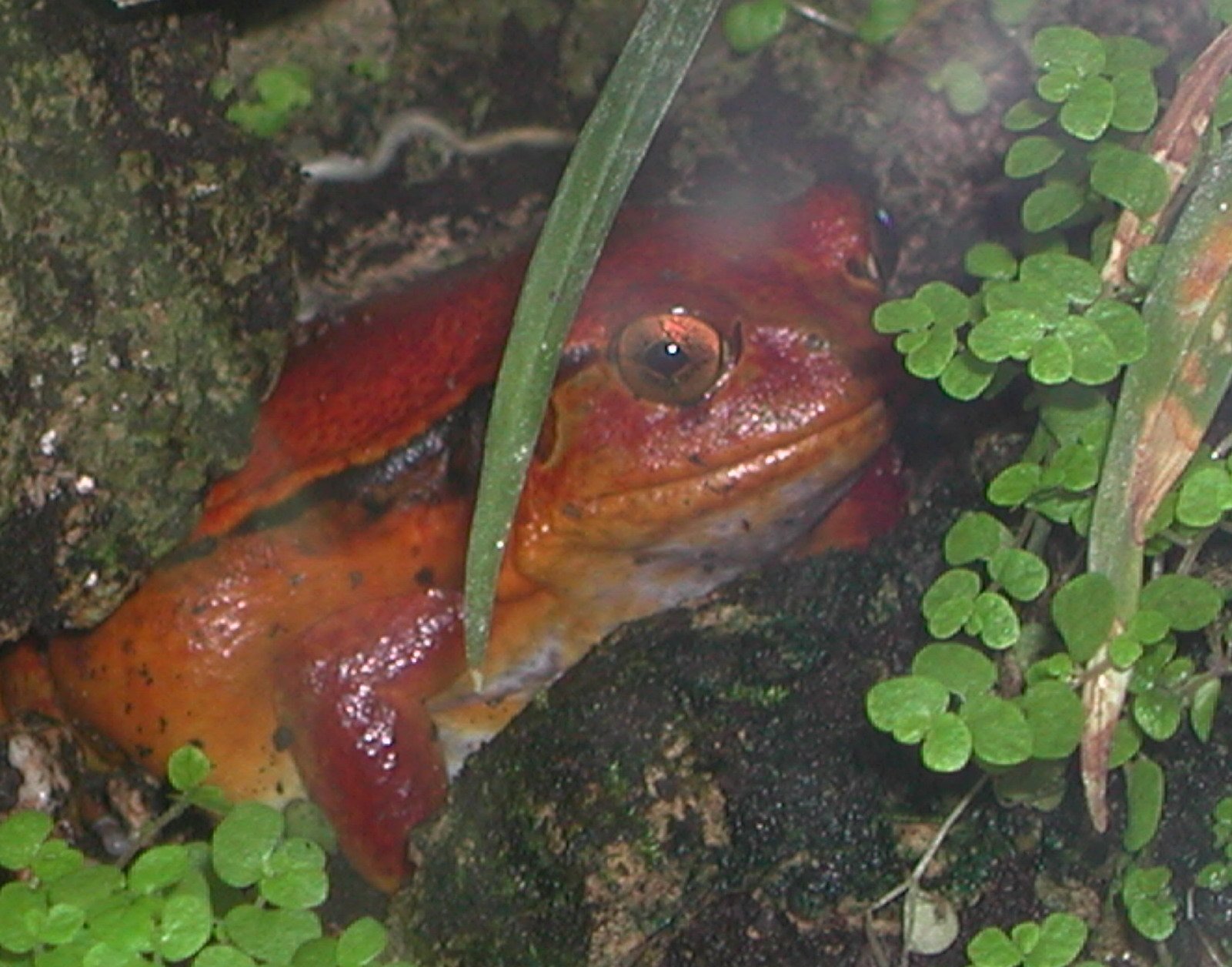
The females are a brilliant tomato red, the males smaller and brownish. It buries itself by day. When threatened it releases a sticky foam that irritates mucous membranes.
Do you keep this species?
Add your animal to Reptoria – Reptoria reminds you about feeding and shedding. Add your animal for free →
Look for Tomato frog (Dyscophus antongilii) in the marketplace →
Related species
- Antsouhy tomato frog (Dyscophus insularis) – Intermediate
- False tomato frog (Dyscophus guineti) – Intermediate
- Flat-headed bullfrog (Kaloula baleata) – Beginner
- Asian painted frog (Kaloula pulchra) – Beginner
- Banded rubber frog (Phrynomantis bifasciatus) – Intermediate
- Italian crested newt (Triturus carnifex) – Intermediate
- Yellow-bellied poison frog (Ameerega hahneli) – Intermediate
- Amazonian horned frog (Ceratophrys cornuta) – Intermediate
What you need to start
To keep Tomato frog (Dyscophus antongilii) you typically need: a suitable enclosure (60×40×40 cm), substrate (Coco humus 10–15 cm for burying, leaf litter, a shallow water dish), a heat source with a thermostat, UVB lighting, thermometer and hygrometer, a water dish and hides. You will find equipment in the Reptoria marketplace.
The complete, interactive care database is in the Reptoria app.
Last updated: 9 October 2026 · Editor: Reptoria editorial team · Sources include: https://de.wikipedia.org/wiki/Roter_Tomatenfrosch, https://en.wikipedia.org/wiki/Dyscophus_antongilii
All values are non-binding guidance and do not replace expert advice. Research thoroughly from several sources before acquiring and keeping an animal, and observe the applicable law (species and animal protection in particular).