Wasp spider (Argiope bruennichi)
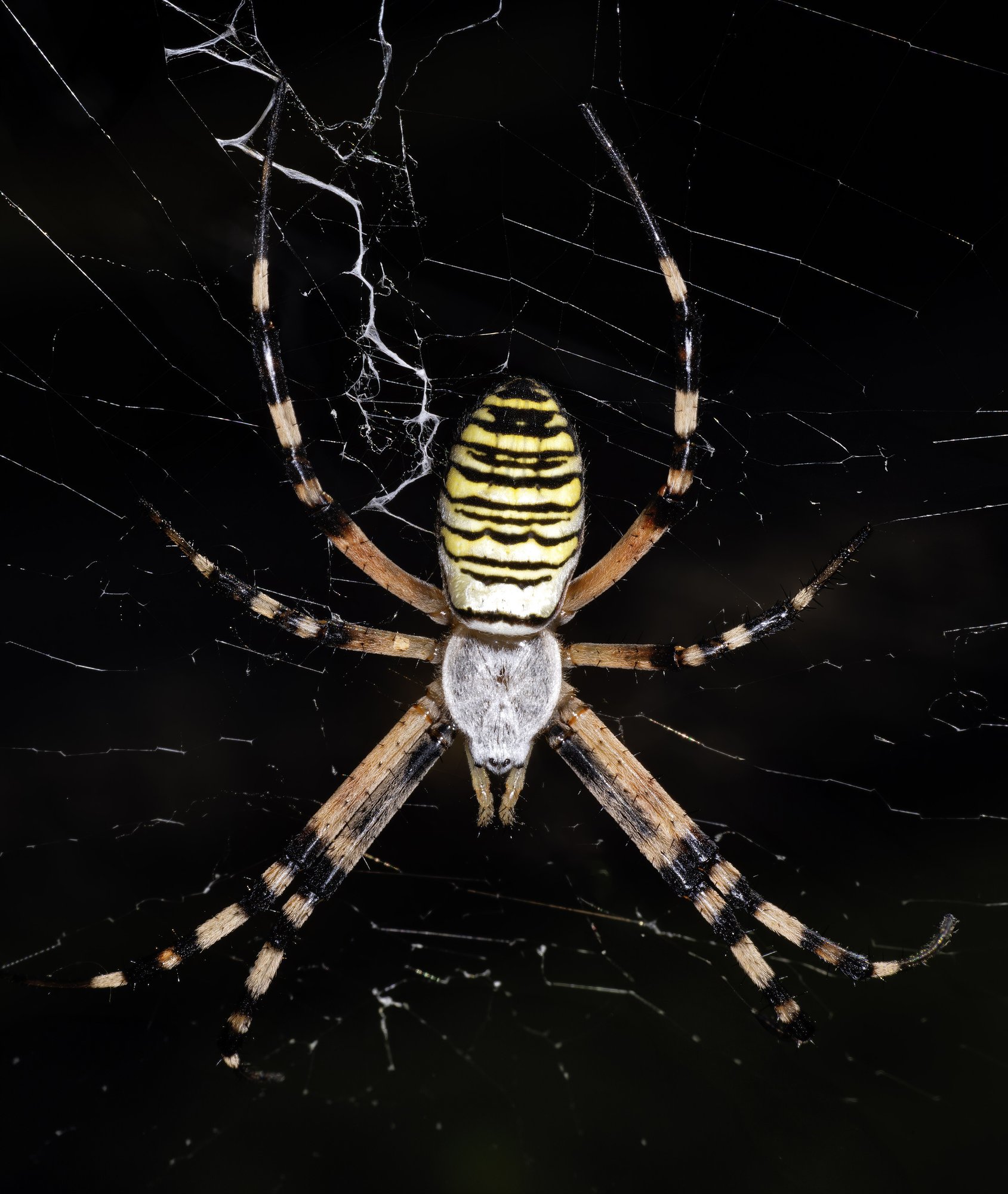
Invertebrates · Difficulty: Intermediate
Key facts and care guidance for Wasp spider (Argiope bruennichi) (origin: Originally Mediterranean; today established across central Europe including Germany). Adult size around females 14–17 mm body (the leg span is greater), males 4–6 mm. Life expectancy approx. 1 year (the adult female dies in autumn after laying). The values below are carefully researched guidance.
Short answers
Wasp spider: How big does the enclosure need to be?
30×30×40 cm (tall, for a large orb web; a mesh or gauze cage).
Wasp spider: What temperature does it need?
Daytime 22–26 °C (summer), sunny areas up to ~30 °C, at night 14–18 °C.
Wasp spider: Does it need UVB lighting?
UVB: UVB not essential; diurnal, natural daylight and a bright position are beneficial.
Wasp spider: How long do they live?
Life expectancy: approx. 1 year (the adult female dies in autumn after laying).
Wasp spider: Is it suitable for beginners?
Rather not – it is considered an intermediate species (difficulty: Intermediate).
Climate
- Daytime temperature
- 22–26 °C (summer), sunny areas up to ~30 °C
- Night temperature
- 14–18 °C
- Basking spot
- —
- Humidity
- 50–70 %
- UVB
- UVB not essential; diurnal, natural daylight and a bright position are beneficial
Enclosure
- Minimum size
- 30×30×40 cm (tall, for a large orb web; a mesh or gauze cage)
- Substrate
- A soil and sand mix with grasses and stems as anchors for the web; planted like a meadow
Feeding
- Food
- Flying insects: locusts, crickets, flies, moths
- Feeding interval
- adults 1–2×/week, juveniles more often and smaller prey
Key facts
- Adult size
- females 14–17 mm body (the leg span is greater), males 4–6 mm
- Life expectancy
- approx. 1 year (the adult female dies in autumn after laying)
- Origin
- Originally Mediterranean; today established across central Europe including Germany
- Protection status
- Native; general protection under §39 of the Federal Nature Conservation Act (taking from the wild only with good reason). Not "specially protected", no CITES.
- Brumation
- The adult does not overwinter – it dies in autumn; overwintering happens as an egg sac, and the spiderlings hatch in spring
- Cohabitation
- Keep them singly. Solitary and cannibalistic; the female often eats the male during or after mating. No groups or permanent pairs.
Notes
A classic outdoor orb-web spider, and hardly a typical terrarium species: short-lived (annual), and it needs a large web. Keeper experiences are usually seasonal. The bite is harmless to humans. Husbandry data are sparse – the figures follow its field ecology.
Do you keep this species?
Add your animal to Reptoria – Reptoria reminds you about feeding and shedding. Add your animal for free →
Look for Wasp spider (Argiope bruennichi) in the marketplace →
Related species
- Lobed argiope (Argiope lobata) – Intermediate
- Woodlouse spider (Dysdera crocata) – Intermediate
- Huntsman spider (Heteropoda venatoria) – Beginner
- Brown recluse spider (Loxosceles reclusa) – Expert
- David Bowie huntsman spider (Heteropoda davidbowie) – Intermediate
- Tube-web spider (Segestria florentina) – Intermediate
- Raft spider (Dolomedes fimbriatus) – Expert
- Segmented spider (Liphistius sp.) – Expert
What you need to start
To keep Wasp spider (Argiope bruennichi) you typically need: a suitable enclosure (30×30×40 cm (tall, for a large orb web; a mesh or gauze cage)), substrate (A soil and sand mix with grasses and stems as anchors for the web; planted like a meadow), a heat source with a thermostat, UVB lighting, thermometer and hygrometer, a water dish and hides. You will find equipment in the Reptoria marketplace.
The complete, interactive care database is in the Reptoria app.
Last updated: 25 September 2026 · Editor: Reptoria editorial team · Sources include: https://de.wikipedia.org/wiki/Wespenspinne, https://en.wikipedia.org/wiki/Argiope_lobata
All values are non-binding guidance and do not replace expert advice. Research thoroughly from several sources before acquiring and keeping an animal, and observe the applicable law (species and animal protection in particular).