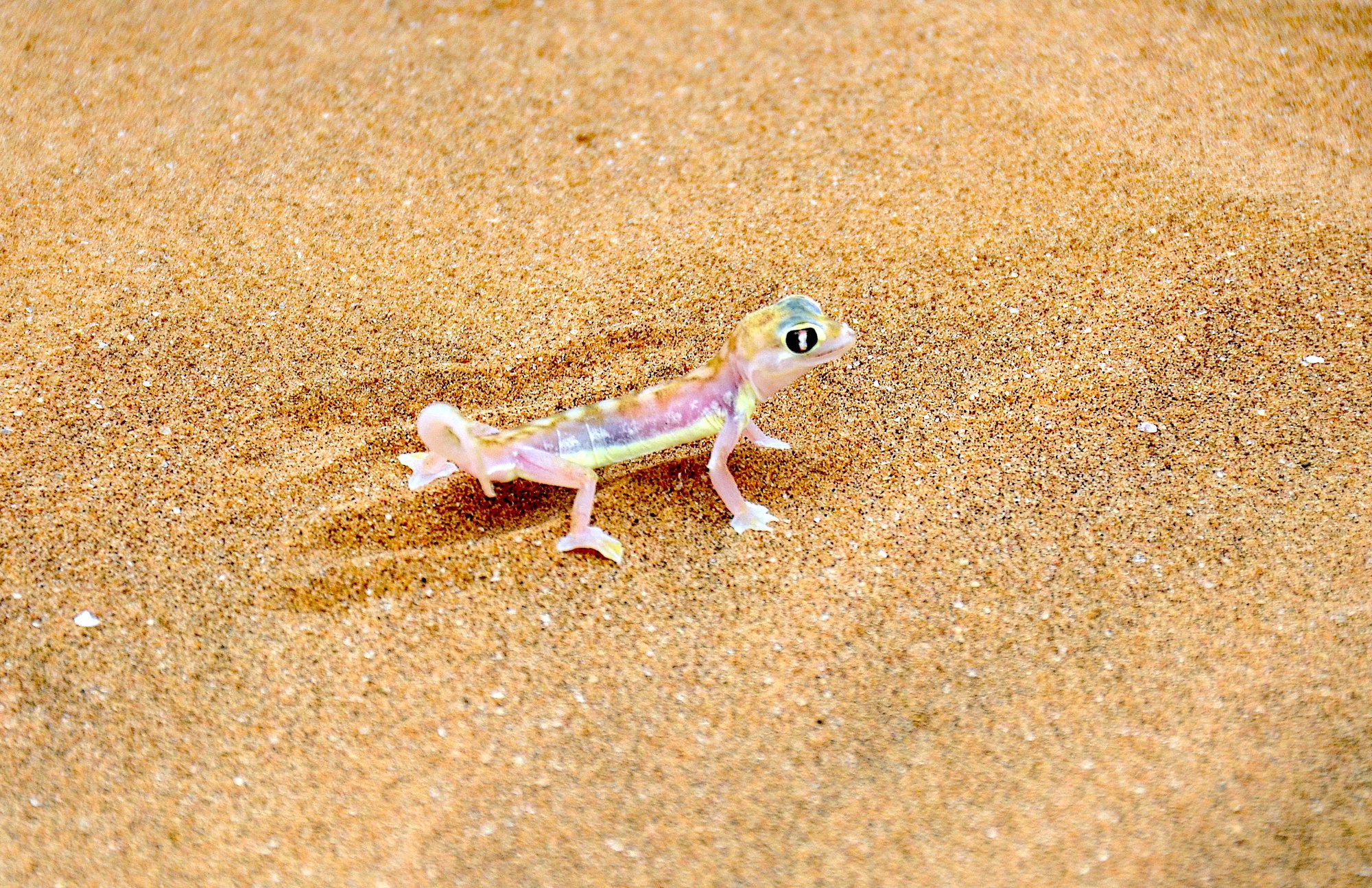
Web-footed gecko (Pachydactylus rangei)
Geckos · Difficulty: Intermediate
Key facts and care guidance for Web-footed gecko (Pachydactylus rangei) (origin: The Namib Desert). Adult size around 10–13 cm. Life expectancy 8–12 years. The values below are carefully researched guidance.
Short answers
Web-footed gecko: How big does the enclosure need to be?
60×40×40 cm.
Web-footed gecko: What temperature does it need?
Daytime 24–30 °C, basking spot 32 °C, at night 16–20 °C.
Web-footed gecko: Does it need UVB lighting?
UVB: Not essential.
Web-footed gecko: How long do they live?
Life expectancy: 8–12 years.
Web-footed gecko: Is it suitable for beginners?
Rather not – it is considered an intermediate species (difficulty: Intermediate).
Climate
- Daytime temperature
- 24–30 °C
- Night temperature
- 16–20 °C
- Basking spot
- 32 °C
- Humidity
- 40–55 %, fog at night
- UVB
- Not essential
Enclosure
- Minimum size
- 60×40×40 cm
- Substrate
- Deep, fine dune sand (at least 15 cm) for digging
Feeding
- Food
- Small insects
- Feeding interval
- adults 3×/week
Key facts
- Adult size
- 10–13 cm
- Life expectancy
- 8–12 years
- Origin
- The Namib Desert
- Protection status
- Not listed under CITES
- Brumation
- A cooler spell of 6–8 weeks
- Cohabitation
- Keeping them singly is the safest option. Sources clearly disagree here: the classic view is that males are aggressive towards each other like most geckos and fight when housed together, while experienced breeders also report entirely aggression-free group housing with several males and females. Anyone wanting to try a group should watch closely, provide plenty of tunnels and retreats, and separate immediately at the first sign of conflict.
Notes
Translucent skin and webbing between the toes for digging in sand. Nocturnal; it digs deep burrows by day – sand depth is decisive.
Do you keep this species?
Add your animal to Reptoria – Reptoria reminds you about feeding and shedding. Add your animal for free →
Look for Web-footed gecko (Pachydactylus rangei) in the marketplace →
Related species
- Bibron's thick-toed gecko (Pachydactylus bibronii) – Beginner
- Spotted thick-toed gecko (Pachydactylus maculatus) – Beginner with some knowledge
- Cape thick-toed gecko (Pachydactylus capensis) – Beginner with some knowledge
- Namaqua thick-toed gecko (Pachydactylus namaquensis) – Beginner with some knowledge
- Rough thick-toed gecko (Pachydactylus rugosus) – Beginner with some knowledge
- Tiger thick-toed gecko (Pachydactylus tigrinus) – Beginner with some knowledge
- Weber's thick-toed gecko (Pachydactylus weberi) – Beginner with some knowledge
- Arabian short-fingered gecko (Stenodactylus arabicus) – Beginner with some knowledge
What you need to start
To keep Web-footed gecko (Pachydactylus rangei) you typically need: a suitable enclosure (60×40×40 cm), substrate (Deep, fine dune sand (at least 15 cm) for digging), a heat source with a thermostat, UVB lighting, thermometer and hygrometer, a water dish and hides. You will find equipment in the Reptoria marketplace.
The complete, interactive care database is in the Reptoria app.
Last updated: 9 October 2026 · Editor: Reptoria editorial team · Sources include: https://animaldiversity.org/accounts/Pachydactylus_rangei/, https://de.wikipedia.org/wiki/Namibgecko, https://geckotime.com/ecology-care-and-breeding-of-the-namib-web-footed-gecko/
All values are non-binding guidance and do not replace expert advice. Research thoroughly from several sources before acquiring and keeping an animal, and observe the applicable law (species and animal protection in particular).