Amboina sailfin lizard (Hydrosaurus amboinensis)
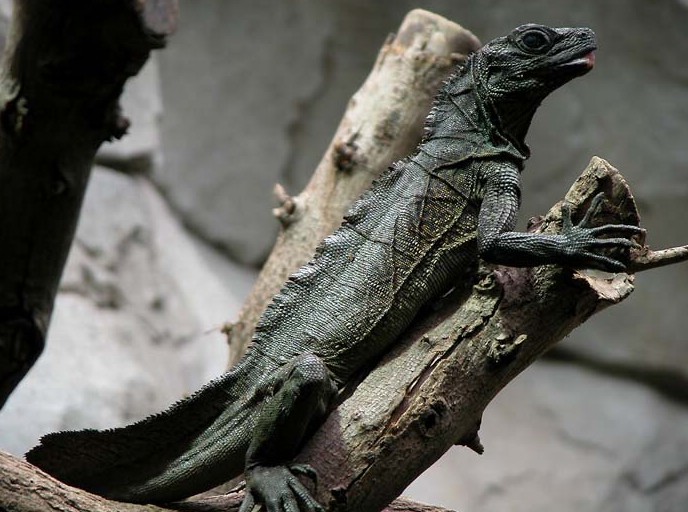
Agamas · Difficulty: Intermediate to expert
Key facts and care guidance for Amboina sailfin lizard (Hydrosaurus amboinensis) (origin: Indonesia (Moluccas, Halmahera) and New Guinea, always near water). Adult size around males 90–110 cm, females 75–90 cm total length (exceptionally up to 120 cm). Life expectancy 15–25 years. The values below are carefully researched guidance.
Short answers
Amboina sailfin lizard: How big does the enclosure need to be?
From 200×150×200 cm for one animal; for a pair from 230×150×200 cm (15 % more floor space per additional animal, as in the 1997 expert report) With a large water section.
Amboina sailfin lizard: What temperature does it need?
Daytime 26–32 °C (locally up to 35 °C), basking spot 35–40 °C, at night 22–24 °C.
Amboina sailfin lizard: Does it need UVB lighting?
UVB: Essential (rainforest-grade UVB).
Amboina sailfin lizard: How long do they live?
Life expectancy: 15–25 years.
Amboina sailfin lizard: Is it suitable for beginners?
No – better suited to experienced keepers (difficulty: Intermediate to expert).
Climate
- Daytime temperature
- 26–32 °C (locally up to 35 °C)
- Night temperature
- 22–24 °C
- Basking spot
- 35–40 °C
- Humidity
- 70–90 %
- UVB
- Essential (rainforest-grade UVB)
Enclosure
- Minimum size
- from 200×150×200 cm for one animal; for a pair from 230×150×200 cm (15 % more floor space per additional animal, as in the 1997 expert report) With a large water section.
- Substrate
- Damp forest floor or terrarium soil plus a large swimming basin
Feeding
- Food
- Omnivorous: in adult animals roughly half insects (grasshoppers, roaches, crickets) and half plant matter (leaves, flowers, fruit, vegetables), plus occasional fish. Juveniles eat predominantly animal food. Give calcium and vitamins via the food.
- Feeding interval
- juveniles daily, adults 2–3×/week
Key facts
- Adult size
- males 90–110 cm, females 75–90 cm total length (exceptionally up to 120 cm)
- Life expectancy
- 15–25 years
- Origin
- Indonesia (Moluccas, Halmahera) and New Guinea, always near water
- Protection status
- Annex B (CITES II since 2023) – registration required
- Brumation
- None
- Cohabitation
- Singly or as a pair; the males are very territorial and fight fiercely. The reason: several males fight over territory and the warm spot until one is injured or spends its life in a corner. Females usually get on, but each needs its own warm spot and hide; feed them separately once they differ in size.
Notes
Very large, skittish and fast; a large swimming area and stable climbing opportunities are essential. Panic dashes cause snout injuries – visual screening is needed.
Do you keep this species?
Add your animal to Reptoria – Reptoria reminds you about feeding and shedding. Add your animal for free →
Look for Amboina sailfin lizard (Hydrosaurus amboinensis) in the marketplace →
Related species
- Papuan sailfin lizard (Hydrosaurus microlophus) – Expert
- Philippine sailfin lizard (Hydrosaurus pustulatus) – Expert
- Sulawesi sailfin lizard (Hydrosaurus celebensis) – Expert
- Weber's sailfin lizard (Hydrosaurus weberi) – Expert
- Frilled lizard (Chlamydosaurus kingii) – Intermediate
- Egyptian spiny-tailed lizard (Uromastyx aegyptia) – Intermediate to expert
- Bell's angle-headed dragon (Gonocephalus bellii) – Intermediate to expert
- Eared forest dragon (Hypsilurus auritus) – Expert
What you need to start
To keep Amboina sailfin lizard (Hydrosaurus amboinensis) you typically need: a suitable enclosure (from 200×150×200 cm for one animal; for a pair from 230×150×200 cm (15 % more floor space per additional animal, as in the 1997 expert report) With a large water section.), substrate (Damp forest floor or terrarium soil plus a large swimming basin), a heat source with a thermostat, UVB lighting, thermometer and hygrometer, a water dish and hides. You will find equipment in the Reptoria marketplace.
The complete, interactive care database is in the Reptoria app.
Last updated: 2 November 2026 · Editor: Reptoria editorial team · Sources include: reptile.guide, Wikipedia DE, einrichtungsbeispiele.de, reptile-database.reptarium.cz, Wikipedia EN
All values are non-binding guidance and do not replace expert advice. Research thoroughly from several sources before acquiring and keeping an animal, and observe the applicable law (species and animal protection in particular).