Sulawesi sailfin lizard (Hydrosaurus celebensis)
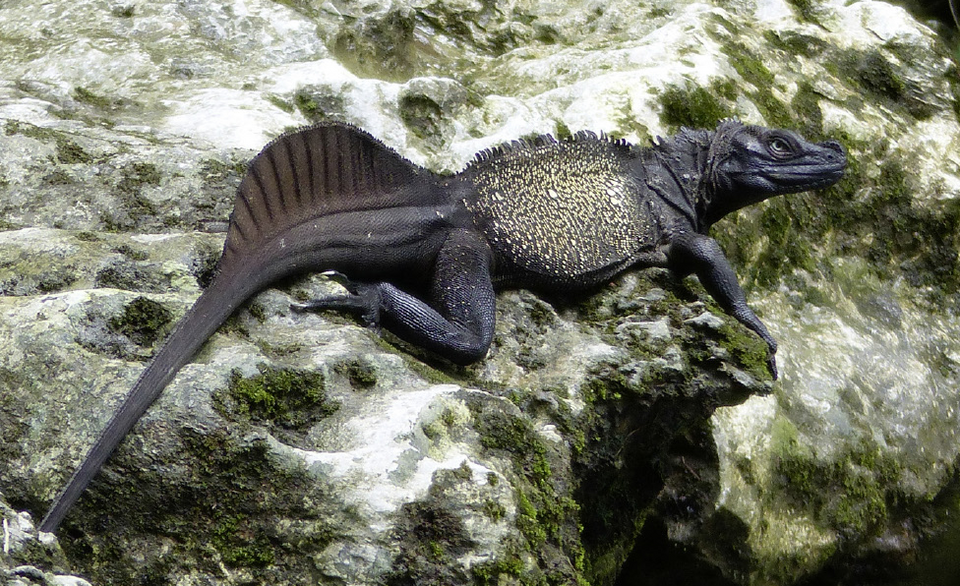
Agamas · Difficulty: Expert
Key facts and care guidance for Sulawesi sailfin lizard (Hydrosaurus celebensis) (origin: The Indonesian island of Sulawesi (Celebes), humid lowlands and tropical rainforest). Adult size around total length up to ~100 cm. Life expectancy 15–20 years. The values below are carefully researched guidance.
Short answers
Sulawesi sailfin lizard: How big does the enclosure need to be?
250×150×150 cm (one adult animal), larger is recommended; a water basin covering at least a third of the floor.
Sulawesi sailfin lizard: What temperature does it need?
Daytime 28–32 °C, basking spot up to ~38 °C (basking spot), at night 24–26 °C.
Sulawesi sailfin lizard: Does it need UVB lighting?
UVB: A high UVB requirement (Ferguson zone 2–3, UV index 3–5); a powerful UVB lamp for D3 and calcium metabolism.
Sulawesi sailfin lizard: How long do they live?
Life expectancy: 15–20 years.
Sulawesi sailfin lizard: Is it suitable for beginners?
No – better suited to experienced keepers (difficulty: Expert).
Climate
- Daytime temperature
- 28–32 °C
- Night temperature
- 24–26 °C
- Basking spot
- up to ~38 °C (basking spot)
- Humidity
- 70–90 %
- UVB
- A high UVB requirement (Ferguson zone 2–3, UV index 3–5); a powerful UVB lamp for D3 and calcium metabolism
Enclosure
- Minimum size
- 250×150×150 cm (one adult animal), larger is recommended; a water basin covering at least a third of the floor
- Substrate
- A mix of soil, sand and leaf litter, moisture-retaining and diggable; a large deep water basin
Feeding
- Food
- Omnivorous: crickets, locusts, earthworms, fish plus leafy greens, herbs and fruit
- Feeding interval
- juveniles daily, adults animal food 3–4×/week plus plant food offered daily
Key facts
- Adult size
- total length up to ~100 cm
- Life expectancy
- 15–20 years
- Origin
- The Indonesian island of Sulawesi (Celebes), humid lowlands and tropical rainforest
- Protection status
- No CITES status (as of research in 2024/25); mostly wild-caught, under pressure from trade and habitat loss → mind the origin and captive breeding
- Brumation
- None (tropical)
- Cohabitation
- Keep them singly, or at most as a pair in very large facilities; territorial, nervous animals that flee; never keep males together
Notes
The largest of the three species. Very high demands on space, equipment and experience. It swims and flees into the water → a large, deep tank is essential. Shy → a risk of injury on the glass, so soft structures and dense planting.
Do you keep this species?
Add your animal to Reptoria – Reptoria reminds you about feeding and shedding. Add your animal for free →
Look for Sulawesi sailfin lizard (Hydrosaurus celebensis) in the marketplace →
Related species
- Amboina sailfin lizard (Hydrosaurus amboinensis) – Intermediate to expert
- Papuan sailfin lizard (Hydrosaurus microlophus) – Expert
- Philippine sailfin lizard (Hydrosaurus pustulatus) – Expert
- Weber's sailfin lizard (Hydrosaurus weberi) – Expert
- Frilled lizard (Chlamydosaurus kingii) – Intermediate
- Eared forest dragon (Hypsilurus auritus) – Expert
- Inland earless dragon (Tympanocryptis intima) – Expert
- Blanford's flying lizard (Draco blanfordii) – Expert
What you need to start
To keep Sulawesi sailfin lizard (Hydrosaurus celebensis) you typically need: a suitable enclosure (250×150×150 cm (one adult animal), larger is recommended; a water basin covering at least a third of the floor), substrate (A mix of soil, sand and leaf litter, moisture-retaining and diggable; a large deep water basin), a heat source with a thermostat, UVB lighting, thermometer and hygrometer, a water dish and hides. You will find equipment in the Reptoria marketplace.
The complete, interactive care database is in the Reptoria app.
Last updated: 2 November 2026 · Editor: Reptoria editorial team · Sources include: https://en.wikipedia.org/wiki/Hydrosaurus_celebensis, https://reptile-database.reptarium.cz/species?genus=Hydrosaurus&species=celebensis
All values are non-binding guidance and do not replace expert advice. Research thoroughly from several sources before acquiring and keeping an animal, and observe the applicable law (species and animal protection in particular).