Arabian sand boa (Eryx jayakari)
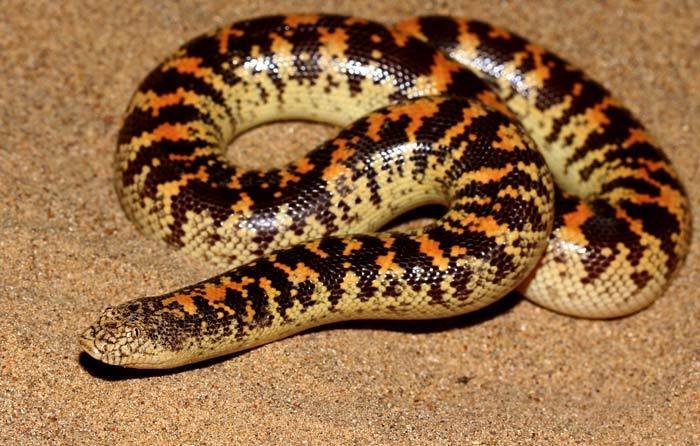
Snakes · Difficulty: Beginner to intermediate
Key facts and care guidance for Arabian sand boa (Eryx jayakari) (origin: The Arabian Peninsula / Middle East, sand deserts). Adult size around 30–40 cm (♀ up to ~50 cm). Life expectancy 15–20 years. The values below are carefully researched guidance.
Short answers
Arabian sand boa: How big does the enclosure need to be?
From 60×40×40 cm for an adult animal; floor space counts, height is secondary.
Arabian sand boa: What temperature does it need?
Daytime warm side 29–32 °C, cool side 24–26 °C — there must be a gradient in the enclosure, basking spot Warmest spot in the substrate 32–35 °C, at night 20–22 °C.
Arabian sand boa: Does it need UVB lighting?
UVB: Optional.
Arabian sand boa: How long do they live?
Life expectancy: 15–20 years.
Arabian sand boa: Is it suitable for beginners?
Partly – manageable with some prior knowledge (difficulty: Beginner to intermediate).
Climate
- Daytime temperature
- warm side 29–32 °C, cool side 24–26 °C — there must be a gradient in the enclosure
- Night temperature
- 20–22 °C
- Basking spot
- Warmest spot in the substrate 32–35 °C
- Humidity
- 30–40 %
- UVB
- Optional
Enclosure
- Minimum size
- from 60×40×40 cm for an adult animal; floor space counts, height is secondary
- Substrate
- 8–15 cm of fine sand or a sand-clay mix for full burrowing, plus a damp moss box to aid shedding
Feeding
- Food
- Frozen-thawed mice of a suitable size (the prey should be no thicker than the snake at its widest point); in the wild predominantly geckos and amphisbaenians
- Feeding interval
- adults every 7–10 days
Key facts
- Adult size
- 30–40 cm (♀ up to ~50 cm)
- Life expectancy
- 15–20 years
- Origin
- The Arabian Peninsula / Middle East, sand deserts
- Protection status
- CITES Appendix II / EU Annex B (registration required, Boidae)
- Brumation
- None
- Cohabitation
- Keeping them singly is recommended. Snakes are solitary and do not seek company. The concrete reason is the feeding accident: if two animals grab the same food item, one can swallow the other along with it. On top of that, once they are kept together you can no longer tell which animal has eaten and which is losing weight. For breeding, put them together under supervision.
Notes
A small, burrowing desert ambush hunter with upward-facing eyes; keep it dry and warm. It spends almost all its time buried, and is non-venomous and harmless.
Do you keep this species?
Add your animal to Reptoria – Reptoria reminds you about feeding and shedding. Add your animal for free →
Look for Arabian sand boa (Eryx jayakari) in the marketplace →
Related species
- Egyptian sand boa (Eryx colubrinus colubrinus) – Beginner
- Red sand boa (Eryx johnii) – Intermediate
- Kenyan sand boa (Eryx colubrinus loveridgei) – Beginner
- Saharan sand boa (Eryx muelleri) – Beginner
- Dwarf sand boa (Eryx miliaris) – Beginner
- Tatar sand boa (Eryx tataricus) – Beginner
- Javelin sand boa (Eryx jaculus) – Beginner
- Caatinga rainbow boa (Epicrates assisi) – Intermediate
What you need to start
To keep Arabian sand boa (Eryx jayakari) you typically need: a suitable enclosure (from 60×40×40 cm for an adult animal; floor space counts, height is secondary), substrate (8–15 cm of fine sand or a sand-clay mix for full burrowing, plus a damp moss box to aid shedding), a heat source with a thermostat, UVB lighting, thermometer and hygrometer, a water dish and hides. You will find equipment in the Reptoria marketplace.
The complete, interactive care database is in the Reptoria app.
Last updated: 9 October 2026 · Editor: Reptoria editorial team · Sources include: azreptiles.com, Wikipedia EN, EUR-Lex VO (EU) 2026/1383, Gutachten Mindestanforderungen Reptilien BML 1997 (lokal), eu_annex.txt (lokal)
All values are non-binding guidance and do not replace expert advice. Research thoroughly from several sources before acquiring and keeping an animal, and observe the applicable law (species and animal protection in particular).