Argentine snake-necked turtle (Hydromedusa tectifera)
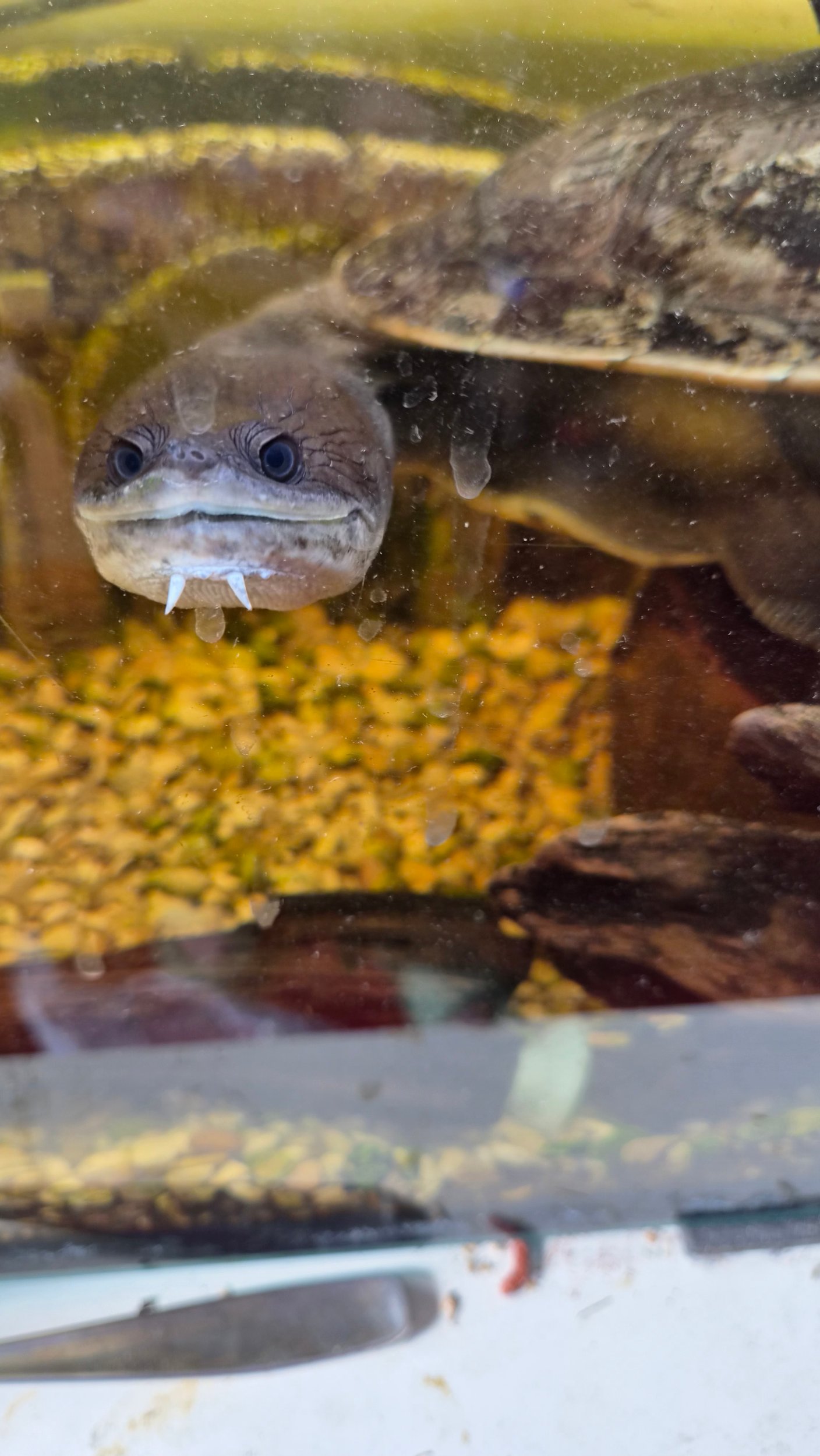
Turtles & tortoises · Difficulty: Intermediate
Key facts and care guidance for Argentine snake-necked turtle (Hydromedusa tectifera) (origin: Northeast Argentina (Chaco, Formosa), Uruguay, eastern Paraguay and southeast Brazil; slow-flowing waters, ponds and swamps with a soft bottom and aquatic plants). Adult size around 20–30 cm. Life expectancy 30–40 years. The values below are carefully researched guidance.
Short answers
Argentine snake-necked turtle: How big does the enclosure need to be?
From 150×75 cm water surface for one animal, water depth 40–45 cm, plus an accessible land area with deep substrate for egg-laying.
Argentine snake-necked turtle: What temperature does it need?
Daytime 20–24 °C water temperature, briefly up to 26 °C; permanently warmer is harmful, basking spot 30 °C, at night 16–20 °C.
Argentine snake-necked turtle: Does it need UVB lighting?
UVB: A low dose of UVB is recommended (UVB 6%). This species is nocturnal, lives practically entirely in the water and barely basks — its body temperature simply follows the water. A lamp directly over a haul-out spot still belongs in the tank, though, but must not heat the water.
Argentine snake-necked turtle: How long do they live?
Life expectancy: 30–40 years.
Argentine snake-necked turtle: Is it suitable for beginners?
Rather not – it is considered an intermediate species (difficulty: Intermediate).
Climate
- Daytime temperature
- 20–24 °C water temperature, briefly up to 26 °C; permanently warmer is harmful
- Night temperature
- 16–20 °C
- Basking spot
- 30 °C
- Humidity
- Aquatic
- UVB
- A low dose of UVB is recommended (UVB 6%). This species is nocturnal, lives practically entirely in the water and barely basks — its body temperature simply follows the water. A lamp directly over a haul-out spot still belongs in the tank, though, but must not heat the water
Enclosure
- Minimum size
- from 150×75 cm water surface for one animal, water depth 40–45 cm, plus an accessible land area with deep substrate for egg-laying
- Substrate
- Water 30–45 cm deep, sand, dense planting, roots
Feeding
- Food
- Purely carnivorous, preferring aquatic snails; plus aquatic insects and their larvae, fish, shrimp, earthworms and amphibian larvae. Shelled snails also cover the calcium requirement
- Feeding interval
- 3×/week
Key facts
- Adult size
- 20–30 cm
- Life expectancy
- 30–40 years
- Origin
- Northeast Argentina (Chaco, Formosa), Uruguay, eastern Paraguay and southeast Brazil; slow-flowing waters, ponds and swamps with a soft bottom and aquatic plants
- Protection status
- Not listed under CITES
- Brumation
- A cooler spell of 8–12 weeks
- Cohabitation
- Single housing or a pair. Two males harass each other and the females; under constant courtship a female visibly loses weight. A pair therefore only works if you can remove the male as soon as he harasses the female — a second tank belongs in the plan. With more space, put one male with several females, so the courtship is spread out.
Notes
To be kept cooler than the tropical side-necks – temperatures above 27 °C are tolerated poorly. A strict carnivore that hunts in a densely planted tank. It rarely basks.
Do you keep this species?
Add your animal to Reptoria – Reptoria reminds you about feeding and shedding. Add your animal for free →
Look for Argentine snake-necked turtle (Hydromedusa tectifera) in the marketplace →
Related species
- African helmeted turtle (Pelomedusa subrufa) – Beginner to intermediate
- Eastern long-necked turtle (Chelodina longicollis) – Intermediate
- Gibba turtle (Mesoclemmys gibba) – Intermediate
- Matamata (Chelus fimbriata) – Expert
- Hilaire's toadhead turtle (Phrynops hilarii) – Intermediate
- Murray River turtle (Emydura macquarii) – Intermediate
- Northern snake-necked turtle (Chelodina rugosa) – Intermediate
- Reimann's snake-necked turtle (Chelodina reimanni) – Intermediate
What you need to start
To keep Argentine snake-necked turtle (Hydromedusa tectifera) you typically need: a suitable enclosure (from 150×75 cm water surface for one animal, water depth 40–45 cm, plus an accessible land area with deep substrate for egg-laying), substrate (Water 30–45 cm deep, sand, dense planting, roots), a heat source with a thermostat, UVB lighting, thermometer and hygrometer, a water dish and hides. You will find equipment in the Reptoria marketplace.
The complete, interactive care database is in the Reptoria app.
Last updated: 5 November 2026 · Editor: Reptoria editorial team · Sources include: turtles.linnaeus.naturalis.nl (Turtles of the World, Naturalis), en.wikipedia.org, reptile-database.reptarium.cz, chelonia-science.de, de.wikipedia.org (Unionsliste invasiver Arten)
All values are non-binding guidance and do not replace expert advice. Research thoroughly from several sources before acquiring and keeping an animal, and observe the applicable law (species and animal protection in particular).