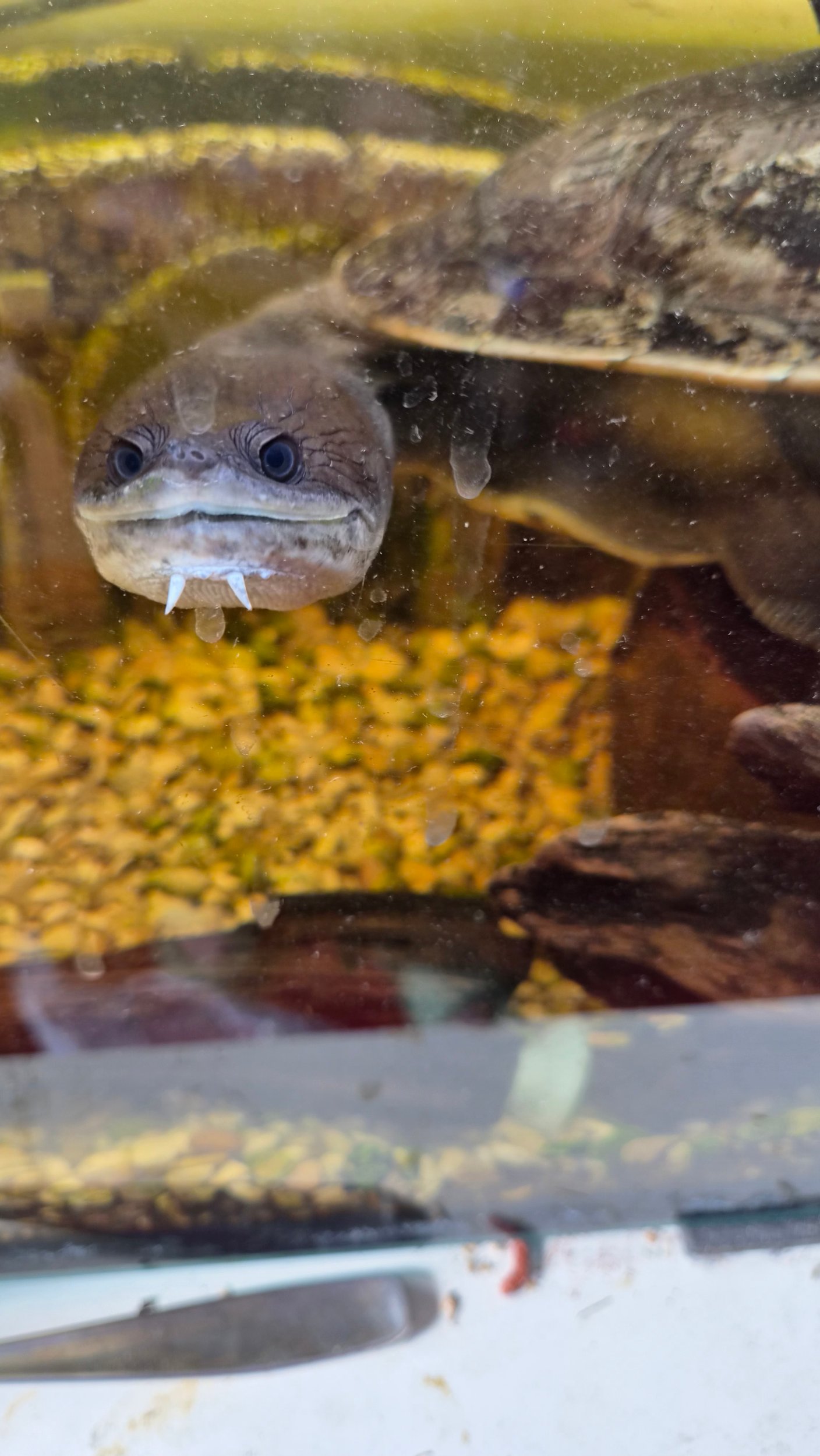
Northern snake-necked turtle (Chelodina rugosa)
Turtles & tortoises · Difficulty: Intermediate
Key facts and care guidance for Northern snake-necked turtle (Chelodina rugosa) (origin: Southern New Guinea (Indonesia, Papua New Guinea), Torres Strait islands, Cape York Peninsula (northern Australia)). Adult size around 25–36 cm. Life expectancy 30–40 years (estimate; no documented maximum age). The values below are carefully researched guidance.
Short answers
Northern snake-necked turtle: How big does the enclosure need to be?
180×90×70 cm aquarium for one animal (1997 expert report: length five times the shell length, width half the length – for females up to 36 cm shell), water depth around 45 cm; for a pair from 180×90×70 cm, for one male with two to three females from 220×110 cm (six times by three times the shell length).
Northern snake-necked turtle: What temperature does it need?
Daytime 25–28 °C (water), basking spot 32–35 °C (basking spot), at night 24–26 °C (water).
Northern snake-necked turtle: Does it need UVB lighting?
UVB: Essential (UVB 6 %).
Northern snake-necked turtle: How long do they live?
Life expectancy: 30–40 years (estimate; no documented maximum age).
Northern snake-necked turtle: Is it suitable for beginners?
Rather not – it is considered an intermediate species (difficulty: Intermediate).
Climate
- Daytime temperature
- 25–28 °C (water)
- Night temperature
- 24–26 °C (water)
- Basking spot
- 32–35 °C (basking spot)
- Humidity
- Aquatic
- UVB
- Essential (UVB 6 %)
Enclosure
- Minimum size
- 180×90×70 cm aquarium for one animal (1997 expert report: length five times the shell length, width half the length – for females up to 36 cm shell), water depth around 45 cm; for a pair from 180×90×70 cm, for one male with two to three females from 220×110 cm (six times by three times the shell length)
- Substrate
- Water depth around 45 cm with roots and ledges just below the surface, soft sand bottom (about 20 cm high in places for underwater egg-laying), basking spot
Feeding
- Food
- Fish, insects, crustaceans – purely carnivorous
- Feeding interval
- 3×/week
Key facts
- Adult size
- 25–36 cm
- Life expectancy
- 30–40 years (estimate; no documented maximum age)
- Origin
- Southern New Guinea (Indonesia, Papua New Guinea), Torres Strait islands, Cape York Peninsula (northern Australia)
- Protection status
- Not listed under CITES
- Brumation
- No hibernation; for breeding a few weeks cooler at about 24 °C water (simulating the dry season)
- Cohabitation
- Kept singly or as a pair with a spare tank. Single keeping is the least stressful option, because older animals can become very intolerant of tank mates and inflict nasty bite wounds. A pair, or one male with two to three females, only works in a correspondingly larger tank (about six times by three times the shell length) with visual barriers – and only if a second tank is ready so they can be separated immediately if they fight. The 1997 expert report rates the genus as suitable for groups, but notes that males are sometimes incompatible; two males do not belong together.
Notes
To be kept warmer than the eastern long-necked turtle. A pure carnivore with a very long, thick neck that usually lies in wait in a hiding place on the bottom. The only turtle that lays its eggs underwater.
Do you keep this species?
Add your animal to Reptoria – Reptoria reminds you about feeding and shedding. Add your animal for free →
Look for Northern snake-necked turtle (Chelodina rugosa) in the marketplace →
Related species
- Eastern long-necked turtle (Chelodina longicollis) – Intermediate
- Reimann's snake-necked turtle (Chelodina reimanni) – Intermediate
- African helmeted turtle (Pelomedusa subrufa) – Beginner to intermediate
- Argentine snake-necked turtle (Hydromedusa tectifera) – Intermediate
- Gibba turtle (Mesoclemmys gibba) – Intermediate
- Matamata (Chelus fimbriata) – Expert
- Hilaire's toadhead turtle (Phrynops hilarii) – Intermediate
- Murray River turtle (Emydura macquarii) – Intermediate
What you need to start
To keep Northern snake-necked turtle (Chelodina rugosa) you typically need: a suitable enclosure (180×90×70 cm aquarium for one animal (1997 expert report: length five times the shell length, width half the length – for females up to 36 cm shell), water depth around 45 cm; for a pair from 180×90×70 cm, for one male with two to three females from 220×110 cm (six times by three times the shell length)), substrate (Water depth around 45 cm with roots and ledges just below the surface, soft sand bottom (about 20 cm high in places for underwater egg-laying), basking spot), a heat source with a thermostat, UVB lighting, thermometer and hygrometer, a water dish and hides. You will find equipment in the Reptoria marketplace.
The complete, interactive care database is in the Reptoria app.
Last updated: 24 September 2026 · Editor: Reptoria editorial team · Sources include: Reptile Database: Chelodina siebenrocki – Artprofil (oviparous) – https://reptile-database.reptarium.cz/species?genus=Chelodina&species=siebenrocki, Wikipedia: Chelodina longicollis – verwandte Art als Vergleich (Schlupf nach 3-5 Monaten) – https://en.wikipedia.org/wiki/Eastern_long-necked_turtle, Reptile Database: Chelodina rugosa, Synonym siebenrocki – https://reptile-database.reptarium.cz/species?genus=Chelodina&species=rugosa, TTWG 2021, Turtles of the World 9th ed.: siebenrocki/intergularis Synonyme von C. rugosa – https://iucn-tftsg.org/checklist-and-atlas/, Shea, Thomson & Georges 2020, Zootaxa 4779(3): C. oblonga = südwestaustralische Art – https://doi.org/10.11646/zootaxa.4779.3.9
All values are non-binding guidance and do not replace expert advice. Research thoroughly from several sources before acquiring and keeping an animal, and observe the applicable law (species and animal protection in particular).