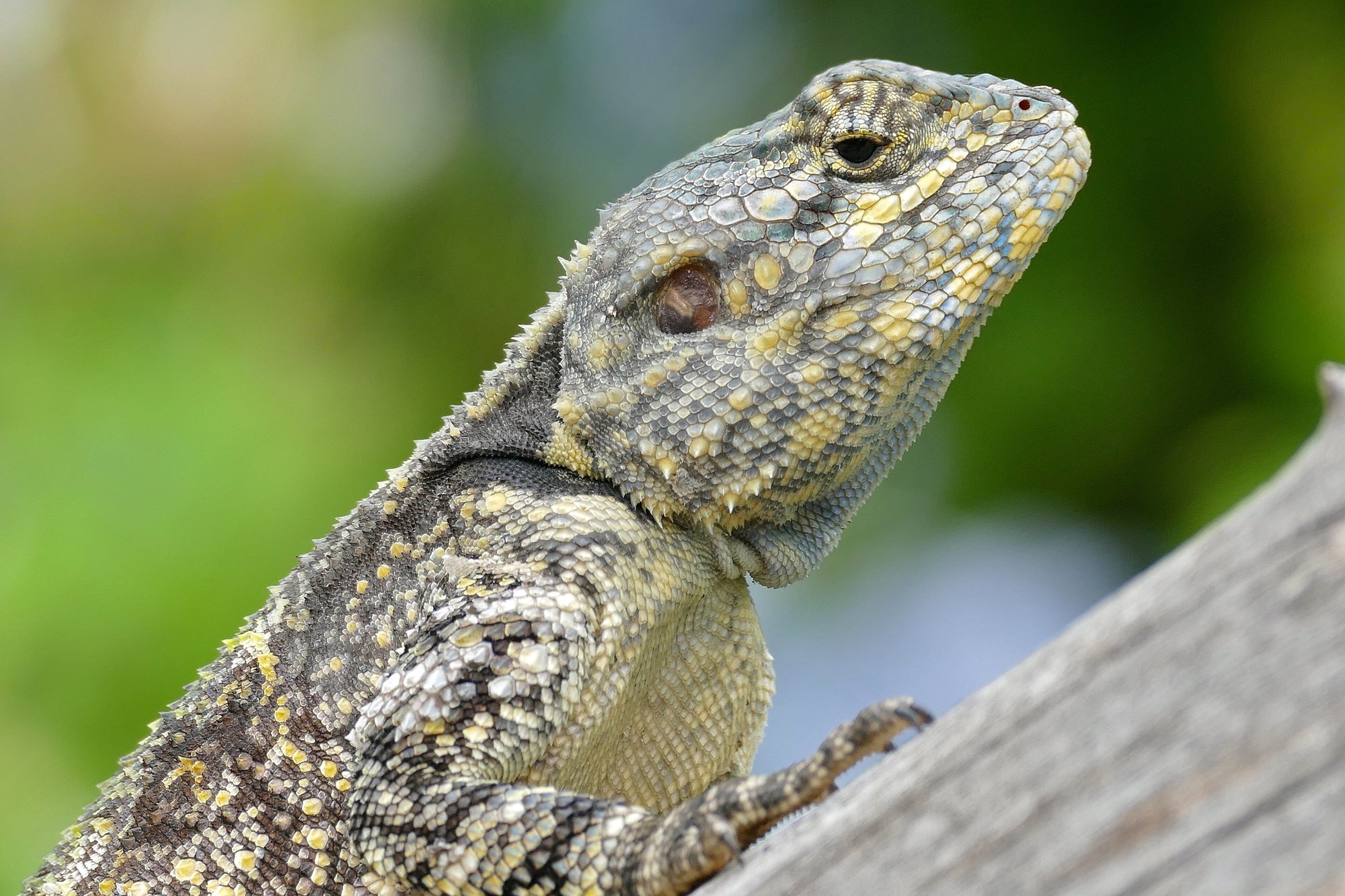
Blue-headed tree agama (Acanthocercus atricollis)
Agamas · Difficulty: Intermediate
Key facts and care guidance for Blue-headed tree agama (Acanthocercus atricollis) (origin: Eastern and southern Africa – savannah trees). Adult size around 30–38 cm total length. Life expectancy approx. 6–10 years. The values below are carefully researched guidance.
Short answers
Blue-headed tree agama: How big does the enclosure need to be?
From 130×90×160 cm for a single animal or a pair; for a group of 1.2 correspondingly more floor space. Height matters more than floor space, and every animal needs its own basking spot.
Blue-headed tree agama: What temperature does it need?
Daytime 27–33 °C, basking spot 42 °C, at night 19–23 °C.
Blue-headed tree agama: Does it need UVB lighting?
UVB: Essential (UVB 10.0).
Blue-headed tree agama: How long do they live?
Life expectancy: approx. 6–10 years.
Blue-headed tree agama: Is it suitable for beginners?
Rather not – it is considered an intermediate species (difficulty: Intermediate).
Climate
- Daytime temperature
- 27–33 °C
- Night temperature
- 19–23 °C
- Basking spot
- 42 °C
- Humidity
- 60–70 % during the day, up to 80 % at night
- UVB
- Essential (UVB 10.0)
Enclosure
- Minimum size
- from 130×90×160 cm for a single animal or a pair; for a group of 1.2 correspondingly more floor space. Height matters more than floor space, and every animal needs its own basking spot
- Substrate
- Sand-loam, sturdy climbing branches, cork tubes
Feeding
- Food
- House crickets, field crickets, grasshoppers, roaches, worms and occasionally wax moth larvae; plus plant matter such as herbs, flowers, hibiscus and dried dandelion. No butterhead or iceberg lettuce (unfavourable calcium-to-phosphorus ratio)
- Feeding interval
- 4×/week
Key facts
- Adult size
- 30–38 cm total length
- Life expectancy
- approx. 6–10 years
- Origin
- Eastern and southern Africa – savannah trees
- Protection status
- Not listed under CITES
- Brumation
- None
- Cohabitation
- In pairs (1.1) or as a harem of 1.2 – males strictly separate. The reason: several males fight over territory and the basking spot until one is injured or permanently sits in a corner. Females usually get along, but each needs her own basking and hiding spot; feed separately if sizes differ.
Notes
An arboreal agama – it needs height and stout horizontal branches under the spot. The male has a brilliant blue head. Markedly shyer than bearded dragons.
Do you keep this species?
Add your animal to Reptoria – Reptoria reminds you about feeding and shedding. Add your animal for free →
Look for Blue-headed tree agama (Acanthocercus atricollis) in the marketplace →
Related species
- Blue-throated agama (Acanthocercus cyanogaster) – Intermediate
- Common agama – red-headed (Agama agama) – Intermediate
- Variegated toad-headed agama (Phrynocephalus versicolor) – Expert
- Common butterfly lizard (Leiolepis belliana) – Intermediate
- Large-eared rock agama (Paralaudakia nupta) – Intermediate
- Roughtail rock agama (Stellagama stellio) – Intermediate
- Caucasian agama (Paralaudakia caucasia) – Intermediate
- Namibian rock agama (Agama planiceps) – Intermediate
What you need to start
To keep Blue-headed tree agama (Acanthocercus atricollis) you typically need: a suitable enclosure (from 130×90×160 cm for a single animal or a pair; for a group of 1.2 correspondingly more floor space. Height matters more than floor space, and every animal needs its own basking spot), substrate (Sand-loam, sturdy climbing branches, cork tubes), a heat source with a thermostat, UVB lighting, thermometer and hygrometer, a water dish and hides. You will find equipment in the Reptoria marketplace.
The complete, interactive care database is in the Reptoria app.
Last updated: 2 November 2026 · Editor: Reptoria editorial team · Sources include: einrichtungsbeispiele.de, terrariengemeinschaft.de, Wikipedia EN, eur-lex.europa.eu, krugerpark.co.za
All values are non-binding guidance and do not replace expert advice. Research thoroughly from several sources before acquiring and keeping an animal, and observe the applicable law (species and animal protection in particular).