Caucasian agama (Paralaudakia caucasia)
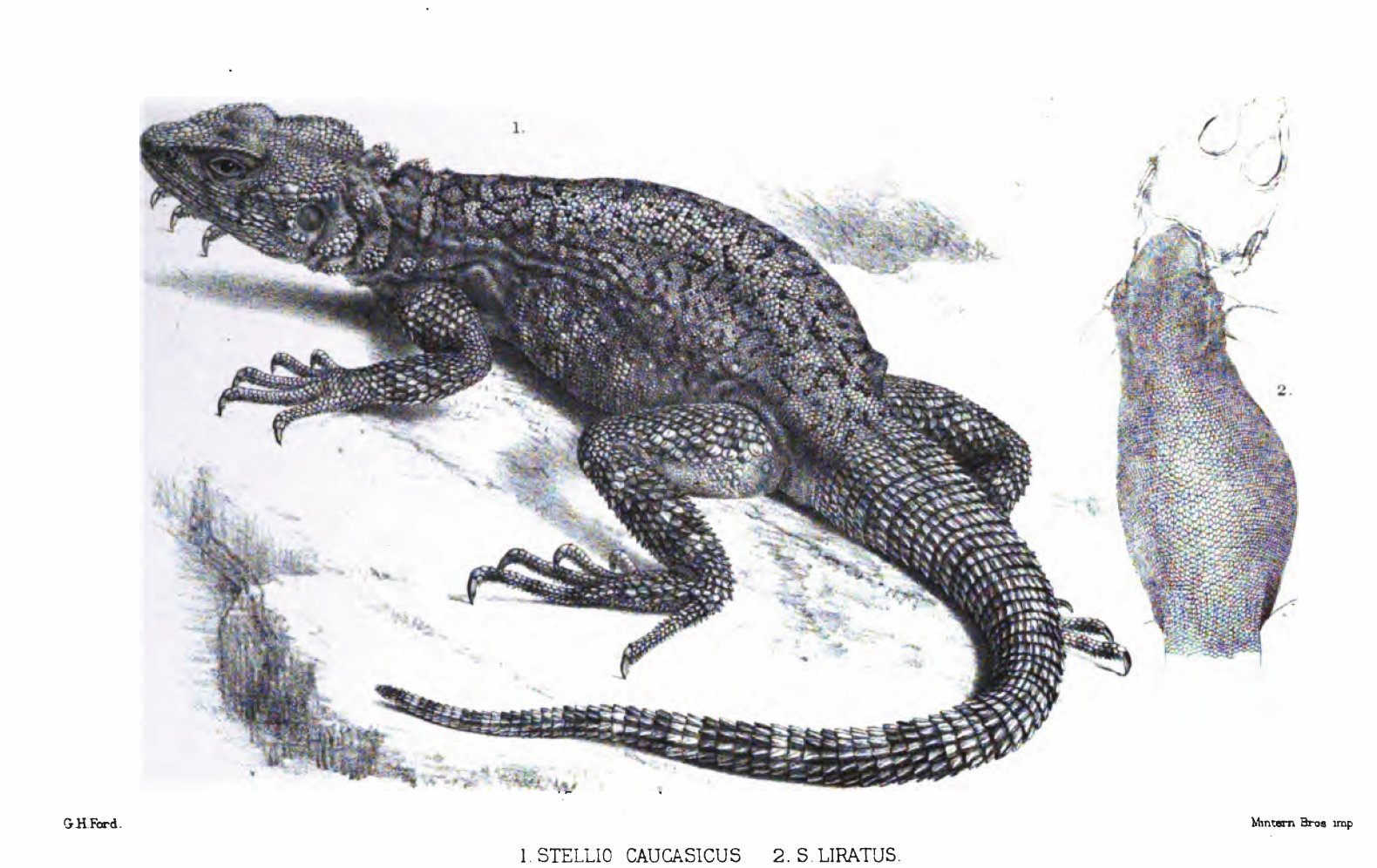
Agamas · Difficulty: Intermediate
Key facts and care guidance for Caucasian agama (Paralaudakia caucasia) (origin: The Caucasus to Central Asia (Georgia, Armenia, Azerbaijan, eastern Turkey, northern Iran, Turkmenistan, Afghanistan, Pakistan); rocky slopes at 300–3,370 m). Adult size around up to approx. 35 cm total length (SVL under 15 cm). Life expectancy approx. 10–15 years. The values below are carefully researched guidance.
Short answers
Caucasian agama: How big does the enclosure need to be?
120×60×80 cm (rock structures, some height); the German minimum for a pair is ~75×45×60 cm, larger is recommended.
Caucasian agama: What temperature does it need?
Daytime 28–35 °C, basking spot 45–55 °C, at night 15–20 °C.
Caucasian agama: Does it need UVB lighting?
UVB: UVB needed (Ferguson zone 3–4, UV index 4–6).
Caucasian agama: How long do they live?
Life expectancy: approx. 10–15 years.
Caucasian agama: Is it suitable for beginners?
Rather not – it is considered an intermediate species (difficulty: Intermediate).
Climate
- Daytime temperature
- 28–35 °C
- Night temperature
- 15–20 °C
- Basking spot
- 45–55 °C
- Humidity
- 30–50 %
- UVB
- UVB needed (Ferguson zone 3–4, UV index 4–6)
Enclosure
- Minimum size
- 120×60×80 cm (rock structures, some height); the German minimum for a pair is ~75×45×60 cm, larger is recommended
- Substrate
- A sand-loam mix, solid rock structures with crevices and caves, climbing rocks
Feeding
- Food
- Insects (beetles, locusts, crickets, hymenopterans) plus a little plant food; calcium and vitamins
- Feeding interval
- adults 3×/week, juveniles daily
Key facts
- Adult size
- up to approx. 35 cm total length (SVL under 15 cm)
- Life expectancy
- approx. 10–15 years
- Origin
- The Caucasus to Central Asia (Georgia, Armenia, Azerbaijan, eastern Turkey, northern Iran, Turkmenistan, Afghanistan, Pakistan); rocky slopes at 300–3,370 m
- Protection status
- IUCN "Least Concern"; not listed under CITES
- Brumation
- A pronounced winter rest is needed: about 3–4 months at ~8–12 °C (in the wild they are active from late March to October)
- Cohabitation
- Keep them singly (territorial, rock-dwelling); one male plus females is possible in a large facility with visual barriers. NEVER keep males together.
Notes
A montane rock agama – a strong basking gradient, plenty of crevices and hides, and a marked day-night and seasonal rhythm (a winter rest!). Species-specific care sheets are scarce; some husbandry figures are derived from related rock agamas (Laudakia, Stellagama).
Do you keep this species?
Add your animal to Reptoria – Reptoria reminds you about feeding and shedding. Add your animal for free →
Look for Caucasian agama (Paralaudakia caucasia) in the marketplace →
Related species
- Large-eared rock agama (Paralaudakia nupta) – Intermediate
- Himalayan agama (Paralaudakia himalayana) – Intermediate
- Red-bellied rock agama (Paralaudakia erythrogastra) – Intermediate
- Blue-headed tree agama (Acanthocercus atricollis) – Intermediate
- Common agama – red-headed (Agama agama) – Intermediate
- Variegated toad-headed agama (Phrynocephalus versicolor) – Expert
- Common butterfly lizard (Leiolepis belliana) – Intermediate
- Roughtail rock agama (Stellagama stellio) – Intermediate
What you need to start
To keep Caucasian agama (Paralaudakia caucasia) you typically need: a suitable enclosure (120×60×80 cm (rock structures, some height); the German minimum for a pair is ~75×45×60 cm, larger is recommended), substrate (A sand-loam mix, solid rock structures with crevices and caves, climbing rocks), a heat source with a thermostat, UVB lighting, thermometer and hygrometer, a water dish and hides. You will find equipment in the Reptoria marketplace.
The complete, interactive care database is in the Reptoria app.
Last updated: 30 October 2026 · Editor: Reptoria editorial team · Sources include: https://en.wikipedia.org/wiki/Paralaudakia_caucasia, https://reptile-database.reptarium.cz/species?genus=Paralaudakia&species=caucasia
All values are non-binding guidance and do not replace expert advice. Research thoroughly from several sources before acquiring and keeping an animal, and observe the applicable law (species and animal protection in particular).