Blue poison dart frog (Dendrobates azureus)
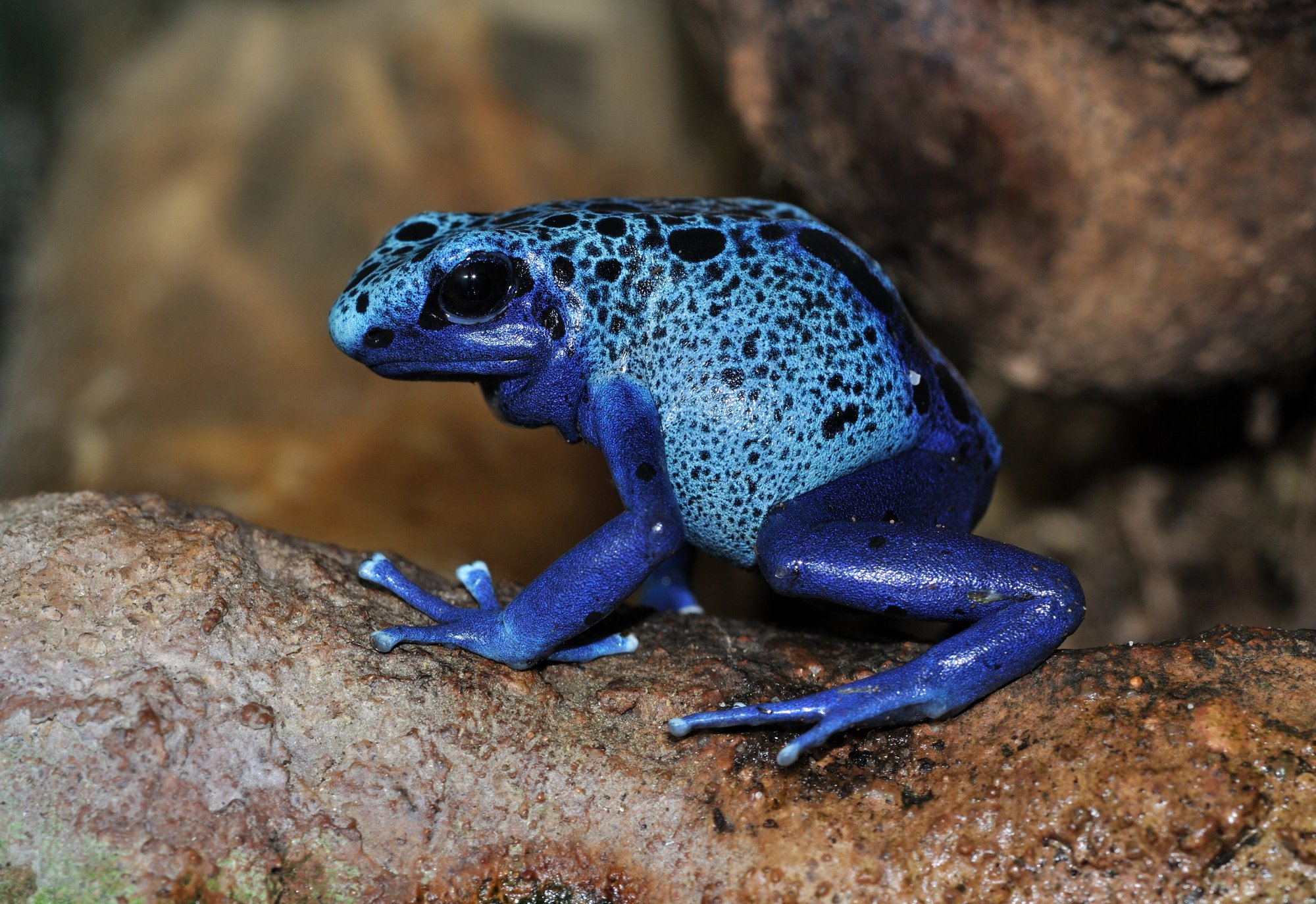
Amphibians · Difficulty: Beginner to intermediate
Key facts and care guidance for Blue poison dart frog (Dendrobates azureus) (origin: The Sipaliwini savanna at the tripoint of Suriname, Brazil and French Guiana; a blue colour form of Dendrobates tinctorius). Adult size around ~4–4,5 cm. Life expectancy 10–15 years. The values below are carefully researched guidance.
Short answers
Blue poison dart frog: How big does the enclosure need to be?
50 × 50 × 50 cm for a pair (larger for a group).
Blue poison dart frog: What temperature does it need?
Daytime 24–27 °C, at night ~22 °C.
Blue poison dart frog: Does it need UVB lighting?
UVB: Optional.
Blue poison dart frog: How long do they live?
Life expectancy: 10–15 years.
Blue poison dart frog: Is it suitable for beginners?
Partly – manageable with some prior knowledge (difficulty: Beginner to intermediate).
Climate
- Daytime temperature
- 24–27 °C
- Night temperature
- ~22 °C
- Basking spot
- —
- Humidity
- 80–90 %
- UVB
- Optional
Enclosure
- Minimum size
- 50 × 50 × 50 cm for a pair (larger for a group)
- Substrate
- Rainforest, bromeliads, leaf litter, moss, a small water section
Feeding
- Food
- Fruit flies, springtails, small house crickets, isopods
- Feeding interval
- Daily to several times a week, dusted
Key facts
- Adult size
- ~4–4,5 cm
- Life expectancy
- 10–15 years
- Origin
- The Sipaliwini savanna at the tripoint of Suriname, Brazil and French Guiana; a blue colour form of Dendrobates tinctorius
- Protection status
- CITES Appendix II / EU Annex B, registration required
- Brumation
- None
- Cohabitation
- In pairs (1.1). Both sexes are territorial; two females do not work together because they fight over the male, and two males also displace each other with calling, chasing and wrestling. Larger groups only in noticeably bigger, heavily structured enclosures with several visual barriers. The subordinate animal often shows no injury, just sits hidden and loses condition.
Notes
A robust beginner's poison dart frog. Captive-bred animals are non-toxic; the females are strongly territorial towards each other.
Do you keep this species?
Add your animal to Reptoria – Reptoria reminds you about feeding and shedding. Add your animal for free →
Look for Blue poison dart frog (Dendrobates azureus) in the marketplace →
Related species
- Yellow-banded poison dart frog (Dendrobates leucomelas) – Beginner
- Golden poison frog (Dendrobates nubeculosus) – Intermediate
- Green and black poison dart frog (Dendrobates auratus) – Beginner
- Dyeing poison dart frog (Dendrobates tinctorius) – Beginner
- Yellow-striped poison frog (Dendrobates truncatus) – Beginner
- Yellow-bellied poison frog (Ameerega hahneli) – Intermediate
- Anthony's poison frog (Hyloxalus nexipus) – Intermediate
- Bassler's poison frog (Ameerega bassleri) – Intermediate
What you need to start
To keep Blue poison dart frog (Dendrobates azureus) you typically need: a suitable enclosure (50 × 50 × 50 cm for a pair (larger for a group)), substrate (Rainforest, bromeliads, leaf litter, moss, a small water section), a heat source with a thermostat, UVB lighting, thermometer and hygrometer, a water dish and hides. You will find equipment in the Reptoria marketplace.
The complete, interactive care database is in the Reptoria app.
Last updated: 9 October 2026 · Editor: Reptoria editorial team · Sources include: Wikipedia DE (Blauer Baumsteiger), Wikipedia EN (Dendrobates tinctorius), animaldiversity.org, einrichtungsbeispiele.de, eu_annex.txt (lokal, VO (EU) 2026/1383)
All values are non-binding guidance and do not replace expert advice. Research thoroughly from several sources before acquiring and keeping an animal, and observe the applicable law (species and animal protection in particular).