Dyeing poison dart frog (Dendrobates tinctorius)
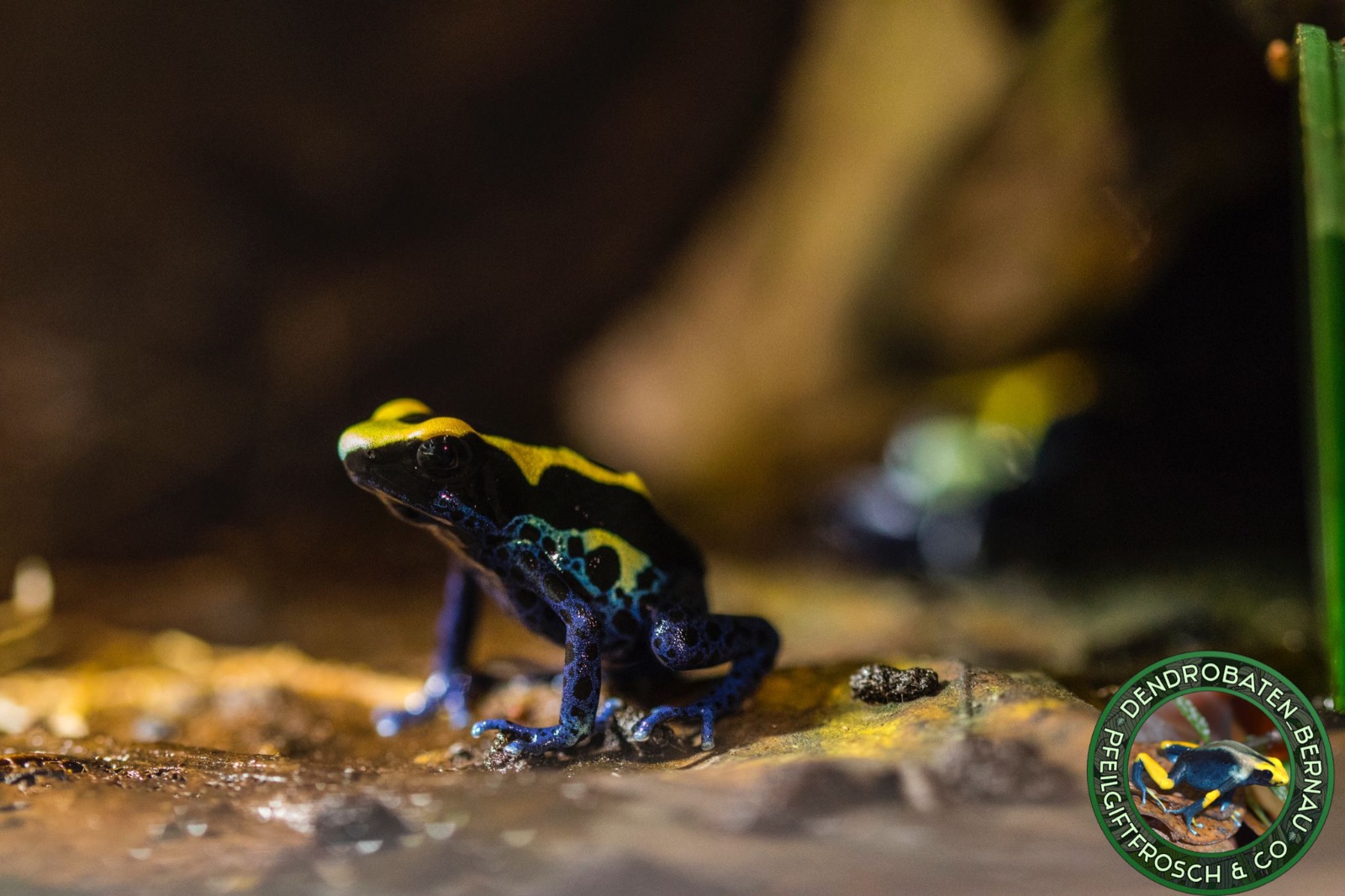
Amphibians · Difficulty: Beginner
Key facts and care guidance for Dyeing poison dart frog (Dendrobates tinctorius) (origin: The Guiana Shield: Guyana, Suriname, French Guiana, northern Brazil (note: the "Ecuador/Peru" figures given in some sources are wrong – that is the range of Epipedobates)). Adult size around 4–5 cm (large "Giant" morphs up to ~6 cm), females larger. Life expectancy approx. 8–15 years (up to over 20). The values below are carefully researched guidance.
Short answers
Dyeing poison dart frog: How big does the enclosure need to be?
A rainforest enclosure or paludarium from 50×50×50 cm for one pair; considerably larger for a group.
Dyeing poison dart frog: What temperature does it need?
Daytime 24–27 °C (not above ~28 °C), at night 20–23 °C (night-time drop).
Dyeing poison dart frog: Does it need UVB lighting?
UVB: Weak UVB (Ferguson zone 1) optional and recommended; not essential.
Dyeing poison dart frog: How long do they live?
Life expectancy: approx. 8–15 years (up to over 20).
Dyeing poison dart frog: Is it suitable for beginners?
Yes – it is considered suitable for beginners (difficulty: Beginner).
Climate
- Daytime temperature
- 24–27 °C (not above ~28 °C)
- Night temperature
- 20–23 °C (night-time drop)
- Basking spot
- —
- Humidity
- 70–90 % by day, up to 100 % at night
- UVB
- Weak UVB (Ferguson zone 1) optional and recommended; not essential
Enclosure
- Minimum size
- a rainforest enclosure or paludarium from 50×50×50 cm for one pair; considerably larger for a group
- Substrate
- A drainage layer plus forest floor, coco or sphagnum, dense planting (bromeliads), leaf litter, visual barriers
Feeding
- Food
- Small feeder animals: fruit flies (Drosophila), springtails, micro crickets, aphids – supplemented and dusted with calcium
- Feeding interval
- adults ~3×/week or several times a week, juveniles daily or more often
Key facts
- Adult size
- 4–5 cm (large "Giant" morphs up to ~6 cm), females larger
- Life expectancy
- approx. 8–15 years (up to over 20)
- Origin
- The Guiana Shield: Guyana, Suriname, French Guiana, northern Brazil (note: the "Ecuador/Peru" figures given in some sources are wrong – that is the range of Epipedobates)
- Protection status
- CITES Appendix II / EU Species Protection Regulation Annex B; proof of origin and registration with the responsible authority are required
- Brumation
- No winter rest; possibly a slight dry or rainy season simulation to stimulate breeding
- Cohabitation
- Keeping a pair (1.1) is the least stressful option. Females are highly aggressive towards each other (dominance fights, suppression to the point of death) → never keep two females together, and no female-only groups either. Two males with one female (2.1) is possible in a large, well-structured tank, but: you have to watch whether one male is permanently pushed aside, and separate them if so.
Notes
Non-toxic in captivity because of the change of diet (the toxin comes from wild food); wash your hands all the same, and minimise handling. Common mistakes: too warm (above 28 °C is quickly fatal), groups of females (aggression), and an enclosure that is too small or monotonous. Diurnal, very colourful, and a robust beginner's poison dart frog.
Do you keep this species?
Add your animal to Reptoria – Reptoria reminds you about feeding and shedding. Add your animal for free →
Dyeing poison dart frog (Dendrobates tinctorius) currently offered
- Dendrobates Tinctorius Cobalt – Cobalt · Bernau · 45 €
- Dendrobates Tinctorius Bruyère F2 – Bruyère · Bernau · 75 €
- Dendrobates Tinctorius Bruyère F2 Pärchen – Bruyère · Bernau · 200 €
Related species
- Blue poison dart frog (Dendrobates azureus) – Beginner to intermediate
- Yellow-banded poison dart frog (Dendrobates leucomelas) – Beginner
- Golden poison frog (Dendrobates nubeculosus) – Intermediate
- Green and black poison dart frog (Dendrobates auratus) – Beginner
- Yellow-striped poison frog (Dendrobates truncatus) – Beginner
- Yellow-bellied poison frog (Ameerega hahneli) – Intermediate
- Anthony's poison frog (Hyloxalus nexipus) – Intermediate
- Bassler's poison frog (Ameerega bassleri) – Intermediate
What you need to start
To keep Dyeing poison dart frog (Dendrobates tinctorius) you typically need: a suitable enclosure (a rainforest enclosure or paludarium from 50×50×50 cm for one pair; considerably larger for a group), substrate (A drainage layer plus forest floor, coco or sphagnum, dense planting (bromeliads), leaf litter, visual barriers), a heat source with a thermostat, UVB lighting, thermometer and hygrometer, a water dish and hides. You will find equipment in the Reptoria marketplace.
The complete, interactive care database is in the Reptoria app.
Last updated: 24 September 2026 · Editor: Reptoria editorial team · Sources include: dendrobates-leucomelas.de, einrichtungsbeispiele.de, pfeilgiftfrosch.net, tropenfrosch.info
All values are non-binding guidance and do not replace expert advice. Research thoroughly from several sources before acquiring and keeping an animal, and observe the applicable law (species and animal protection in particular).