Green and black poison dart frog (Dendrobates auratus)
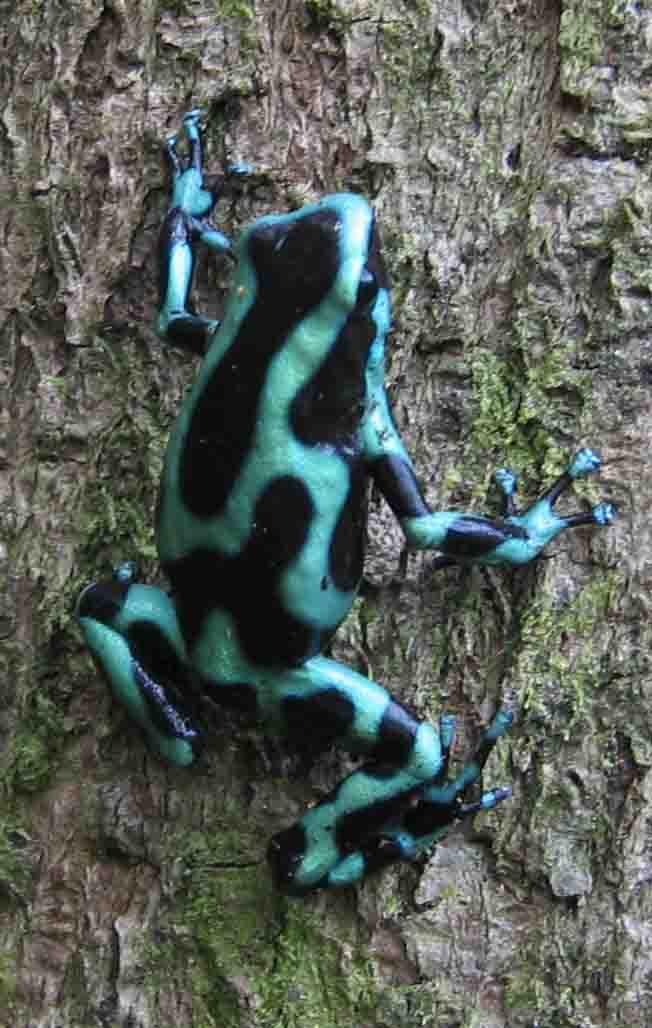
Amphibians · Difficulty: Beginner
Key facts and care guidance for Green and black poison dart frog (Dendrobates auratus) (origin: Central America, north-western Colombia). Adult size around 3–5 cm snout–vent length, robust females up to 5.5 cm. Life expectancy 10–15 years, well-cared-for animals over 20 years. The values below are carefully researched guidance.
Short answers
Green and black poison dart frog: How big does the enclosure need to be?
60×45×60 cm.
Green and black poison dart frog: What temperature does it need?
Daytime 22–26 °C, basking spot No basking spot, at night 20–23 °C (only a slight drop of 2–4 °C).
Green and black poison dart frog: Does it need UVB lighting?
UVB: Not essential, but recommended: low-output UVB (UV index 1–2) supports calcium metabolism and natural behaviour.
Green and black poison dart frog: How long do they live?
Life expectancy: 10–15 years, well-cared-for animals over 20 years.
Green and black poison dart frog: Is it suitable for beginners?
Yes – it is considered suitable for beginners (difficulty: Beginner).
Climate
- Daytime temperature
- 22–26 °C
- Night temperature
- 20–23 °C (only a slight drop of 2–4 °C)
- Basking spot
- No basking spot
- Humidity
- 80–95 %
- UVB
- Not essential, but recommended: low-output UVB (UV index 1–2) supports calcium metabolism and natural behaviour
Enclosure
- Minimum size
- 60×45×60 cm
- Substrate
- Drainage plus coco humus, moss, bromeliads, leaf litter
Feeding
- Food
- Fruit flies, springtails
- Feeding interval
- Adults every 2–3 days, juveniles daily.
Key facts
- Adult size
- 3–5 cm snout–vent length, robust females up to 5.5 cm
- Life expectancy
- 10–15 years, well-cared-for animals over 20 years
- Origin
- Central America, north-western Colombia
- Protection status
- CITES II
- Brumation
- A slight dry spell
- Cohabitation
- Group housing works well, the species is not very aggressive within itself. Allow for roughly 40 litres of enclosure volume per frog. Females can harass each other and eat foreign clutches; pairs or groups with a surplus of males have proved successful. Do not mix different poison frog species, nor different colour morphs of the same species.
Notes
A very easily kept beginner's species in many colour forms (green-black, blue, bronze). It lives close to the ground and is easy to watch.
Do you keep this species?
Add your animal to Reptoria – Reptoria reminds you about feeding and shedding. Add your animal for free →
Look for Green and black poison dart frog (Dendrobates auratus) in the marketplace →
Related species
- Blue poison dart frog (Dendrobates azureus) – Beginner to intermediate
- Yellow-banded poison dart frog (Dendrobates leucomelas) – Beginner
- Golden poison frog (Dendrobates nubeculosus) – Intermediate
- Dyeing poison dart frog (Dendrobates tinctorius) – Beginner
- Yellow-striped poison frog (Dendrobates truncatus) – Beginner
- Yellow-bellied poison frog (Ameerega hahneli) – Intermediate
- Anthony's poison frog (Hyloxalus nexipus) – Intermediate
- Bassler's poison frog (Ameerega bassleri) – Intermediate
What you need to start
To keep Green and black poison dart frog (Dendrobates auratus) you typically need: a suitable enclosure (60×45×60 cm), substrate (Drainage plus coco humus, moss, bromeliads, leaf litter), a heat source with a thermostat, UVB lighting, thermometer and hygrometer, a water dish and hides. You will find equipment in the Reptoria marketplace.
The complete, interactive care database is in the Reptoria app.
Last updated: 9 October 2026 · Editor: Reptoria editorial team · Sources include: exo-terra.com, pfeilgift-welt.de, megazoo-nord.de, einrichtungsbeispiele.de, joshsfrogs.com
All values are non-binding guidance and do not replace expert advice. Research thoroughly from several sources before acquiring and keeping an animal, and observe the applicable law (species and animal protection in particular).