Golden poison frog (Dendrobates nubeculosus)
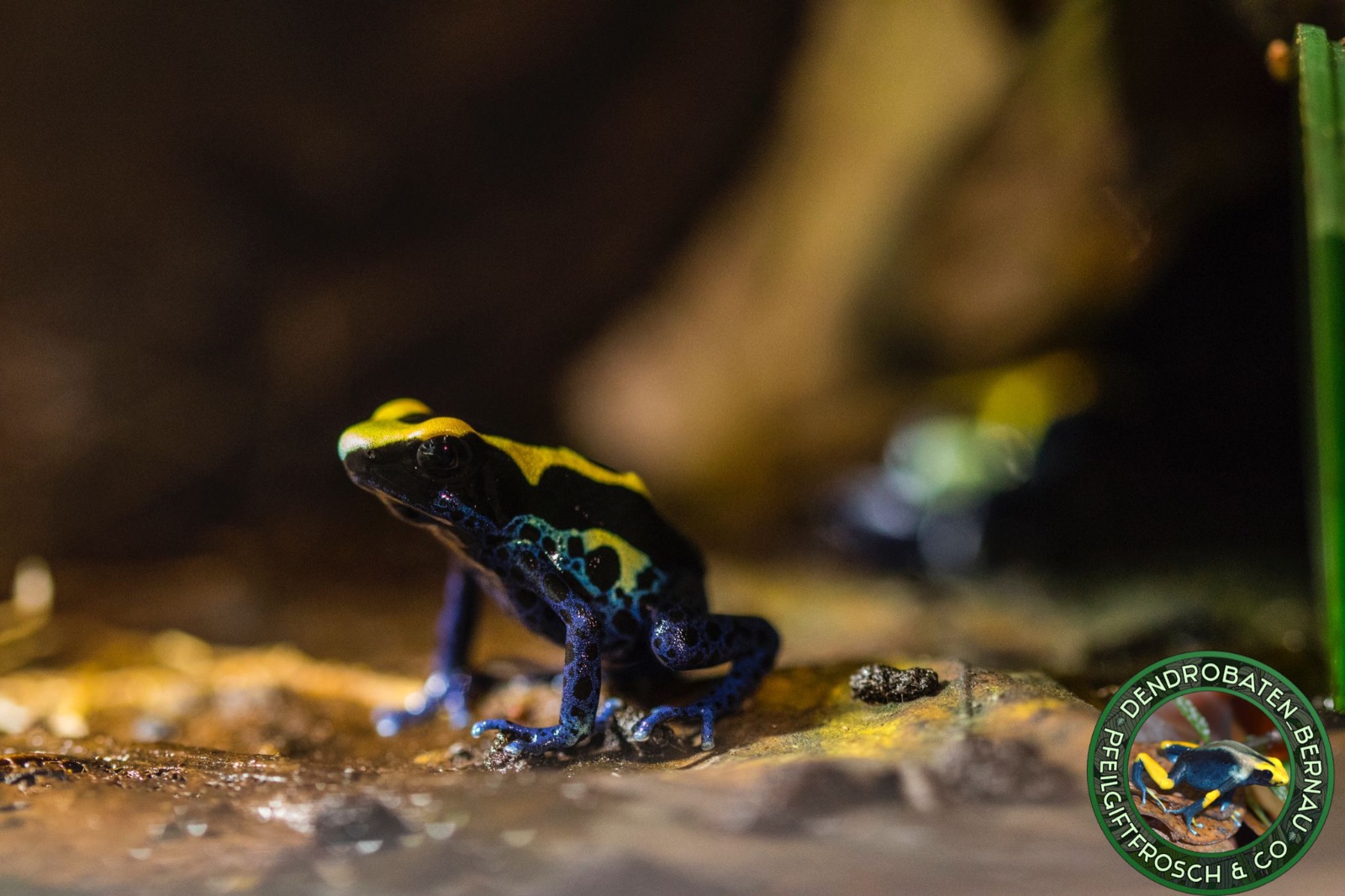
Amphibians · Difficulty: Intermediate
Key facts and care guidance for Golden poison frog (Dendrobates nubeculosus) (origin: Guyana). Adult size around ca. 2,5 cm (nur ein Exemplar bekannt). Life expectancy 8–15 years. The values below are carefully researched guidance.
Short answers
Golden poison frog: How big does the enclosure need to be?
40×40×50 cm for a pair, planted.
Golden poison frog: What temperature does it need?
Daytime 22–26 °C, basking spot No basking spot — direct heat is harmful, at night 18–21 °C.
Golden poison frog: Does it need UVB lighting?
UVB: Weak UVB recommended (UVB 2.0), no strong lamp.
Golden poison frog: How long do they live?
Life expectancy: 8–15 years.
Golden poison frog: Is it suitable for beginners?
Rather not – it is considered an intermediate species (difficulty: Intermediate).
Climate
- Daytime temperature
- 22–26 °C
- Night temperature
- 18–21 °C
- Basking spot
- No basking spot — direct heat is harmful
- Humidity
- 80–95 %, mist daily
- UVB
- Weak UVB recommended (UVB 2.0), no strong lamp
Enclosure
- Minimum size
- 40×40×50 cm for a pair, planted
- Substrate
- Forest-floor substrate with a drainage layer, moss, leaf litter, bromeliads and film canisters as spawning sites
Feeding
- Food
- Springtails, fruit flies and aphids, dusted regularly with calcium and vitamins
- Feeding interval
- adults daily to every other day
Key facts
- Adult size
- ca. 2,5 cm (nur ein Exemplar bekannt)
- Life expectancy
- 8–15 years
- Origin
- Guyana
- Protection status
- CITES II — proof of origin required
- Brumation
- No winter rest, at most a short dry spell to trigger breeding
- Cohabitation
- In pairs. Raise juveniles separately from adults. Not because they would be eaten — these animals are far too small for that — but because the larger ones get to the food first and the smaller ones fall behind. Provide enough hiding places so that every animal can retreat, and feed separately if there is a size difference.
Notes
A rarely kept species from the Guiana Shield.
Do you keep this species?
Add your animal to Reptoria – Reptoria reminds you about feeding and shedding. Add your animal for free →
Look for Golden poison frog (Dendrobates nubeculosus) in the marketplace →
Related species
- Blue poison dart frog (Dendrobates azureus) – Beginner to intermediate
- Yellow-banded poison dart frog (Dendrobates leucomelas) – Beginner
- Green and black poison dart frog (Dendrobates auratus) – Beginner
- Dyeing poison dart frog (Dendrobates tinctorius) – Beginner
- Yellow-striped poison frog (Dendrobates truncatus) – Beginner
- Yellow-bellied poison frog (Ameerega hahneli) – Intermediate
- Anthony's poison frog (Hyloxalus nexipus) – Intermediate
- Bassler's poison frog (Ameerega bassleri) – Intermediate
What you need to start
To keep Golden poison frog (Dendrobates nubeculosus) you typically need: a suitable enclosure (40×40×50 cm for a pair, planted), substrate (Forest-floor substrate with a drainage layer, moss, leaf litter, bromeliads and film canisters as spawning sites), a heat source with a thermostat, UVB lighting, thermometer and hygrometer, a water dish and hides. You will find equipment in the Reptoria marketplace.
The complete, interactive care database is in the Reptoria app.
Last updated: 30 October 2026 · Editor: Reptoria editorial team · Sources include: https://en.wikipedia.org/wiki/Dendrobates_nubeculosus, https://species.wikimedia.org/wiki/Dendrobates_nubeculosus, https://www.dendrobase.de/html/D_dendrobates_nubeculosus.html
All values are non-binding guidance and do not replace expert advice. Research thoroughly from several sources before acquiring and keeping an animal, and observe the applicable law (species and animal protection in particular).