Colombian rainbow boa (Epicrates maurus)
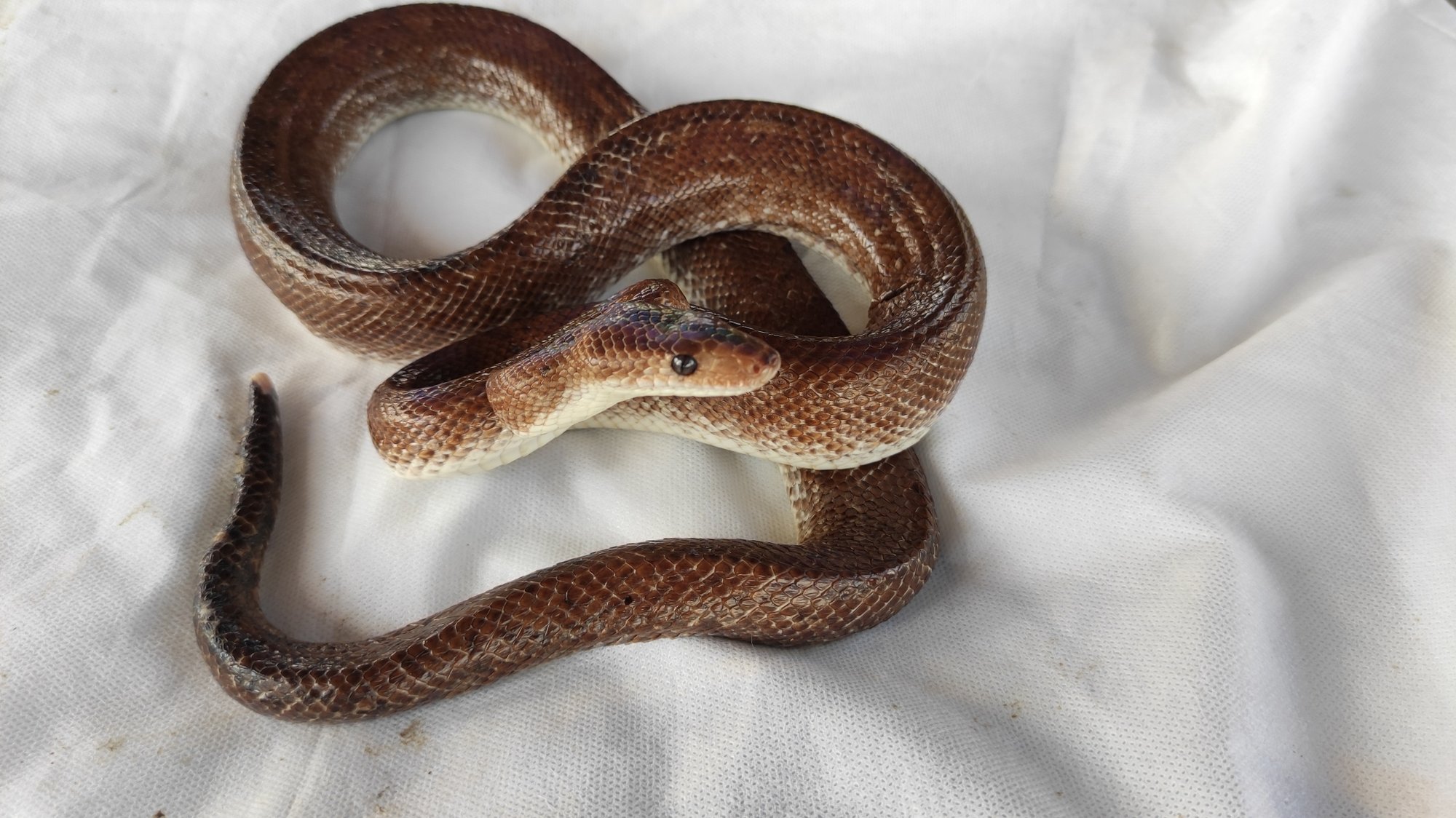
Snakes · Difficulty: Intermediate
Key facts and care guidance for Colombian rainbow boa (Epicrates maurus) (origin: Northern South America and Central America – Colombia, Venezuela, the Guianas, Trinidad, to Costa Rica and Panama). Adult size around 120–180 cm (usually 130–150 cm; females larger). Life expectancy 20–25 years, more with very good care. The values below are carefully researched guidance.
Short answers
Colombian rainbow boa: How big does the enclosure need to be?
From 150×90×135 cm (minimum size according to the 1997 expert report, E. angulifer over 1.5 m, 1 adult animal).
Colombian rainbow boa: What temperature does it need?
Daytime 26–30 °C, basking spot 30–32 °C (local hot spot), at night 22–24 °C.
Colombian rainbow boa: Does it need UVB lighting?
UVB: UVB not essential, low UVB optional.
Colombian rainbow boa: How long do they live?
Life expectancy: 20–25 years, more with very good care.
Colombian rainbow boa: Is it suitable for beginners?
Rather not – it is considered an intermediate species (difficulty: Intermediate).
Climate
- Daytime temperature
- 26–30 °C
- Night temperature
- 22–24 °C
- Basking spot
- 30–32 °C (local hot spot)
- Humidity
- 65–85 % (higher at night)
- UVB
- UVB not essential, low UVB optional
Enclosure
- Minimum size
- from 150×90×135 cm (minimum size according to the 1997 expert report, E. angulifer over 1.5 m, 1 adult animal)
- Substrate
- Coco humus or forest floor, damp and diggable, with leaf litter
Feeding
- Food
- Mice and rats (frozen-thawed)
- Feeding interval
- adults every 10–14 days, juveniles every 5–7 days
Key facts
- Adult size
- 120–180 cm (usually 130–150 cm; females larger)
- Life expectancy
- 20–25 years, more with very good care
- Origin
- Northern South America and Central America – Colombia, Venezuela, the Guianas, Trinidad, to Costa Rica and Panama
- Protection status
- CITES Appendix II / EU Regulation Annex B; registration required in Germany (proof of origin needed)
- Brumation
- None
- Cohabitation
- Keep them singly – solitary; put them together only under supervision for breeding. Even where group keeping works, the feeding accident remains the risk: always feed them singly, ideally in separate boxes, and only house animals of roughly the same size together.
Notes
The most robust rainbow boa and the one best suited to boa beginners; less iridescent than E. c. cenchria. Facultative parthenogenesis is documented. Sufficient humidity still matters.
Do you keep this species?
Add your animal to Reptoria – Reptoria reminds you about feeding and shedding. Add your animal for free →
Look for Colombian rainbow boa (Epicrates maurus) in the marketplace →
Related species
- Caatinga rainbow boa (Epicrates assisi) – Intermediate
- Cerrado rainbow boa (Epicrates crassus) – Intermediate
- Colombian rainbow boa (Epicrates alvarezi) – Intermediate
- Colombian rainbow boa (Epicrates cenchria cenchria) – Intermediate
- Egyptian sand boa (Eryx colubrinus colubrinus) – Beginner
- Arabian sand boa (Eryx jayakari) – Beginner to intermediate
- Red sand boa (Eryx johnii) – Intermediate
- Kenyan sand boa (Eryx colubrinus loveridgei) – Beginner
What you need to start
To keep Colombian rainbow boa (Epicrates maurus) you typically need: a suitable enclosure (from 150×90×135 cm (minimum size according to the 1997 expert report, E. angulifer over 1.5 m, 1 adult animal)), substrate (Coco humus or forest floor, damp and diggable, with leaf litter), a heat source with a thermostat, UVB lighting, thermometer and hygrometer, a water dish and hides. You will find equipment in the Reptoria marketplace.
The complete, interactive care database is in the Reptoria app.
Last updated: 2 November 2026 · Editor: Reptoria editorial team · Sources include: Wikipedia EN, legislation.gov.uk, reptifiles.com, snaketracks.com, terrarien-welten.de
All values are non-binding guidance and do not replace expert advice. Research thoroughly from several sources before acquiring and keeping an animal, and observe the applicable law (species and animal protection in particular).