Devil's flower mantis (Idolomantis diabolica)
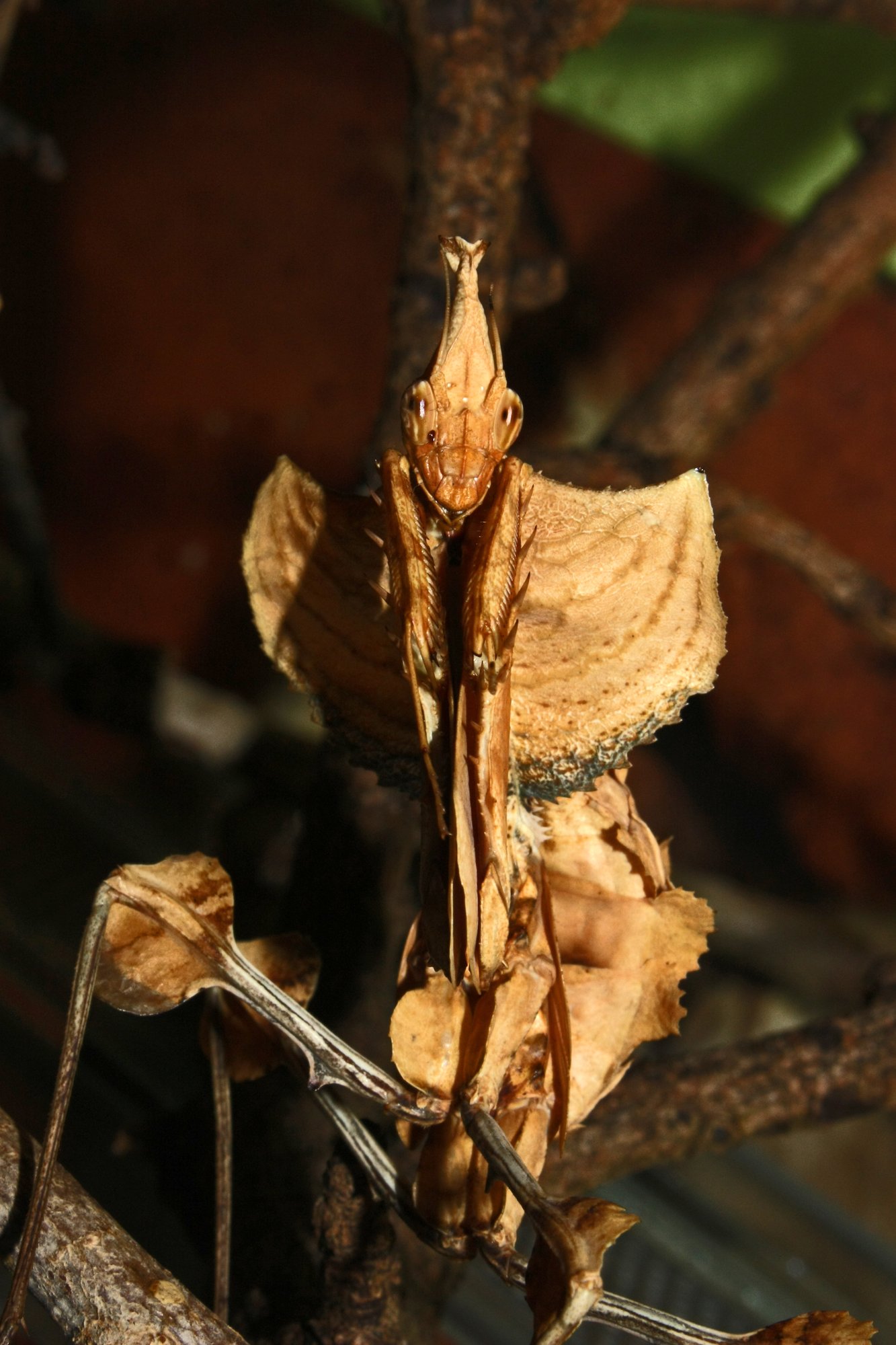
Invertebrates · Difficulty: Expert
Key facts and care guidance for Devil's flower mantis (Idolomantis diabolica) (origin: East Africa (Tanzania, Kenya, Ethiopia, Uganda, Somalia among others)). Adult size around females ~11–13 cm, males smaller. Life expectancy approx. 10–15 months (females longer). The values below are carefully researched guidance.
Short answers
Devil's flower mantis: How big does the enclosure need to be?
A mesh or gauze cage, height at least 3× the body length (~40–45 cm+); smooth walls are unsuitable.
Devil's flower mantis: What temperature does it need?
Daytime 30–40 °C (warm; high during the day), basking spot local hot spot ~40 °C (heat lamp from above), at night 20–25 °C.
Devil's flower mantis: Does it need UVB lighting?
UVB: UVB not essential.
Devil's flower mantis: How long do they live?
Life expectancy: approx. 10–15 months (females longer).
Devil's flower mantis: Is it suitable for beginners?
No – better suited to experienced keepers (difficulty: Expert).
Climate
- Daytime temperature
- 30–40 °C (warm; high during the day)
- Night temperature
- 20–25 °C
- Basking spot
- local hot spot ~40 °C (heat lamp from above)
- Humidity
- rather low to moderate with very good ventilation; mist in the evening, higher for shedding and subadults (figures vary, ~30–60 %)
- UVB
- UVB not essential
Enclosure
- Minimum size
- a mesh or gauze cage, height at least 3× the body length (~40–45 cm+); smooth walls are unsuitable
- Substrate
- Dry (coco humus or kitchen paper)
Feeding
- Food
- Flying prey only (flies, blowflies, moths) – it does not hunt on the ground
- Feeding interval
- adults 2–3×/week, juveniles more often
Key facts
- Adult size
- females ~11–13 cm, males smaller
- Life expectancy
- approx. 10–15 months (females longer)
- Origin
- East Africa (Tanzania, Kenya, Ethiopia, Uganda, Somalia among others)
- Protection status
- No protected status
- Brumation
- None
- Cohabitation
- Keep them singly. Territorial and cannibalistic. The reason is not fighting but feeding: these animals take anything that fits in the mouth, and a second animal in the enclosure counts.
Notes
The most demanding species listed here – it needs heat, very good ventilation and exclusively flying food. Moulting is the critical point for survival; it is sensitive to waterlogging and stagnant air. For experienced keepers only.
Do you keep this species?
Add your animal to Reptoria – Reptoria reminds you about feeding and shedding. Add your animal for free →
Look for Devil's flower mantis (Idolomantis diabolica) in the marketplace →
Related species
- Spiny flower mantis (Pseudocreobotra wahlbergii) – Beginner to intermediate
- African giant mantis (Sphodromantis lineola) – Beginner
- African giant mantis (Sphodromantis viridis) – Beginner
- Egyptian dwarf mantis (Miomantis paykullii) – Beginner
- Asian ant mantis (Odontomantis planiceps) – Beginner
- Giant Asian mantis (Hierodula patellifera) – Beginner
- Banded flower mantis (Theopropus elegans) – Intermediate
- Boxer mantis (Ephestiasula pictipes) – Intermediate
What you need to start
To keep Devil's flower mantis (Idolomantis diabolica) you typically need: a suitable enclosure (a mesh or gauze cage, height at least 3× the body length (~40–45 cm+); smooth walls are unsuitable), substrate (Dry (coco humus or kitchen paper)), a heat source with a thermostat, UVB lighting, thermometer and hygrometer, a water dish and hides. You will find equipment in the Reptoria marketplace.
The complete, interactive care database is in the Reptoria app.
Last updated: 30 October 2026 · Editor: Reptoria editorial team · Sources include: https://de.wikipedia.org/wiki/Teufelsblume, https://en.wikipedia.org/wiki/Idolomantis_diabolica
All values are non-binding guidance and do not replace expert advice. Research thoroughly from several sources before acquiring and keeping an animal, and observe the applicable law (species and animal protection in particular).