Egyptian tortoise (Testudo kleinmanni)
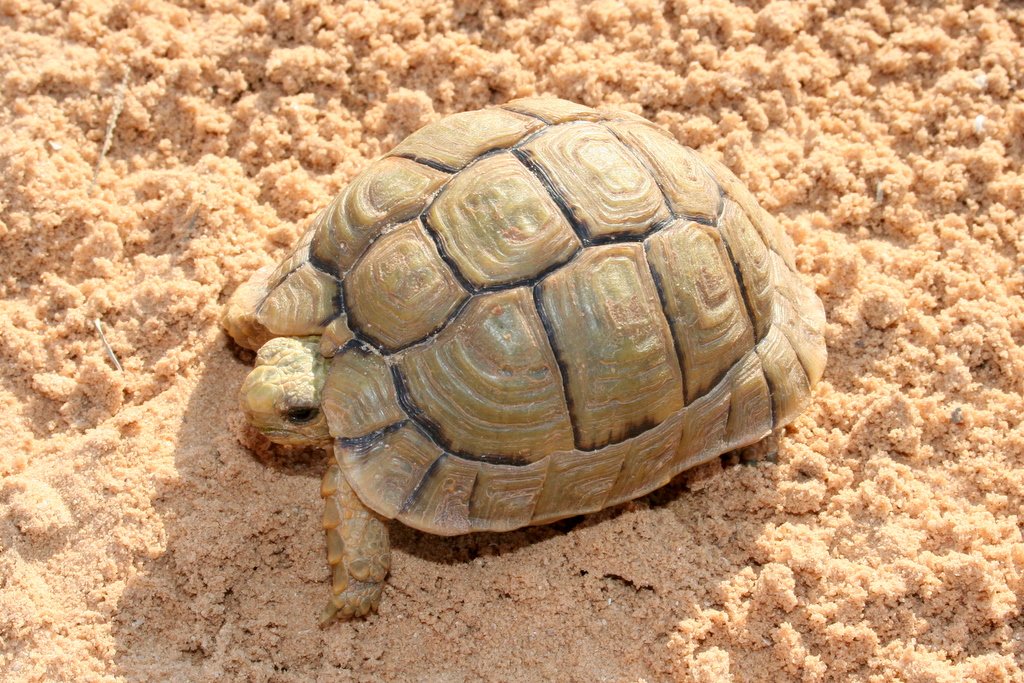
Turtles & tortoises · Difficulty: Intermediate to expert
Key facts and care guidance for Egyptian tortoise (Testudo kleinmanni) (origin: Coastal semi-deserts and dry steppe from Libya through Egypt to southern Israel, mostly within a strip up to about 120 km from the Mediterranean; almost extinct in the wild in Egypt). Adult size around males 9–11 cm, females up to 13–14 cm (the smallest tortoise). Life expectancy up to ~50 years. The values below are carefully researched guidance.
Short answers
Egyptian tortoise: How big does the enclosure need to be?
A dry enclosure from ~2 m² (e.g. 200 × 100 cm).
Egyptian tortoise: What temperature does it need?
Daytime summer 25–35 °C, winter (main activity period) 15–23 °C; basking spot 35–45 °C in summer, 25–30 °C in winter, basking spot 35–40 °C, at night 15–20 °C.
Egyptian tortoise: Does it need UVB lighting?
UVB: Essential (desert-grade UVB).
Egyptian tortoise: How long do they live?
Life expectancy: up to ~50 years.
Egyptian tortoise: Is it suitable for beginners?
No – better suited to experienced keepers (difficulty: Intermediate to expert).
Climate
- Daytime temperature
- summer 25–35 °C, winter (main activity period) 15–23 °C; basking spot 35–45 °C in summer, 25–30 °C in winter
- Night temperature
- 15–20 °C
- Basking spot
- 35–40 °C
- Humidity
- during the day 50–60 %, noticeably higher at night and in the early morning hours (80–90 %); substrate surface dry during the day
- UVB
- Essential (desert-grade UVB)
Enclosure
- Minimum size
- a dry enclosure from ~2 m² (e.g. 200 × 100 cm)
- Substrate
- A sand-loam mix (about 5:1), deep and diggable
Feeding
- Food
- Herbivorous: wild herbs, leaves, flowers; very high in fibre and calcium
- Feeding interval
- Plant food daily, in moderate portions (a small species)
Key facts
- Adult size
- males 9–11 cm, females up to 13–14 cm (the smallest tortoise)
- Life expectancy
- up to ~50 years
- Origin
- Coastal semi-deserts and dry steppe from Libya through Egypt to southern Israel, mostly within a strip up to about 120 km from the Mediterranean; almost extinct in the wild in Egypt
- Protection status
- CITES Appendix I / EU Annex A – the yellow EU certificate plus a commercial-use permit are mandatory
- Brumation
- No winter dormancy. Instead a summer rest (aestivation): withdrawal from mid-April, strict rest roughly from June to early September, ending with a good soaking shower from early to mid-September. Main activity runs from October to April.
- Cohabitation
- Small groups get on; keep the climate strictly dry. Two males harass each other and the females; under constant courtship a female visibly loses condition. One male to several females, and plan for a way to separate them.
Notes
A desert species – permanently warm and dry, and no outdoor keeping in central Europe. CITES I, with strict documentation requirements; only with a legal certificate.
Do you keep this species?
Add your animal to Reptoria – Reptoria reminds you about feeding and shedding. Add your animal for free →
Look for Egyptian tortoise (Testudo kleinmanni) in the marketplace →
Related species
- Marginated tortoise (Testudo marginata) – Beginner to intermediate
- Hermann's tortoise – Dalmatian (Testudo hermanni hercegovinensis) – Beginner
- Hermann's tortoise – eastern (Testudo hermanni boettgeri) – Beginner
- Hermann's tortoise – western (Testudo hermanni hermanni) – Beginner to intermediate
- Hermann's tortoise (Testudo hermanni) – Beginner
- Spur-thighed tortoise – Armenian (Testudo graeca armeniaca) – Intermediate
- Spur-thighed tortoise – Golan (Testudo graeca terrestris) – Intermediate
- Spur-thighed tortoise – Iberian (Testudo graeca graeca) – Intermediate
What you need to start
To keep Egyptian tortoise (Testudo kleinmanni) you typically need: a suitable enclosure (a dry enclosure from ~2 m² (e.g. 200 × 100 cm)), substrate (A sand-loam mix (about 5:1), deep and diggable), a heat source with a thermostat, UVB lighting, thermometer and hygrometer, a water dish and hides. You will find equipment in the Reptoria marketplace.
The complete, interactive care database is in the Reptoria app.
Last updated: 9 October 2026 · Editor: Reptoria editorial team · Sources include: landschildkroeten-hunsrueck.de, testudo-kleinmanni.com, EUR-Lex VO (EU) 2026/1383, Gutachten Mindestanforderungen Reptilien, BML 1997 (lokal), der-zooexperte.de
All values are non-binding guidance and do not replace expert advice. Research thoroughly from several sources before acquiring and keeping an animal, and observe the applicable law (species and animal protection in particular).