Hermann's tortoise – eastern (Testudo hermanni boettgeri)
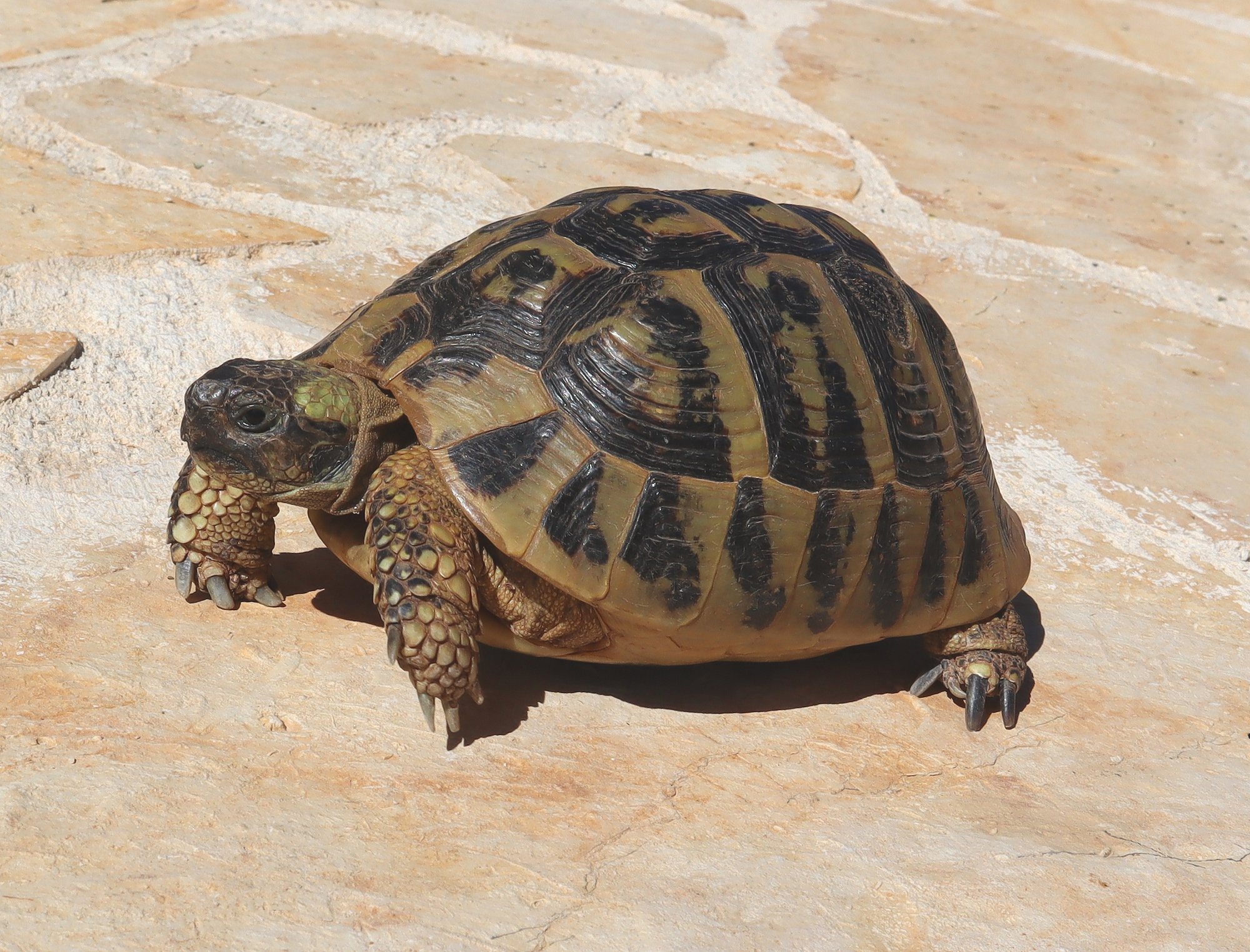
Turtles & tortoises · Difficulty: Beginner
Key facts and care guidance for Hermann's tortoise – eastern (Testudo hermanni boettgeri) (origin: The southern and south-eastern Balkans: Greece, Bulgaria, Albania, North Macedonia, Serbia, European Turkey, Romania). Adult size around males 13–21 cm, females 16–26 cm carapace length; individual females over 30 cm (the largest hermanni form). Life expectancy 50–90+ years. The values below are carefully researched guidance.
Short answers
Hermann's tortoise – eastern: How big does the enclosure need to be?
Outdoor keeping is mandatory: an outdoor enclosure of at least 10 m² for the first adult animal, at least 5 m² more for each additional one, plus a cold frame or greenhouse with a heat lamp. Indoor winter/bad-weather quarters per the official formula length = 8 × carapace length, width = half the length (so for a 25 cm carapace, about 200×100 cm for two animals), at least 1.5–2 m² per animal.
Hermann's tortoise – eastern: What temperature does it need?
Daytime 22–28 °C (outdoors / cold frame), basking spot 40–45 °C (basking spot under a heat emitter), at night 15–20 °C (night-time drop).
Hermann's tortoise – eastern: Does it need UVB lighting?
UVB: UVB essential when kept indoors (Ferguson zone 3, UV index 3–5); outdoors the sun covers it.
Hermann's tortoise – eastern: How long do they live?
Life expectancy: 50–90+ years.
Hermann's tortoise – eastern: Is it suitable for beginners?
Yes – it is considered suitable for beginners (difficulty: Beginner).
Climate
- Daytime temperature
- 22–28 °C (outdoors / cold frame)
- Night temperature
- 15–20 °C (night-time drop)
- Basking spot
- 40–45 °C (basking spot under a heat emitter)
- Humidity
- 40–60 % (juveniles need a humid microclimate of 60–80 %)
- UVB
- UVB essential when kept indoors (Ferguson zone 3, UV index 3–5); outdoors the sun covers it
Enclosure
- Minimum size
- outdoor keeping is mandatory: an outdoor enclosure of at least 10 m² for the first adult animal, at least 5 m² more for each additional one, plus a cold frame or greenhouse with a heat lamp. Indoor winter/bad-weather quarters per the official formula length = 8 × carapace length, width = half the length (so for a 25 cm carapace, about 200×100 cm for two animals), at least 1.5–2 m² per animal.
- Substrate
- A garden-soil, sand and loam mix they can dig in; leaf litter or hay for structure
Feeding
- Food
- Strictly herbivorous: fibre-rich wild herbs (dandelion, plantain, clover, thistle) and flowers; no fruit and no animal protein; calcium (cuttlebone)
- Feeding interval
- wild herbs freely available every day, no overfeeding, one fasting day a week; juveniles daily
Key facts
- Adult size
- males 13–21 cm, females 16–26 cm carapace length; individual females over 30 cm (the largest hermanni form)
- Life expectancy
- 50–90+ years
- Origin
- The southern and south-eastern Balkans: Greece, Bulgaria, Albania, North Macedonia, Serbia, European Turkey, Romania
- Protection status
- CITES Appendix II / EU Annex A: an EU certificate (the yellow CITES form with photo documentation), plus registration and marking duties
- Brumation
- Yes — annual winter dormancy, 3–5 months at 4–6 °C (roughly late October/November to March) in moist substrate or in a fridge; officially prescribed as overwintering and essential for metabolism and life expectancy.
- Cohabitation
- Keeping them singly is straightforward. Group keeping only as one male with several (2–3 or more) females in a large outdoor enclosure with visual barriers; never two males (territorial fights, and constant courtship stresses the females)
Notes
The most commonly kept tortoise, robust and beginner-friendly. Common mistakes: overwintered too warm or too damp, overfeeding and protein (pyramiding, kidney damage), and vitamin D deficiency without UVB or sun.
Do you keep this species?
Add your animal to Reptoria – Reptoria reminds you about feeding and shedding. Add your animal for free →
Look for Hermann's tortoise – eastern (Testudo hermanni boettgeri) in the marketplace →
Related species
- Egyptian tortoise (Testudo kleinmanni) – Intermediate to expert
- Marginated tortoise (Testudo marginata) – Beginner to intermediate
- Hermann's tortoise – Dalmatian (Testudo hermanni hercegovinensis) – Beginner
- Hermann's tortoise – western (Testudo hermanni hermanni) – Beginner to intermediate
- Hermann's tortoise (Testudo hermanni) – Beginner
- Spur-thighed tortoise – Armenian (Testudo graeca armeniaca) – Intermediate
- Spur-thighed tortoise – Golan (Testudo graeca terrestris) – Intermediate
- Spur-thighed tortoise – Iberian (Testudo graeca graeca) – Intermediate
What you need to start
To keep Hermann's tortoise – eastern (Testudo hermanni boettgeri) you typically need: a suitable enclosure (outdoor keeping is mandatory: an outdoor enclosure of at least 10 m² for the first adult animal, at least 5 m² more for each additional one, plus a cold frame or greenhouse with a heat lamp. Indoor winter/bad-weather quarters per the official formula length = 8 × carapace length, width = half the length (so for a 25 cm carapace, about 200×100 cm for two animals), at least 1.5–2 m² per animal.), substrate (A garden-soil, sand and loam mix they can dig in; leaf litter or hay for structure), a heat source with a thermostat, UVB lighting, thermometer and hygrometer, a water dish and hides. You will find equipment in the Reptoria marketplace.
The complete, interactive care database is in the Reptoria app.
Last updated: 9 October 2026 · Editor: Reptoria editorial team · Sources include: BMEL-Gutachten Reptilien 1997, EU-VO 338/97 (Anhang, Fassung 2026/1383), landschildkroeten-hunsrueck.de, reptilienauffangstation.de, schildkroeten-farm.de
All values are non-binding guidance and do not replace expert advice. Research thoroughly from several sources before acquiring and keeping an animal, and observe the applicable law (species and animal protection in particular).