Hermann's tortoise (Testudo hermanni)
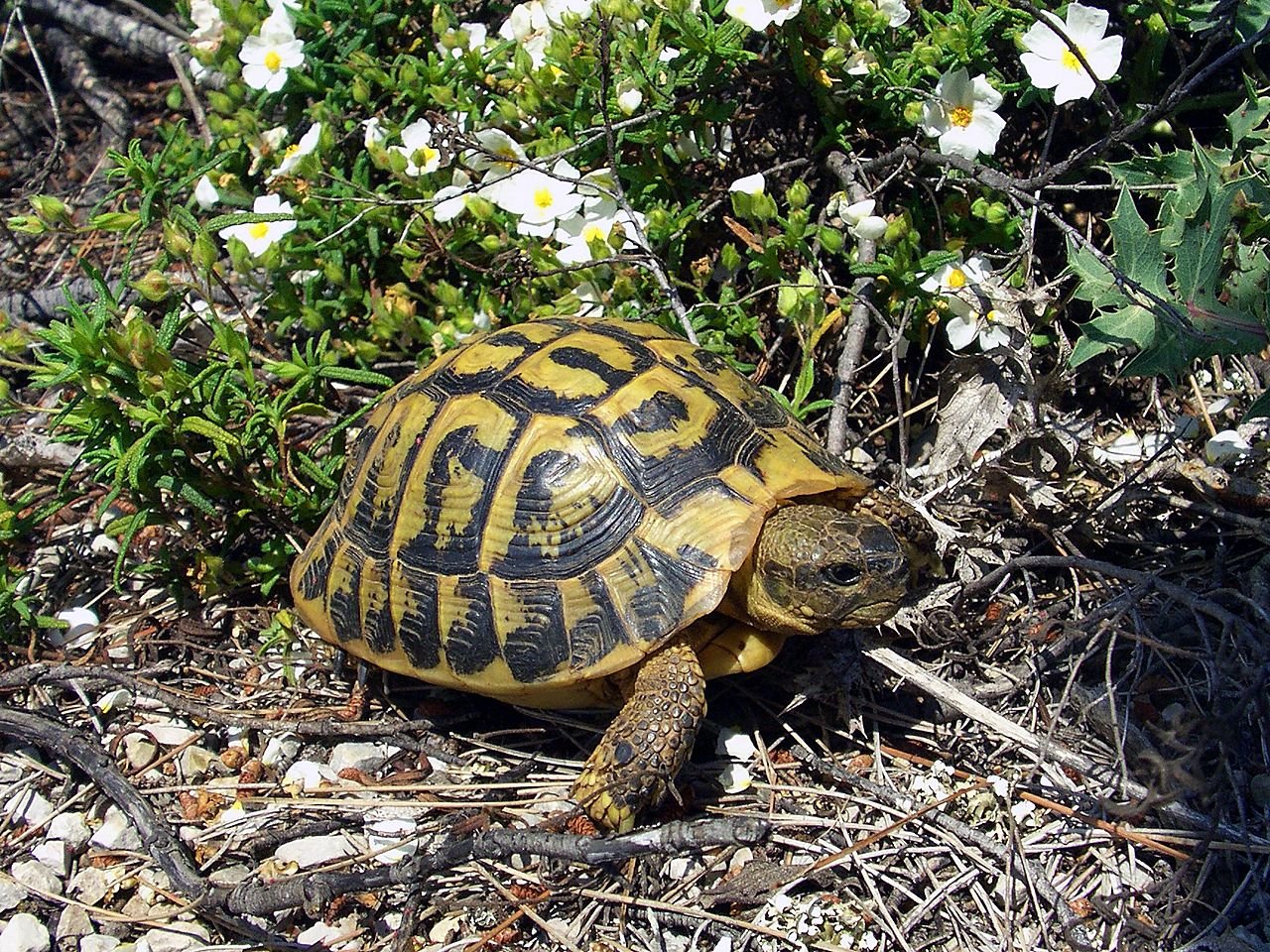
Turtles & tortoises · Difficulty: Beginner
Key facts and care guidance for Hermann's tortoise (Testudo hermanni) (origin: The Mediterranean region: Spain, southern France, Italy, the eastern Adriatic, the Balkans as far as Greece and Bulgaria). Adult size around 14–30 cm depending on subspecies (the Dalmatian form the smallest, the eastern form the largest). Life expectancy 50–90+ years. The values below are carefully researched guidance.
Short answers
Hermann's tortoise: How big does the enclosure need to be?
Keeping them outdoors is essential: a cold frame or greenhouse plus an outdoor enclosure of about 8–10 m² per adult animal; a terrarium alone does not meet their needs.
Hermann's tortoise: What temperature does it need?
Daytime 22–30 °C (outdoors / cold frame), basking spot 38–42 °C (basking spot under a heat emitter), at night 15–20 °C (night-time drop).
Hermann's tortoise: Does it need UVB lighting?
UVB: UVB essential when kept indoors (Ferguson zone 3, UV index 3–5); outdoors the sun covers it.
Hermann's tortoise: How long do they live?
Life expectancy: 50–90+ years.
Hermann's tortoise: Is it suitable for beginners?
Yes – it is considered suitable for beginners (difficulty: Beginner).
Climate
- Daytime temperature
- 22–30 °C (outdoors / cold frame)
- Night temperature
- 15–20 °C (night-time drop)
- Basking spot
- 38–42 °C (basking spot under a heat emitter)
- Humidity
- 40–60 % (juveniles need a humid microclimate of 60–80 %)
- UVB
- UVB essential when kept indoors (Ferguson zone 3, UV index 3–5); outdoors the sun covers it
Enclosure
- Minimum size
- keeping them outdoors is essential: a cold frame or greenhouse plus an outdoor enclosure of about 8–10 m² per adult animal; a terrarium alone does not meet their needs
- Substrate
- A garden-soil, sand and loam mix they can dig in; leaf litter or hay for structure
Feeding
- Food
- Strictly herbivorous: fibre-rich wild herbs (dandelion, plantain, clover, thistle) and flowers; no fruit and no animal protein; calcium (cuttlebone)
- Feeding interval
- wild herbs freely available every day, no overfeeding, one fasting day a week; juveniles daily
Key facts
- Adult size
- 14–30 cm depending on subspecies (the Dalmatian form the smallest, the eastern form the largest)
- Life expectancy
- 50–90+ years
- Origin
- The Mediterranean region: Spain, southern France, Italy, the eastern Adriatic, the Balkans as far as Greece and Bulgaria
- Protection status
- CITES Appendix II / EU Annex A: an EU certificate (the yellow CITES form with photo documentation), plus registration and marking duties
- Brumation
- Yes, in all subspecies: winter dormancy 2–4.5 months at 4–8 °C in moist substrate. Unlike the Greek tortoise, this is mandatory regardless of subspecies and is decisive for metabolism and life expectancy.
- Cohabitation
- Keeping them singly is straightforward. Group keeping only as one male with several (2–3 or more) females in a large outdoor enclosure with visual barriers; never two males (territorial fights, and constant courtship stresses the females)
Notes
Collective entry for all subspecies of Testudo hermanni — intended for captive-bred animals from mixed pairings and for animals whose subspecies is not reliably known. The subspecies mainly differ in size and origin; care is essentially the same.
Do you keep this species?
Add your animal to Reptoria – Reptoria reminds you about feeding and shedding. Add your animal for free →
Hermann's tortoise (Testudo hermanni) currently offered
- Weibl. Griechische Landschildkröte 17J mit Cites und Fundtier – Merzig · 250 €
Related species
- Egyptian tortoise (Testudo kleinmanni) – Intermediate to expert
- Marginated tortoise (Testudo marginata) – Beginner to intermediate
- Hermann's tortoise – Dalmatian (Testudo hermanni hercegovinensis) – Beginner
- Hermann's tortoise – eastern (Testudo hermanni boettgeri) – Beginner
- Hermann's tortoise – western (Testudo hermanni hermanni) – Beginner to intermediate
- Spur-thighed tortoise – Armenian (Testudo graeca armeniaca) – Intermediate
- Spur-thighed tortoise – Golan (Testudo graeca terrestris) – Intermediate
- Spur-thighed tortoise – Iberian (Testudo graeca graeca) – Intermediate
What you need to start
To keep Hermann's tortoise (Testudo hermanni) you typically need: a suitable enclosure (keeping them outdoors is essential: a cold frame or greenhouse plus an outdoor enclosure of about 8–10 m² per adult animal; a terrarium alone does not meet their needs), substrate (A garden-soil, sand and loam mix they can dig in; leaf litter or hay for structure), a heat source with a thermostat, UVB lighting, thermometer and hygrometer, a water dish and hides. You will find equipment in the Reptoria marketplace.
The complete, interactive care database is in the Reptoria app.
Last updated: 3 November 2026 · Editor: Reptoria editorial team · Sources include: https://de.wikipedia.org/wiki/Griechische_Landschildkröte, https://en.wikipedia.org/wiki/Hermann%27s_tortoise, https://reptile-database.reptarium.cz/species?genus=Testudo&species=hermanni, https://reptiliendoktor.com/haltungsempfehlungen/landschildkroeten/, https://www.xn--landschildkrte-6pb.de/haltung/arten/griechische-landschildkroete-testudo-hermanni/
All values are non-binding guidance and do not replace expert advice. Research thoroughly from several sources before acquiring and keeping an animal, and observe the applicable law (species and animal protection in particular).