Harlequin poison frog (Oophaga histrionica)
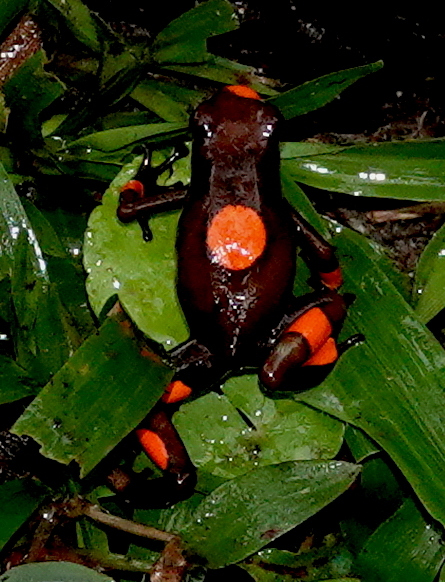
Amphibians · Difficulty: Expert
Key facts and care guidance for Harlequin poison frog (Oophaga histrionica) (origin: Western Colombia – the Chocó rainforest). Adult size around 2,5–3,5 cm. Life expectancy 10–15 years. The values below are carefully researched guidance.
Short answers
Harlequin poison frog: How big does the enclosure need to be?
50×40×60 cm.
Harlequin poison frog: What temperature does it need?
Daytime 22–26 °C, basking spot No basking spot, at night 19–22 °C.
Harlequin poison frog: Does it need UVB lighting?
UVB: Recommended (UVB 2 %).
Harlequin poison frog: How long do they live?
Life expectancy: 10–15 years.
Harlequin poison frog: Is it suitable for beginners?
No – better suited to experienced keepers (difficulty: Expert).
Climate
- Daytime temperature
- 22–26 °C
- Night temperature
- 19–22 °C
- Basking spot
- No basking spot
- Humidity
- 85–100 %
- UVB
- Recommended (UVB 2 %)
Enclosure
- Minimum size
- 50×40×60 cm
- Substrate
- Coco humus, a thick layer of leaf litter, moss, plenty of bromeliads
Feeding
- Food
- Fruit flies, springtails, aphids
- Feeding interval
- daily
Key facts
- Adult size
- 2,5–3,5 cm
- Life expectancy
- 10–15 years
- Origin
- Western Colombia – the Chocó rainforest
- Protection status
- CITES II; wild-caught animals are effectively no longer legally available
- Brumation
- None
- Cohabitation
- Keeping in pairs or as a small group (1.2) is possible. Raise juveniles separately from adults: tadpoles from several females are cannibalistic towards each other, so each larva must grow up individually in its own bromeliad leaf-axil. Among adults, rival females are the real danger - they occasionally destroy or eat other females' clutches, so provide enough egg-laying and retreat spots.
Notes
Oophaga species feed their tadpoles with unfertilised nutritive eggs – the larvae have to stay in bromeliad funnels in the parents' terrarium. Without dense bromeliad planting there is no breeding. Extremely variable colour morphs; note the stated origin (local form) at purchase, and do not mix morphs.
Do you keep this species?
Add your animal to Reptoria – Reptoria reminds you about feeding and shedding. Add your animal for free →
Look for Harlequin poison frog (Oophaga histrionica) in the marketplace →
Related species
- Little devil poison frog (Oophaga sylvatica) – Expert
- Strawberry poison frog (Oophaga pumilio) – Intermediate
- Granular poison frog (Oophaga granulifera) – Intermediate
- Lehmann's poison frog (Oophaga lehmanni) – Expert
- Yellow-bellied poison frog (Ameerega hahneli) – Intermediate
- Anthony's poison frog (Hyloxalus nexipus) – Intermediate
- Bassler's poison frog (Ameerega bassleri) – Intermediate
- Poison frogs (Ranitomeya amazonica) – Intermediate
What you need to start
To keep Harlequin poison frog (Oophaga histrionica) you typically need: a suitable enclosure (50×40×60 cm), substrate (Coco humus, a thick layer of leaf litter, moss, plenty of bromeliads), a heat source with a thermostat, UVB lighting, thermometer and hygrometer, a water dish and hides. You will find equipment in the Reptoria marketplace.
The complete, interactive care database is in the Reptoria app.
Last updated: 9 October 2026 · Editor: Reptoria editorial team · Sources include: https://de.wikipedia.org/wiki/Harlekin-Baumsteiger, https://reptile-database.reptarium.cz/species?genus=Oophaga&species=histrionica, https://en.wikipedia.org/wiki/Lehmann%27s_poison_frog
All values are non-binding guidance and do not replace expert advice. Research thoroughly from several sources before acquiring and keeping an animal, and observe the applicable law (species and animal protection in particular).