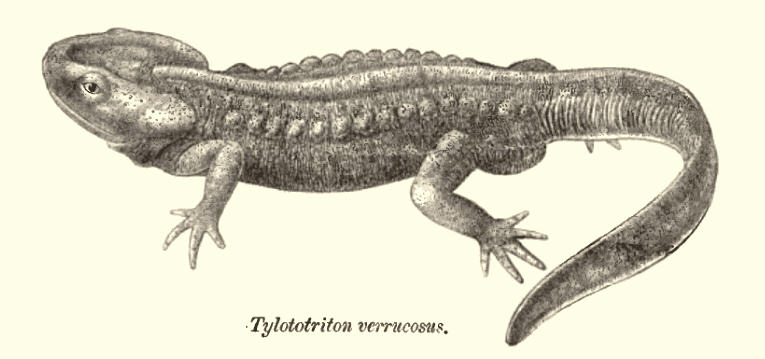
Himalayan newt (Tylototriton verrucosus)
Amphibians · Difficulty: Intermediate
Key facts and care guidance for Himalayan newt (Tylototriton verrucosus) (origin: The Himalayan foothills, northern Thailand, Yunnan). Adult size around 14–20 cm. Life expectancy 15–20 years. The values below are carefully researched guidance.
Short answers
Himalayan newt: How big does the enclosure need to be?
80×40×40 cm aqua-terrarium.
Himalayan newt: What temperature does it need?
Daytime 16–23 °C, basking spot No basking spot, at night 16–19 °C (a slight night-time drop); outside the winter dormancy period, not permanently below 15 °C.
Himalayan newt: Does it need UVB lighting?
UVB: Not essential.
Himalayan newt: How long do they live?
Life expectancy: 15–20 years.
Himalayan newt: Is it suitable for beginners?
Rather not – it is considered an intermediate species (difficulty: Intermediate).
Climate
- Daytime temperature
- 16–23 °C
- Night temperature
- 16–19 °C (a slight night-time drop); outside the winter dormancy period, not permanently below 15 °C
- Basking spot
- No basking spot
- Humidity
- 70–85 % (semi-aquatic)
- UVB
- Not essential
Enclosure
- Minimum size
- 80×40×40 cm aqua-terrarium
- Substrate
- Land area of moss, coco fibre and leaf litter with flat hide slabs; plus a water area taking up about half the space, which for adults may be up to around 20 cm deep — for juveniles no more than 8 cm, with a shallow exit
Feeding
- Food
- Earthworms, woodlice, slugs and soft insects; in the water area red mosquito larvae and freshwater shrimp, also as frozen food from tongs
- Feeding interval
- adults 2×/week
Key facts
- Adult size
- 14–20 cm
- Life expectancy
- 15–20 years
- Origin
- The Himalayan foothills, northern Thailand, Yunnan
- Protection status
- CITES II
- Brumation
- A cool rest period of 8–12 weeks at around 10–15 °C, usually November to January or February; without it there is no offspring
- Cohabitation
- A group is possible. Only put together animals of the same species and roughly the same size — smaller ones will otherwise be treated as food. Offer enough hiding places so that every animal can retreat, and feed them separately when they differ in size.
Notes
Outside the spawning season it spends much of its time on land – the land section must be larger than the water section. Sensitive to warmth.
Do you keep this species?
Add your animal to Reptoria – Reptoria reminds you about feeding and shedding. Add your animal for free →
Look for Himalayan newt (Tylototriton verrucosus) in the marketplace →
Related species
- Emperor newt (Tylototriton shanjing) – Intermediate
- Italian crested newt (Triturus carnifex) – Intermediate
- Alpine salamander (Salamandra atra) – Expert
- Anderson's crocodile newt (Echinotriton andersoni) – Expert
- Anderson's salamander (Ambystoma andersoni) – Intermediate
- Axolotl (Ambystoma mexicanum) – Beginner to intermediate
- Alpine newt (Ichthyosaura alpestris) – Beginner
- Blue-tailed fire-bellied newt (Cynops cyanurus) – Beginner
What you need to start
To keep Himalayan newt (Tylototriton verrucosus) you typically need: a suitable enclosure (80×40×40 cm aqua-terrarium), substrate (Land area of moss, coco fibre and leaf litter with flat hide slabs; plus a water area taking up about half the space, which for adults may be up to around 20 cm deep — for juveniles no more than 8 cm, with a shallow exit), a heat source with a thermostat, UVB lighting, thermometer and hygrometer, a water dish and hides. You will find equipment in the Reptoria marketplace.
The complete, interactive care database is in the Reptoria app.
Last updated: 9 October 2026 · Editor: Reptoria editorial team · Sources include: einrichtungsbeispiele.de, petbook.de, aqualog.de, Wikipedia EN, eur-lex.europa.eu
All values are non-binding guidance and do not replace expert advice. Research thoroughly from several sources before acquiring and keeping an animal, and observe the applicable law (species and animal protection in particular).