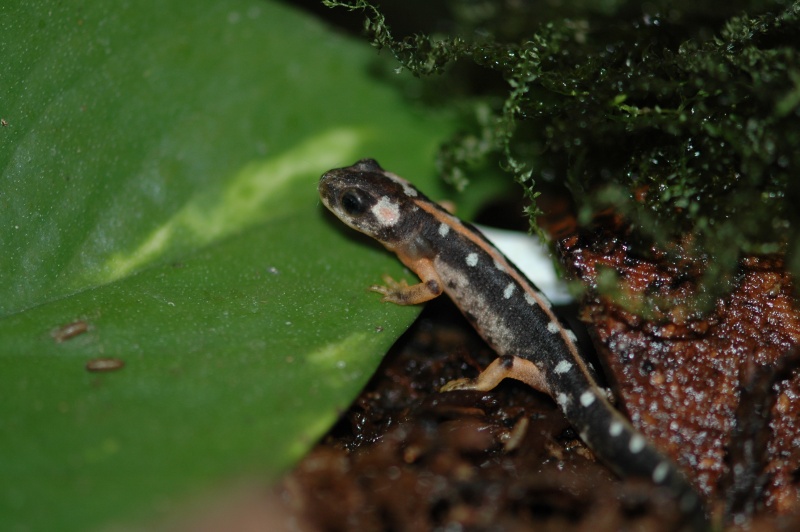
Kaiser's spotted newt (Neurergus kaiseri)
Amphibians · Difficulty: Intermediate
Key facts and care guidance for Kaiser's spotted newt (Neurergus kaiseri) (origin: Western Iran – the Zagros Mountains). Adult size around 10–14 cm. Life expectancy 12–20 years. The values below are carefully researched guidance.
Short answers
Kaiser's spotted newt: How big does the enclosure need to be?
80×40×40 cm, two thirds water.
Kaiser's spotted newt: What temperature does it need?
Daytime 14–21 °C, basking spot No basking spot, at night 10–16 °C.
Kaiser's spotted newt: Does it need UVB lighting?
UVB: Not required.
Kaiser's spotted newt: How long do they live?
Life expectancy: 12–20 years.
Kaiser's spotted newt: Is it suitable for beginners?
Rather not – it is considered an intermediate species (difficulty: Intermediate).
Climate
- Daytime temperature
- 14–21 °C
- Night temperature
- 10–16 °C
- Basking spot
- No basking spot
- Humidity
- Aqua-terrarium
- UVB
- Not required
Enclosure
- Minimum size
- 80×40×40 cm, two thirds water
- Substrate
- A water section 15–25 cm deep, stones, a current, a land section with moss
Feeding
- Food
- Earthworms, frozen food, freshwater shrimp
- Feeding interval
- 2–3×/week
Key facts
- Adult size
- 10–14 cm
- Life expectancy
- 12–20 years
- Origin
- Western Iran – the Zagros Mountains
- Protection status
- CITES I / EU Annex A – sale ONLY with a valid EU commercial-use certificate (the "yellow papers")
- Brumation
- A cooler spell of 10–14 weeks
- Cohabitation
- A group. Only put together animals of the same species and roughly the same size — smaller ones will otherwise be treated as food. Offer enough hiding places so that every animal can retreat, and feed them separately when they differ in size.
Notes
Boldly marked in black, white and orange, and one of the most sought-after newt species. Strictly protected: without yellow CITES papers any sale is prohibited. Captive breeding is well established in Europe.
Do you keep this species?
Add your animal to Reptoria – Reptoria reminds you about feeding and shedding. Add your animal for free →
Look for Kaiser's spotted newt (Neurergus kaiseri) in the marketplace →
Related species
- Kurdistan newt (Neurergus derjugini) – Intermediate
- Strauch's spotted newt (Neurergus strauchii) – Intermediate
- Yellow-spotted newt (Neurergus crocatus) – Intermediate
- Italian crested newt (Triturus carnifex) – Intermediate
- Alpine salamander (Salamandra atra) – Expert
- Anderson's crocodile newt (Echinotriton andersoni) – Expert
- Anderson's salamander (Ambystoma andersoni) – Intermediate
- Axolotl (Ambystoma mexicanum) – Beginner to intermediate
What you need to start
To keep Kaiser's spotted newt (Neurergus kaiseri) you typically need: a suitable enclosure (80×40×40 cm, two thirds water), substrate (A water section 15–25 cm deep, stones, a current, a land section with moss), a heat source with a thermostat, thermometer and hygrometer, a water dish and hides. You will find equipment in the Reptoria marketplace.
The complete, interactive care database is in the Reptoria app.
Last updated: 2 November 2026 · Editor: Reptoria editorial team · Sources include: https://de.wikipedia.org/wiki/Zagros-Molch, https://en.wikipedia.org/wiki/Neurergus_kaiseri
All values are non-binding guidance and do not replace expert advice. Research thoroughly from several sources before acquiring and keeping an animal, and observe the applicable law (species and animal protection in particular).