Pygmy blue-tongued skink (Tiliqua adelaidensis)
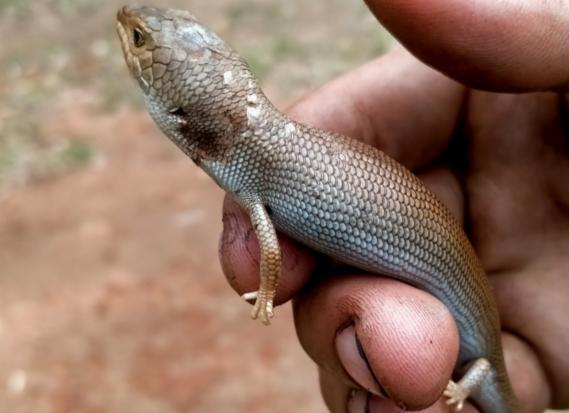
Skinks · Difficulty: Expert
Key facts and care guidance for Pygmy blue-tongued skink (Tiliqua adelaidensis) (origin: Endemic to the Mid North of South Australia (remnant natural grassland); rediscovered in 1992, with a population of only ~5,000–7,000 animals). Adult size around SVL ~9–10 cm, total length ~15 cm (the smallest Tiliqua species). Life expectancy Not reliably documented in captivity (uncertain). The values below are carefully researched guidance.
Short answers
Pygmy blue-tongued skink: How big does the enclosure need to be?
No dependable data on private keeping; zoos use deep-substrate enclosures with vertical tubes as a substitute burrow.
Pygmy blue-tongued skink: What temperature does it need?
Daytime approx. 22–28 °C (inferred from the natural climate, uncertain), basking spot approx. 30–35 °C, basks at the burrow entrance (uncertain), at night approx. 10–18 °C, varying with the season (uncertain).
Pygmy blue-tongued skink: Does it need UVB lighting?
UVB: UVB is presumably needed (a diurnal basker, ~Ferguson zone 3); no published keeper figures (uncertain).
Pygmy blue-tongued skink: How long do they live?
Life expectancy: Not reliably documented in captivity (uncertain).
Pygmy blue-tongued skink: Is it suitable for beginners?
No – better suited to experienced keepers (difficulty: Expert).
Climate
- Daytime temperature
- approx. 22–28 °C (inferred from the natural climate, uncertain)
- Night temperature
- approx. 10–18 °C, varying with the season (uncertain)
- Basking spot
- approx. 30–35 °C, basks at the burrow entrance (uncertain)
- Humidity
- approx. 40–60 % (temperate grassland / semi-arid, uncertain)
- UVB
- UVB is presumably needed (a diurnal basker, ~Ferguson zone 3); no published keeper figures (uncertain)
Enclosure
- Minimum size
- No dependable data on private keeping; zoos use deep-substrate enclosures with vertical tubes as a substitute burrow
- Substrate
- The natural habitat: deep, unploughed grassland soil with vertical wolf-spider burrows as refuges and lookouts
Feeding
- Food
- Omnivorous, ambushing from the burrow entrance: mainly invertebrates, especially spiders and insects, plus a little plant matter
- Feeding interval
- Not reliably documented (uncertain)
Key facts
- Adult size
- SVL ~9–10 cm, total length ~15 cm (the smallest Tiliqua species)
- Life expectancy
- Not reliably documented in captivity (uncertain)
- Origin
- Endemic to the Mid North of South Australia (remnant natural grassland); rediscovered in 1992, with a population of only ~5,000–7,000 animals
- Protection status
- CITES Appendix I (since CoP19 in 2022; previously Appendix III from 22 June 2022) → EU Regulation Annex A. IUCN Endangered, and protected in Australia under the EPBC Act. No legal private trade; any keeping requires a permit and CITES documents – in practice this is reserved for conservation
- Brumation
- Yes – a natural winter rest period (winter in cool South Australia); the exact protocols are not published
- Cohabitation
- Single keeping. Each animal occupies its own burrow (an old spider tube), and the animals use tubes individually; there is no evidence for groups. Zoos provide individual tubes as burrow replacements. Bring a pair together only for controlled mating.
Notes
Despite the name, a pink tongue. Live-bearing. Extremely dependent on its habitat (old wolf-spider burrows). It does NOT belong in private herpetoculture; the husbandry figures are deliberately conservative and uncertain, derived from its natural climate – they cannot be backed by keeper sources.
Do you keep this species?
Add your animal to Reptoria – Reptoria reminds you about feeding and shedding. Add your animal for free →
Look for Pygmy blue-tongued skink (Tiliqua adelaidensis) in the marketplace →
Related species
- Centralian blue-tongued skink (Tiliqua multifasciata) – Intermediate
- Common blue-tongued skink (Tiliqua scincoides) – Beginner
- Halmahera blue-tongued skink (Tiliqua gigas gigas) – Intermediate
- Indonesian blue-tongued skink (Tiliqua gigas) – Beginner to intermediate
- Irian Jaya blue-tongued skink (Tiliqua sp. „Irian Jaya") – Intermediate
- Kei Island blue-tongued skink (Tiliqua gigas keyensis) – Intermediate
- Shingleback skink (Tiliqua rugosa) – Intermediate
- Merauke blue-tongued skink (Tiliqua gigas evanescens) – Intermediate
What you need to start
To keep Pygmy blue-tongued skink (Tiliqua adelaidensis) you typically need: a suitable enclosure (No dependable data on private keeping; zoos use deep-substrate enclosures with vertical tubes as a substitute burrow), substrate (The natural habitat: deep, unploughed grassland soil with vertical wolf-spider burrows as refuges and lookouts), a heat source with a thermostat, UVB lighting, thermometer and hygrometer, a water dish and hides. You will find equipment in the Reptoria marketplace.
The complete, interactive care database is in the Reptoria app.
Last updated: 7 November 2026 · Editor: Reptoria editorial team · Sources include: https://de.wikipedia.org/wiki/Blauzungenskinke, https://en.wikipedia.org/wiki/Tiliqua, https://en.wikipedia.org/wiki/Tiliqua_adelaidensis, https://reptile-database.reptarium.cz/species?genus=Tiliqua&species=adelaidensis
All values are non-binding guidance and do not replace expert advice. Research thoroughly from several sources before acquiring and keeping an animal, and observe the applicable law (species and animal protection in particular).