Rainbow stag beetle (Phalacrognathus muelleri)
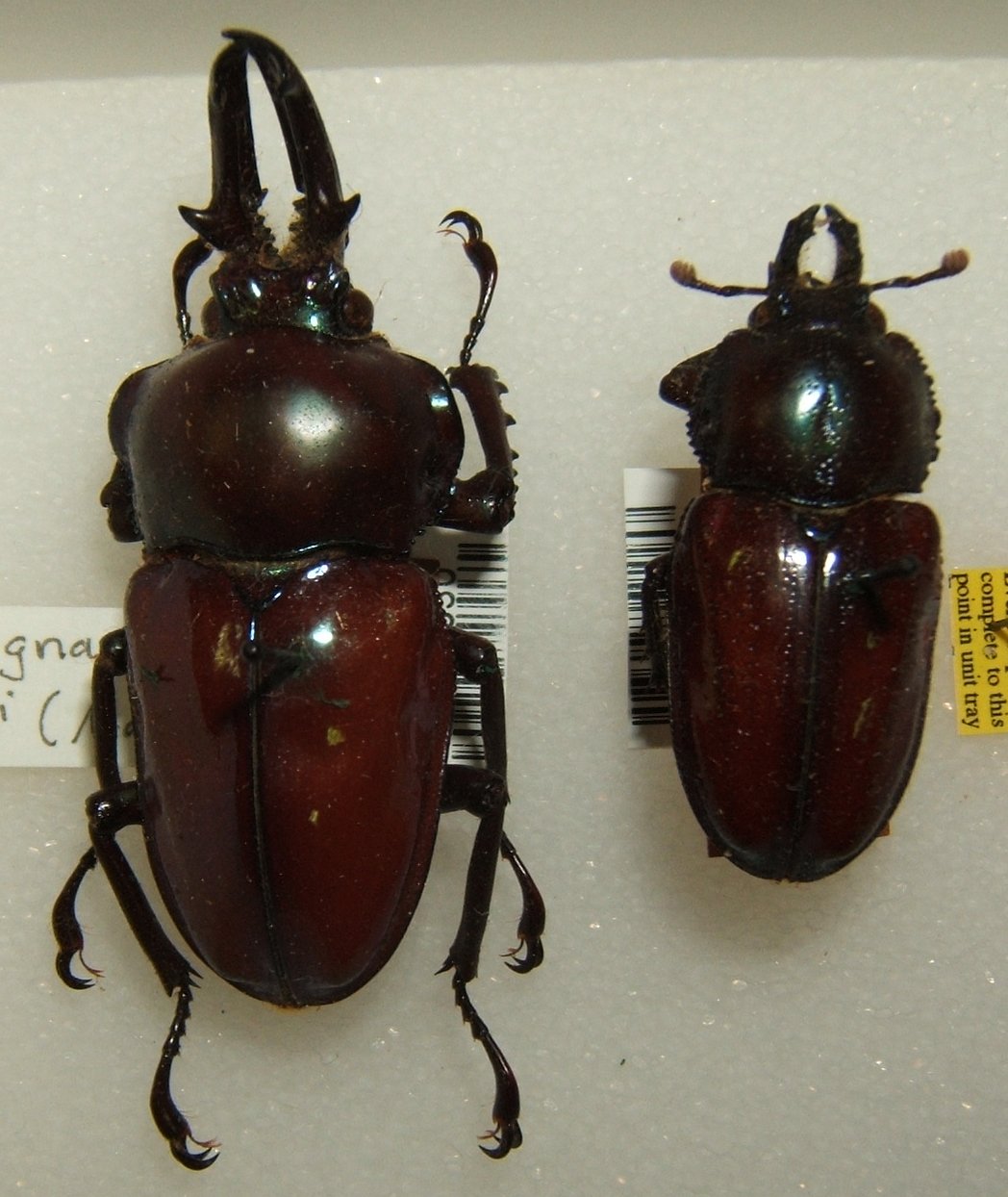
Invertebrates · Difficulty: Intermediate
Key facts and care guidance for Rainbow stag beetle (Phalacrognathus muelleri) (origin: Northern Queensland (Australia) and New Guinea). Adult size around males approx. 40–70 mm (including the mandibles), females approx. 24–40 mm. Life expectancy the beetle is relatively long-lived (several months); egg to beetle takes about 4–8 months. The values below are carefully researched guidance.
Short answers
Rainbow stag beetle: How big does the enclosure need to be?
Beetles: approx. 30×20×20 cm; larvae ideally individually, L3 in at least 0.8 l (flake soil or kinshi).
Rainbow stag beetle: What temperature does it need?
Daytime 20–26 °C (ideally 20–24 °C), at night 18–20 °C.
Rainbow stag beetle: Does it need UVB lighting?
UVB: No UVB needed.
Rainbow stag beetle: How long do they live?
Life expectancy: the beetle is relatively long-lived (several months); egg to beetle takes about 4–8 months.
Rainbow stag beetle: Is it suitable for beginners?
Rather not – it is considered an intermediate species (difficulty: Intermediate).
Climate
- Daytime temperature
- 20–26 °C (ideally 20–24 °C)
- Night temperature
- 18–20 °C
- Basking spot
- —
- Humidity
- 60–80 % (substrate and wood kept damp)
- UVB
- No UVB needed
Enclosure
- Minimum size
- beetles: approx. 30×20×20 cm; larvae ideally individually, L3 in at least 0.8 l (flake soil or kinshi)
- Substrate
- White-rotted deciduous wood or flake soil (fermented wood-humus substrate); damp, not wet
Feeding
- Food
- Beetles: beetle jelly, a sap substitute, overripe fruit; larvae: white-rotted wood or flake soil
- Feeding interval
- beetles: jelly 2–3×/week; the larvae feed continuously from the substrate
Key facts
- Adult size
- males approx. 40–70 mm (including the mandibles), females approx. 24–40 mm
- Life expectancy
- the beetle is relatively long-lived (several months); egg to beetle takes about 4–8 months
- Origin
- Northern Queensland (Australia) and New Guinea
- Protection status
- No CITES or special protection in Germany; export from Australia is regulated – captive-bred animals in the trade
- Brumation
- None (keep the temperature even)
- Cohabitation
- Group housing possible: adult beetles are fairly peaceable for stag beetles, and pair or group housing works well given enough space, food and hiding spots, though males may occasionally compete over feeding spots. Larvae, however, should be raised singly from the second instar (L2) onward — cramped conditions or too little substrate bring a risk of cannibalism and stress.
Notes
One of the easier-to-keep jewel stag beetles, and colourful. Communal rearing of the larvae only with plenty of substrate and space, otherwise cannibalism. Common mistakes: substrate too dry, and larvae too crowded.
Do you keep this species?
Add your animal to Reptoria – Reptoria reminds you about feeding and shedding. Add your animal for free →
Look for Rainbow stag beetle (Phalacrognathus muelleri) in the marketplace →
Related species
- Actaeon beetle (Megasoma actaeon) – Intermediate
- Atlas beetle (Chalcosoma atlas) – Intermediate
- Elephant beetle (Megasoma elephas) – Intermediate
- European rhinoceros beetle (Oryctes nasicornis) – Intermediate
- Goliath beetle (Goliathus goliatus) – Expert
- Grall's flower beetle (Eudicella gralli) – Beginner
- Hercules beetle (Dynastes hercules) – Intermediate
- European stag beetle (Lucanus cervus) – Expert
What you need to start
To keep Rainbow stag beetle (Phalacrognathus muelleri) you typically need: a suitable enclosure (beetles: approx. 30×20×20 cm; larvae ideally individually, L3 in at least 0.8 l (flake soil or kinshi)), substrate (White-rotted deciduous wood or flake soil (fermented wood-humus substrate); damp, not wet), a heat source with a thermostat, UVB lighting, thermometer and hygrometer, a water dish and hides. You will find equipment in the Reptoria marketplace.
The complete, interactive care database is in the Reptoria app.
Last updated: 9 October 2026 · Editor: Reptoria editorial team · Sources include: https://de.wikipedia.org/wiki/Australischer_Pracht-Hirschk%C3%A4fer, https://en.wikipedia.org/wiki/Phalacrognathus_muelleri, https://www.richardsinverts.com/care-sheet-phalacrognathus-muelleri
All values are non-binding guidance and do not replace expert advice. Research thoroughly from several sources before acquiring and keeping an animal, and observe the applicable law (species and animal protection in particular).