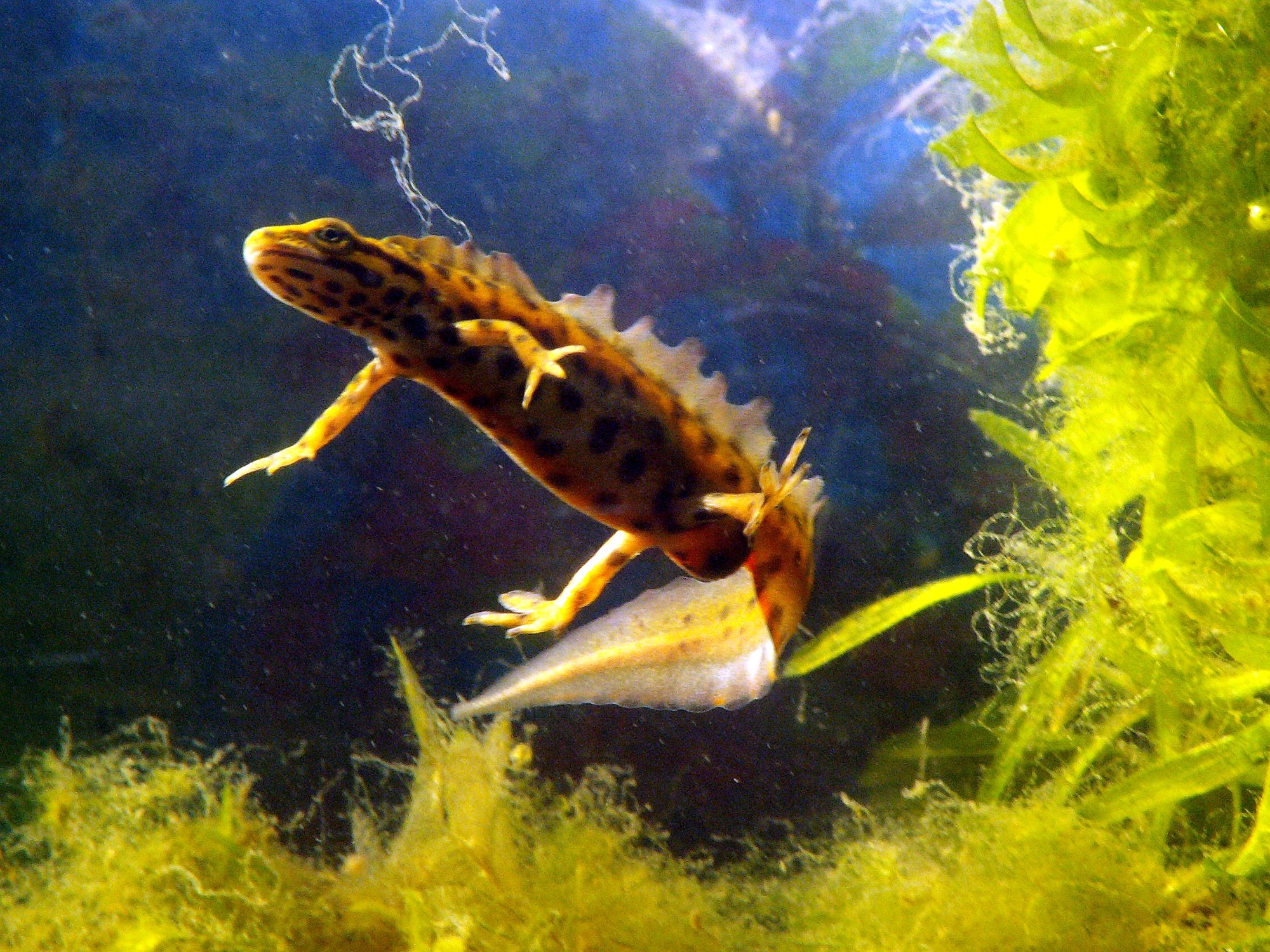
Smooth newt (Lissotriton vulgaris)
Amphibians · Difficulty: Intermediate
Key facts and care guidance for Smooth newt (Lissotriton vulgaris) (origin: Europe (Ireland and Britain to the Caucasus); the commonest newt species in Germany). Adult size around 7–11 cm (males in the aquatic phase have a wavy dorsal crest). Life expectancy approx. 10–15 years (sometimes up to ~20 in captivity). The values below are carefully researched guidance.
Short answers
Smooth newt: How big does the enclosure need to be?
An aqua-terrarium with a water and land section; from ~60–80 cm in length for a small group; densely planted, structured and without fish.
Smooth newt: What temperature does it need?
Daytime cool: 15–20 °C (never permanently above 22 °C), at night 10–18 °C.
Smooth newt: Does it need UVB lighting?
UVB: No strong UVB needed; subdued light is enough.
Smooth newt: How long do they live?
Life expectancy: approx. 10–15 years (sometimes up to ~20 in captivity).
Smooth newt: Is it suitable for beginners?
Rather not – it is considered an intermediate species (difficulty: Intermediate).
Climate
- Daytime temperature
- cool: 15–20 °C (never permanently above 22 °C)
- Night temperature
- 10–18 °C
- Basking spot
- —
- Humidity
- high (land phase humid); in the water phase, in the water
- UVB
- No strong UVB needed; subdued light is enough
Enclosure
- Minimum size
- an aqua-terrarium with a water and land section; from ~60–80 cm in length for a small group; densely planted, structured and without fish
- Substrate
- Land section: damp soil, moss and leaf litter with hides; water section: fine sand or gravel, densely planted
Feeding
- Food
- Aquatic phase: mosquito larvae, daphnia, tubifex, freshwater shrimp; land phase: small insects, worms, isopods
- Feeding interval
- 2–3×/week
Key facts
- Adult size
- 7–11 cm (males in the aquatic phase have a wavy dorsal crest)
- Life expectancy
- approx. 10–15 years (sometimes up to ~20 in captivity)
- Origin
- Europe (Ireland and Britain to the Caucasus); the commonest newt species in Germany
- Protection status
- A native species, SPECIALLY PROTECTED (German nature conservation law with the Federal Species Protection Ordinance); taking or catching them in the wild is prohibited. Keep only legal captive-bred animals with proof of origin; mind any registration duty depending on your state.
- Brumation
- A winter rest is essential (about October to February, 4–8 °C, ~3–4 months); the seasonal shift between the aquatic and land phases must be simulated
- Cohabitation
- Group housing works well, smooth newts are sociable towards each other and not territorial. Keep only similarly sized animals of the same species in a large enough, fish-free tank (at least 60x40x40 cm for four adults); fish eat spawn and larvae and must not be kept together with them.
Notes
A native protected species – legally tricky, and only captive-bred animals with documentation. Cool conditions are essential (room temperature is often too warm in summer). The seasonal rhythm (aquatic and terrestrial phases, a winter rest) has to be reproduced. Delicate skin – avoid handling.
Do you keep this species?
Add your animal to Reptoria – Reptoria reminds you about feeding and shedding. Add your animal for free →
Look for Smooth newt (Lissotriton vulgaris) in the marketplace →
Related species
- Palmate newt (Lissotriton helveticus) – Intermediate
- Bosca's newt (Lissotriton boscai) – Intermediate
- Italian crested newt (Triturus carnifex) – Intermediate
- Alpine salamander (Salamandra atra) – Expert
- Anderson's crocodile newt (Echinotriton andersoni) – Expert
- Anderson's salamander (Ambystoma andersoni) – Intermediate
- Axolotl (Ambystoma mexicanum) – Beginner to intermediate
- Alpine newt (Ichthyosaura alpestris) – Beginner
What you need to start
To keep Smooth newt (Lissotriton vulgaris) you typically need: a suitable enclosure (an aqua-terrarium with a water and land section; from ~60–80 cm in length for a small group; densely planted, structured and without fish), substrate (Land section: damp soil, moss and leaf litter with hides; water section: fine sand or gravel, densely planted), a heat source with a thermostat, UVB lighting, thermometer and hygrometer, a water dish and hides. You will find equipment in the Reptoria marketplace.
The complete, interactive care database is in the Reptoria app.
Last updated: 9 October 2026 · Editor: Reptoria editorial team · Sources include: https://de.wikipedia.org/wiki/Teichmolch, https://en.wikipedia.org/wiki/Smooth_newt, https://herz-fuer-tiere.de/haustiere/aquaristik-terraristik/molche/vergesellschaftung-von-molchen, https://species.wikimedia.org/wiki/Lissotriton_vulgaris, https://www.petbook.de/aquarium-terrarium/wie-kann-man-molchen-ein-artgerechtes-zuhause-bieten
All values are non-binding guidance and do not replace expert advice. Research thoroughly from several sources before acquiring and keeping an animal, and observe the applicable law (species and animal protection in particular).