Striped bark scorpion (Centruroides vittatus)
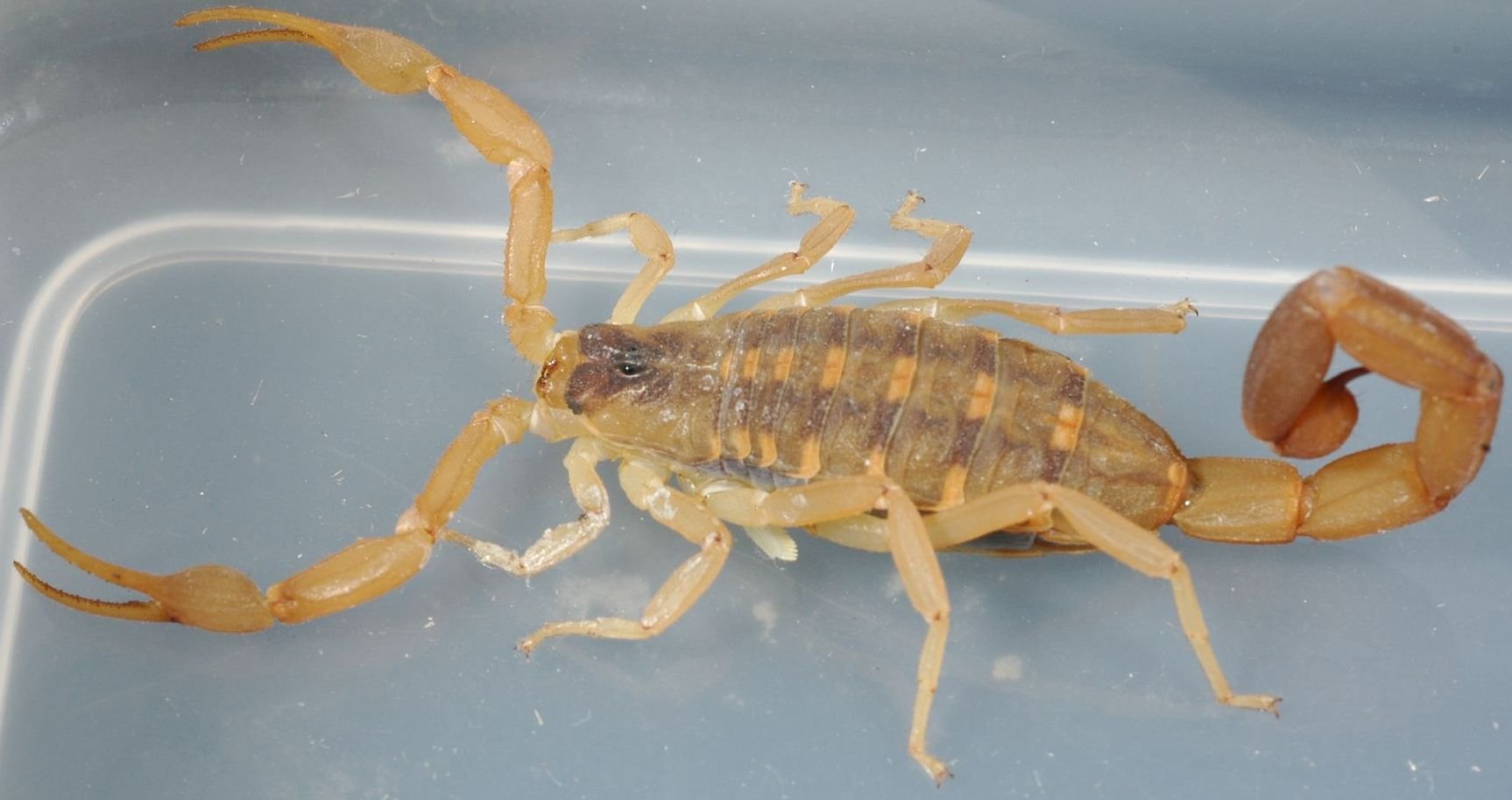
Invertebrates · Difficulty: Intermediate
Key facts and care guidance for Striped bark scorpion (Centruroides vittatus) (origin: The southern USA (Texas among others), northern Mexico). Adult size around approx. 5–7 cm. Life expectancy approx. 4–6 years (females longer). The values below are carefully researched guidance.
Short answers
Striped bark scorpion: How big does the enclosure need to be?
30×30×30 cm, with vertical climbing structures (a bark dweller).
Striped bark scorpion: What temperature does it need?
Daytime 22–29 °C, at night 18–22 °C (not below 18 °C).
Striped bark scorpion: Does it need UVB lighting?
UVB: No UVB needed (nocturnal).
Striped bark scorpion: How long do they live?
Life expectancy: approx. 4–6 years (females longer).
Striped bark scorpion: Is it suitable for beginners?
Rather not – it is considered an intermediate species (difficulty: Intermediate).
Climate
- Daytime temperature
- 22–29 °C
- Night temperature
- 18–22 °C (not below 18 °C)
- Basking spot
- —
- Humidity
- 40–50 % (rather dry, adaptable)
- UVB
- No UVB needed (nocturnal)
Enclosure
- Minimum size
- 30×30×30 cm, with vertical climbing structures (a bark dweller)
- Substrate
- Coarse sand or dry desert substrate, cork bark and stones as hides
Feeding
- Food
- House crickets, small crickets, small roaches
- Feeding interval
- adults 1×/week
Key facts
- Adult size
- approx. 5–7 cm
- Life expectancy
- approx. 4–6 years (females longer)
- Origin
- The southern USA (Texas among others), northern Mexico
- Protection status
- Not listed under CITES
- Brumation
- Not essential (an optional slightly cooler winter spell is possible)
- Cohabitation
- Keep singly – juveniles cannibalise each other according to Wikipedia, and while adults are largely neutral towards each other, group housing remains risky and is only justifiable with a lot of space and hides.
Notes
An excellent climber and escape artist – an absolutely escape-proof lid is needed. The venom is painful but usually not life-threatening medically. A buthid, and quick.
Do you keep this species?
Add your animal to Reptoria – Reptoria reminds you about feeding and shedding. Add your animal for free →
Look for Striped bark scorpion (Centruroides vittatus) in the marketplace →
Related species
- Giant desert hairy scorpion (Hadrurus arizonensis) – Beginner with some knowledge
- Asian giant forest scorpion (Heterometrus longimanus) – Beginner
- Asian black scorpion (Heterometrus petersii) – Beginner
- Asian forest scorpion (Heterometrus spinifer) – Intermediate
- Brazilian yellow scorpion (Tityus serrulatus) – Expert
- Dictator scorpion (Pandinus dictator) – Intermediate
- Italian scorpion (Euscorpius italicus) – Beginner
- Flat rock scorpion (Hadogenes troglodytes) – Intermediate
What you need to start
To keep Striped bark scorpion (Centruroides vittatus) you typically need: a suitable enclosure (30×30×30 cm, with vertical climbing structures (a bark dweller)), substrate (Coarse sand or dry desert substrate, cork bark and stones as hides), a heat source with a thermostat, UVB lighting, thermometer and hygrometer, a water dish and hides. You will find equipment in the Reptoria marketplace.
The complete, interactive care database is in the Reptoria app.
Last updated: 9 October 2026 · Editor: Reptoria editorial team · Sources include: https://en.wikipedia.org/wiki/Centruroides, https://en.wikipedia.org/wiki/Centruroides_vittatus
All values are non-binding guidance and do not replace expert advice. Research thoroughly from several sources before acquiring and keeping an animal, and observe the applicable law (species and animal protection in particular).