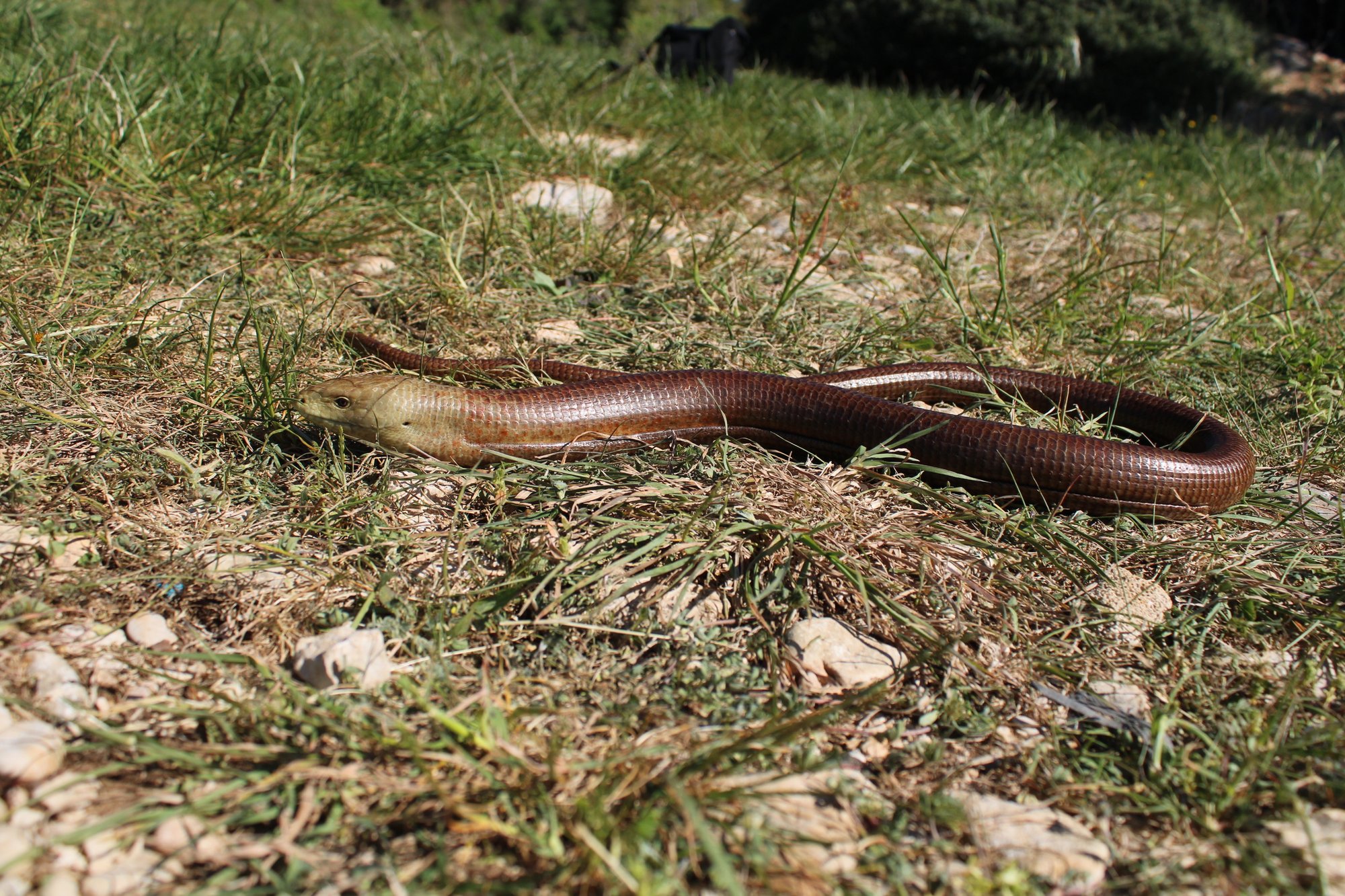
Thracian sheltopusik (Pseudopus apodus thracius)
Lizards · Difficulty: Intermediate
Key facts and care guidance for Thracian sheltopusik (Pseudopus apodus thracius) (origin: South-eastern Europe and the Balkans to the Near East and Central Asia; the subspecies thracius comes from the Balkans (Thrace). Dry, stony, scrubby slopes). Adult size around up to approx. 120 cm, rarely up to 135 cm total length (the largest anguid); with vestigial hind-limb stumps. Life expectancy 20–30 years, individuals over 50 years. The values below are carefully researched guidance.
Short answers
Thracian sheltopusik: How big does the enclosure need to be?
180×60×60 cm for one adult animal (wide and ground-oriented), larger is better.
Thracian sheltopusik: What temperature does it need?
Daytime 24–30 °C, basking spot 35–40 °C (basking spot), at night 18–22 °C.
Thracian sheltopusik: Does it need UVB lighting?
UVB: UVB needed (Ferguson zone 2–3, UV index 2–4).
Thracian sheltopusik: How long do they live?
Life expectancy: 20–30 years, individuals over 50 years.
Thracian sheltopusik: Is it suitable for beginners?
Rather not – it is considered an intermediate species (difficulty: Intermediate).
Climate
- Daytime temperature
- 24–30 °C
- Night temperature
- 18–22 °C
- Basking spot
- 35–40 °C (basking spot)
- Humidity
- 40–60 % during the day, 60–80 % at night
- UVB
- UVB needed (Ferguson zone 2–3, UV index 2–4)
Enclosure
- Minimum size
- 180×60×60 cm for one adult animal (wide and ground-oriented), larger is better
- Substrate
- A sand, loam and soil mix they can dig in, with stone slabs, roots, cork tubes and hiding places
Feeding
- Food
- Snails (preferred), earthworms, large insects, occasionally small rodents or chicks and a little fruit (an omnivorous tendency)
- Feeding interval
- adults 2–3×/week, juveniles more often
Key facts
- Adult size
- up to approx. 120 cm, rarely up to 135 cm total length (the largest anguid); with vestigial hind-limb stumps
- Life expectancy
- 20–30 years, individuals over 50 years
- Origin
- South-eastern Europe and the Balkans to the Near East and Central Asia; the subspecies thracius comes from the Balkans (Thrace). Dry, stony, scrubby slopes
- Protection status
- Not in CITES; no nationwide special requirements in Germany. Nationally protected in several countries of origin – prefer captive-bred animals with proof of origin
- Brumation
- A winter rest is recommended: about 2–4 months at 8–13 °C, in darkness (October/November to February/March), with 2–4 weeks of transition either side – it benefits vitality and breeding
- Cohabitation
- Keep them singly or as a 1.1 pair in a very large enclosure with visual barriers. NEVER keep males together (rival fights, especially in the mating season); separate them for the winter rest or if aggression appears
Notes
A robust, powerful species with a very hard bite (snail-cracking jaws) – it can bite hard under stress, but is non-venomous. A large floor area and stable furnishing are needed. A common mistake: too small a terrarium and no winter rest. Lighting about 14 h in summer / 10 h in winter.
Do you keep this species?
Add your animal to Reptoria – Reptoria reminds you about feeding and shedding. Add your animal for free →
Look for Thracian sheltopusik (Pseudopus apodus thracius) in the marketplace →
Related species
- Sheltopusik (Pseudopus apodus) – Beginner to intermediate
- Madrean alligator lizard (Elgaria kingii) – Intermediate
- Asian glass lizard (Dopasia gracilis) – Intermediate
- Slow worm (Anguis fragilis) – Intermediate
- Hart's glass lizard (Dopasia harti) – Intermediate
- Italian slow worm (Anguis veronensis) – Intermediate
- California legless lizard (Anniella pulchra) – Intermediate
- Moroccan glass lizard (Ophisaurus koellikeri) – Intermediate
What you need to start
To keep Thracian sheltopusik (Pseudopus apodus thracius) you typically need: a suitable enclosure (180×60×60 cm for one adult animal (wide and ground-oriented), larger is better), substrate (A sand, loam and soil mix they can dig in, with stone slabs, roots, cork tubes and hiding places), a heat source with a thermostat, UVB lighting, thermometer and hygrometer, a water dish and hides. You will find equipment in the Reptoria marketplace.
The complete, interactive care database is in the Reptoria app.
Last updated: 30 October 2026 · Editor: Reptoria editorial team · Sources include: https://en.wikipedia.org/wiki/European_glass_lizard, https://reptile-database.reptarium.cz/species?genus=Pseudopus&species=apodus
All values are non-binding guidance and do not replace expert advice. Research thoroughly from several sources before acquiring and keeping an animal, and observe the applicable law (species and animal protection in particular).