Anthony's poison arrow frog (Epipedobates anthonyi)
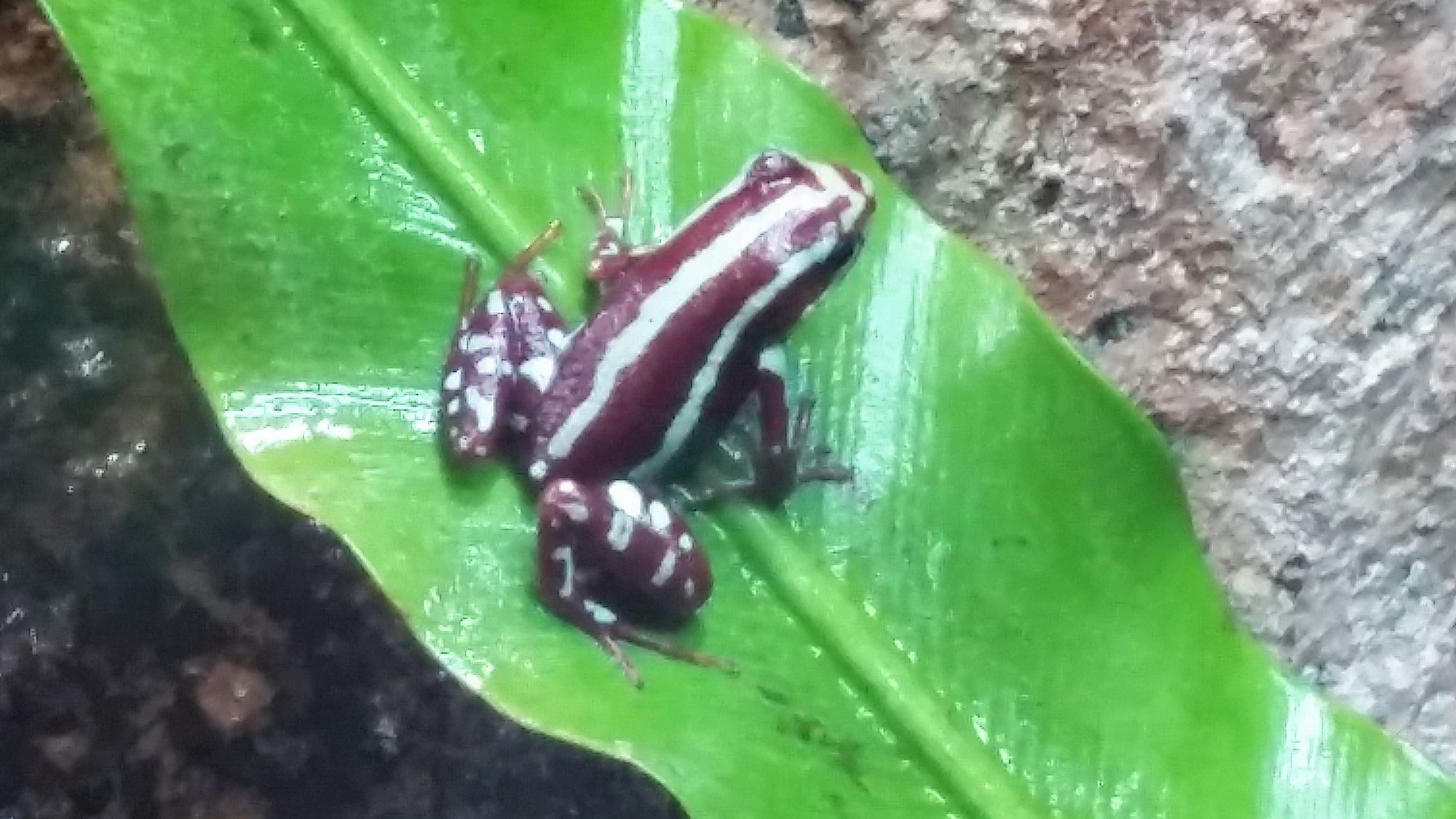
Amphibians · Difficulty: Beginner
Key facts and care guidance for Anthony's poison arrow frog (Epipedobates anthonyi) (origin: South-western Ecuador (the provinces of El Oro and Azuay) and north-western Peru (not to be confused with Epipedobates tricolor)). Adult size around approx. 2–2.5 cm (small). Life expectancy approx. 10–15 years. The values below are carefully researched guidance.
Short answers
Anthony's poison arrow frog: How big does the enclosure need to be?
A rainforest enclosure from 40×40×40 cm for a pair; from ~50×50×50 cm for a small group (larger is better).
Anthony's poison arrow frog: What temperature does it need?
Daytime 22–26 °C (up to ~27 °C), at night 20–22 °C.
Anthony's poison arrow frog: Does it need UVB lighting?
UVB: Weak UVB optional; not essential.
Anthony's poison arrow frog: How long do they live?
Life expectancy: approx. 10–15 years.
Anthony's poison arrow frog: Is it suitable for beginners?
Yes – it is considered suitable for beginners (difficulty: Beginner).
Climate
- Daytime temperature
- 22–26 °C (up to ~27 °C)
- Night temperature
- 20–22 °C
- Basking spot
- —
- Humidity
- 70–90 % by day, up to 100 % at night
- UVB
- Weak UVB optional; not essential
Enclosure
- Minimum size
- a rainforest enclosure from 40×40×40 cm for a pair; from ~50×50×50 cm for a small group (larger is better)
- Substrate
- A drainage layer plus forest floor or coco, moss, leaf litter, dense planting, plenty of hides and visual barriers
Feeding
- Food
- Fruit flies, springtails, micro crickets, aphids, isopods – supplemented and dusted with calcium
- Feeding interval
- adults several times a week (~3×), juveniles daily or more often
Key facts
- Adult size
- approx. 2–2.5 cm (small)
- Life expectancy
- approx. 10–15 years
- Origin
- South-western Ecuador (the provinces of El Oro and Azuay) and north-western Peru (not to be confused with Epipedobates tricolor)
- Protection status
- CITES Appendix II / EU Species Protection Regulation Annex B; proof of origin and registration are required
- Brumation
- No winter rest; possibly simulate a rainy season to stimulate breeding
- Cohabitation
- In pairs or as a small group of one male and two females is the least stressful option. Larger groups, including several males, are possible for this sociable species in large, heavily structured enclosures (about six animals from 60–80 cm length); drawback: males wrestle over territories and females can also be territorial, so suppressed animals must be removed promptly. Only animals of the same species and similar size; do not mix species.
Notes
Diurnal, and loud callers (the males). Non-toxic in captivity (the toxin comes from wild food). Often listed in the trade as "Epipedobates tricolor" – the widespread terrarium form is usually in fact anthonyi. Common mistakes: too little structure or visual screening → aggression, and size differences.
Do you keep this species?
Add your animal to Reptoria – Reptoria reminds you about feeding and shedding. Add your animal for free →
Look for Anthony's poison arrow frog (Epipedobates anthonyi) in the marketplace →
Related species
- Phantasmal poison frog (Epipedobates tricolor) – Beginner to intermediate
- Yellow-bellied poison frog (Ameerega hahneli) – Intermediate
- Anthony's poison frog (Hyloxalus nexipus) – Intermediate
- Bassler's poison frog (Ameerega bassleri) – Intermediate
- Poison frogs (Ranitomeya amazonica) – Intermediate
- Poison frogs (Ranitomeya imitator) – Beginner to intermediate
- Poison frogs (Ranitomeya variabilis) – Intermediate
- Blue poison dart frog (Dendrobates azureus) – Beginner to intermediate
What you need to start
To keep Anthony's poison arrow frog (Epipedobates anthonyi) you typically need: a suitable enclosure (a rainforest enclosure from 40×40×40 cm for a pair; from ~50×50×50 cm for a small group (larger is better)), substrate (A drainage layer plus forest floor or coco, moss, leaf litter, dense planting, plenty of hides and visual barriers), a heat source with a thermostat, UVB lighting, thermometer and hygrometer, a water dish and hides. You will find equipment in the Reptoria marketplace.
The complete, interactive care database is in the Reptoria app.
Last updated: 9 October 2026 · Editor: Reptoria editorial team · Sources include: https://de.wikipedia.org/wiki/Epipedobates_anthonyi, https://en.wikipedia.org/wiki/Anthony%27s_poison_arrow_frog, https://www.alismenagerie.co.uk/care/reptiles-and-amphibians/phantasmal-poison-dart-frog-care
All values are non-binding guidance and do not replace expert advice. Research thoroughly from several sources before acquiring and keeping an animal, and observe the applicable law (species and animal protection in particular).