Brown basilisk (Basiliscus vittatus)
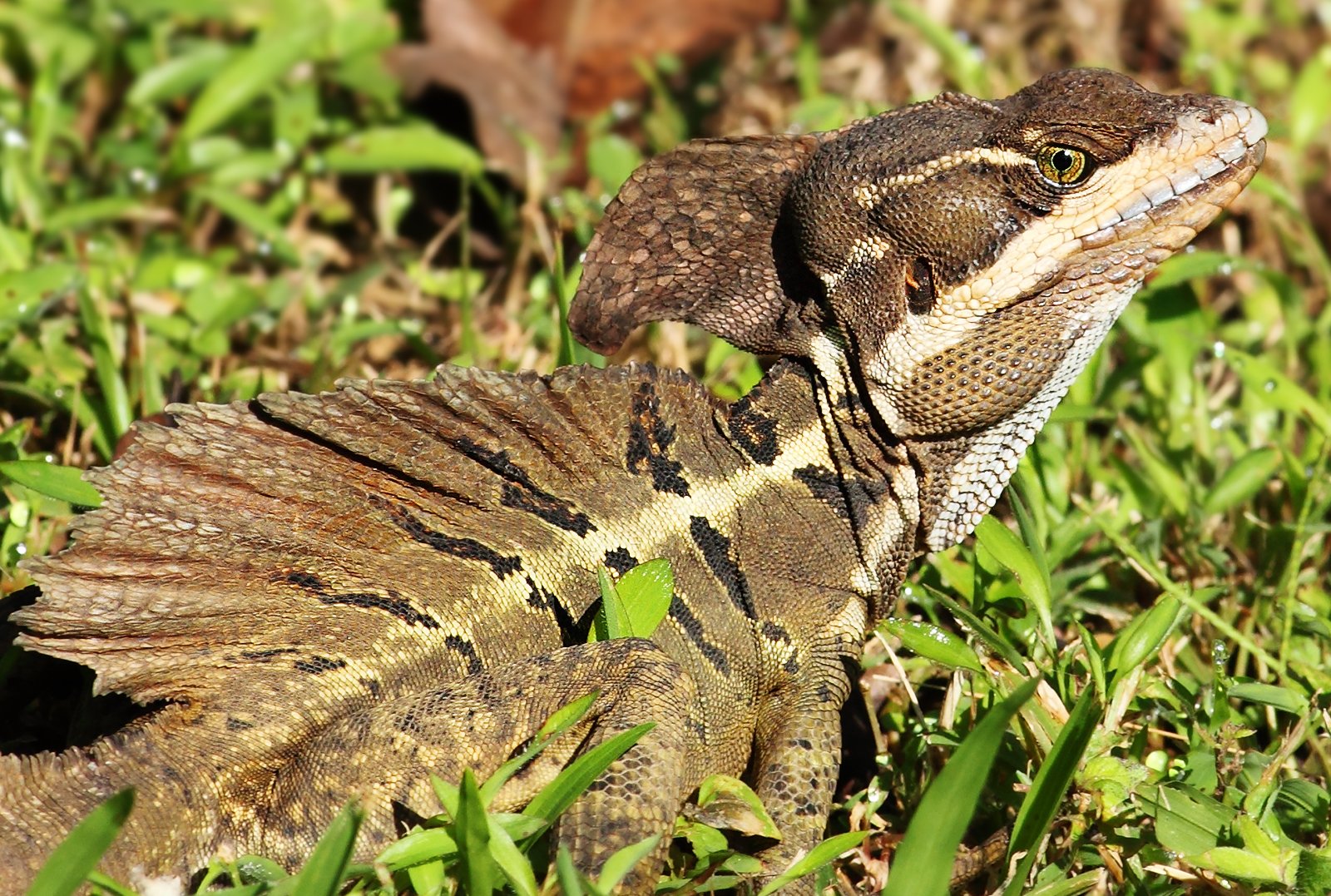
Iguanas · Difficulty: Intermediate
Key facts and care guidance for Brown basilisk (Basiliscus vittatus) (origin: Central America (Mexico to Colombia)). Adult size around Up to ~75 cm total length (SVL ~26 cm). Life expectancy ~7–10 years. The values below are carefully researched guidance.
Short answers
Brown basilisk: How big does the enclosure need to be?
A pair at least 150×80×150 cm (rainforest, with a large bathing spot).
Brown basilisk: What temperature does it need?
Daytime 26–28 °C, basking spot Basking spot 35–40 °C, at night ~22 °C.
Brown basilisk: Does it need UVB lighting?
UVB: Essential.
Brown basilisk: How long do they live?
Life expectancy: ~7–10 years.
Brown basilisk: Is it suitable for beginners?
Rather not – it is considered an intermediate species (difficulty: Intermediate).
Climate
- Daytime temperature
- 26–28 °C
- Night temperature
- ~22 °C
- Basking spot
- Basking spot 35–40 °C
- Humidity
- 70–90 %
- UVB
- Essential
Enclosure
- Minimum size
- a pair at least 150×80×150 cm (rainforest, with a large bathing spot)
- Substrate
- Damp forest floor (soil and coco) with leaf litter
Feeding
- Food
- Mostly insects, also plant food and small vertebrates
- Feeding interval
- Adults several times a week
Key facts
- Adult size
- Up to ~75 cm total length (SVL ~26 cm)
- Life expectancy
- ~7–10 years
- Origin
- Central America (Mexico to Colombia)
- Protection status
- —
- Brumation
- None
- Cohabitation
- Keep in pairs or as a harem: one male with several females works, since females generally tolerate each other but each need their own basking and hiding spots; feed separately if there is a size difference. Several males, however, do not get along — they fight over territory and basking spots until one is injured or permanently pushed into a corner.
Notes
Skittish and fond of running — it needs a large, solidly furnished terrarium with a big water and bathing area (it likes to swim and dive).
Do you keep this species?
Add your animal to Reptoria – Reptoria reminds you about feeding and shedding. Add your animal for free →
Look for Brown basilisk (Basiliscus vittatus) in the marketplace →
Related species
- Plumed basilisk (Basiliscus plumifrons) – Intermediate
- Common basilisk (Basiliscus basiliscus) – Intermediate
- Red-headed basilisk (Basiliscus galeritus) – Expert
- Serrated casquehead iguana (Laemanctus serratus) – Intermediate
- Hernandez's helmeted basilisk (Corytophanes hernandesii) – Expert
- Eastern casquehead iguana (Laemanctus longipes) – Intermediate
- Ghost anole (Anolis lemurinus) – Intermediate
- Aguero's false chameleon (Chamaeleolis agueroi) – Intermediate
What you need to start
To keep Brown basilisk (Basiliscus vittatus) you typically need: a suitable enclosure (a pair at least 150×80×150 cm (rainforest, with a large bathing spot)), substrate (Damp forest floor (soil and coco) with leaf litter), a heat source with a thermostat, UVB lighting, thermometer and hygrometer, a water dish and hides. You will find equipment in the Reptoria marketplace.
The complete, interactive care database is in the Reptoria app.
Last updated: 9 October 2026 · Editor: Reptoria editorial team · Sources include: https://de.wikipedia.org/wiki/Streifenbasilisk, https://reptile-database.reptarium.cz/species?genus=Basiliscus&species=vittatus
All values are non-binding guidance and do not replace expert advice. Research thoroughly from several sources before acquiring and keeping an animal, and observe the applicable law (species and animal protection in particular).