Plumed basilisk (Basiliscus plumifrons)
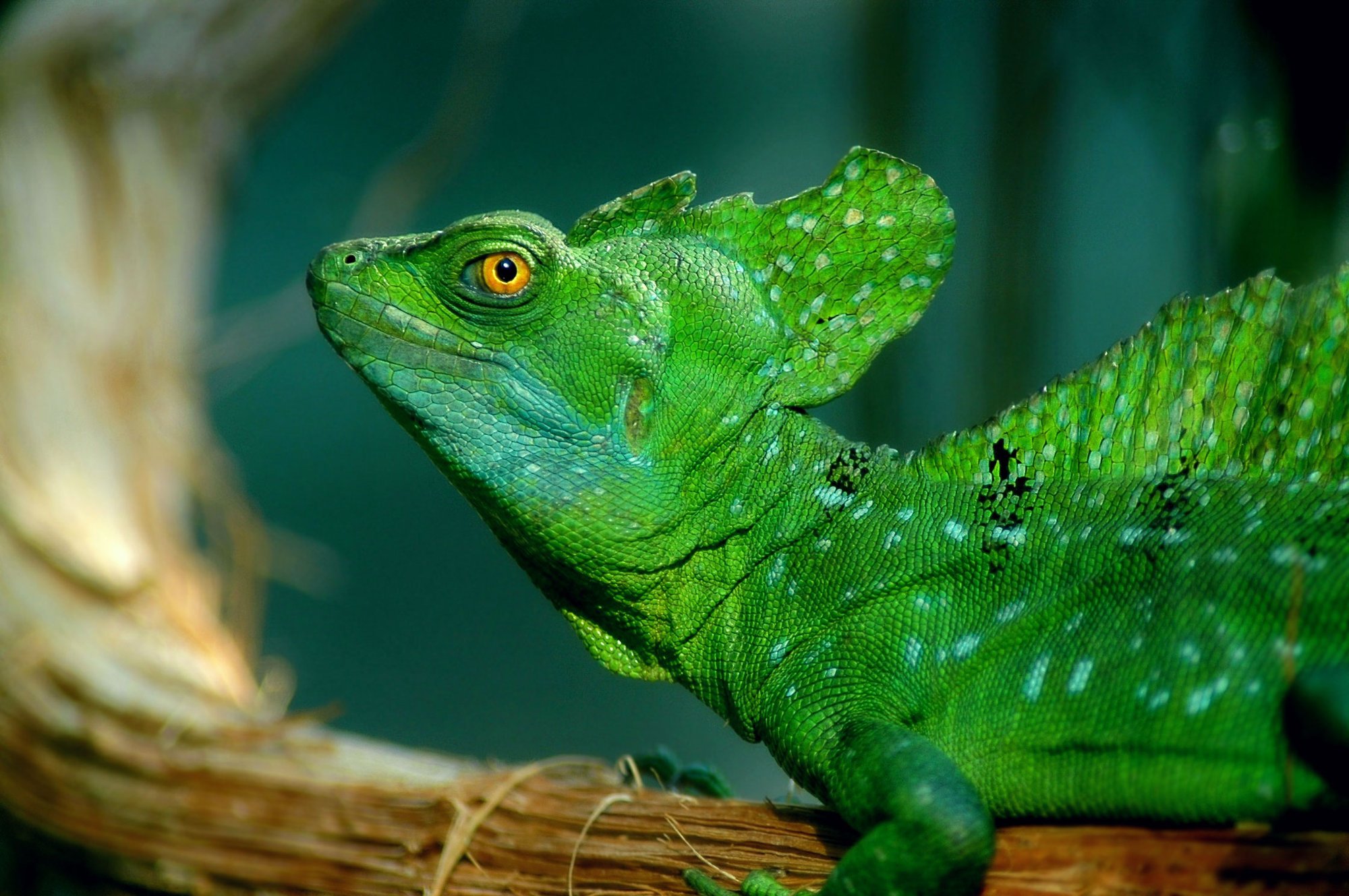
Iguanas · Difficulty: Intermediate
Key facts and care guidance for Plumed basilisk (Basiliscus plumifrons) (origin: Central America (southern Nicaragua, Costa Rica, Panama, eastern Honduras)). Adult size around 70–90 cm total length including the tail (SVL approx. 17–24 cm). Life expectancy approx. 8–12 years (often 5–8, rarely over 10). The values below are carefully researched guidance.
Short answers
Plumed basilisk: How big does the enclosure need to be?
120×90×150 cm (tall format) for one adult animal; considerably larger is better, a pair or group from ~200×150×230 cm.
Plumed basilisk: What temperature does it need?
Daytime 26–30 °C, basking spot 35–40 °C, at night 20–22 °C.
Plumed basilisk: Does it need UVB lighting?
UVB: UVB needed (a UVA/UVB lamp, Ferguson zone 2, UV index approx. 2–3).
Plumed basilisk: How long do they live?
Life expectancy: approx. 8–12 years (often 5–8, rarely over 10).
Plumed basilisk: Is it suitable for beginners?
Rather not – it is considered an intermediate species (difficulty: Intermediate).
Climate
- Daytime temperature
- 26–30 °C
- Night temperature
- 20–22 °C
- Basking spot
- 35–40 °C
- Humidity
- 70–80 % by day, up to 90–100 % at night
- UVB
- UVB needed (a UVA/UVB lamp, Ferguson zone 2, UV index approx. 2–3)
Enclosure
- Minimum size
- 120×90×150 cm (tall format) for one adult animal; considerably larger is better, a pair or group from ~200×150×230 cm
- Substrate
- A damp forest-floor or coco humus and soil mix with leaf litter; a large, clean water section is essential
Feeding
- Food
- Insects (crickets, locusts, roaches, wax moths, superworms), occasionally fish, pinkies or chicks; a little fruit and greens
- Feeding interval
- adults 2–3×/week, juveniles daily
Key facts
- Adult size
- 70–90 cm total length including the tail (SVL approx. 17–24 cm)
- Life expectancy
- approx. 8–12 years (often 5–8, rarely over 10)
- Origin
- Central America (southern Nicaragua, Costa Rica, Panama, eastern Honduras)
- Protection status
- Not listed under CITES, no special protected status in the EU; no registration duty
- Brumation
- No winter rest; possibly a slightly drier spell of 3–4 months
- Cohabitation
- Keep them singly; only in very large enclosures one male plus several females (a harem). NEVER keep males together (territorial, with territorial fights)
Notes
Very shy and nervous; in a panic it runs into the glass and injures its snout → plenty of height, dense planting, visual barriers. A large heated water section (for bathing and escape) is essential. The females need a laying site. A high space and humidity requirement.
Do you keep this species?
Add your animal to Reptoria – Reptoria reminds you about feeding and shedding. Add your animal for free →
Look for Plumed basilisk (Basiliscus plumifrons) in the marketplace →
Related species
- Brown basilisk (Basiliscus vittatus) – Intermediate
- Common basilisk (Basiliscus basiliscus) – Intermediate
- Red-headed basilisk (Basiliscus galeritus) – Expert
- Serrated casquehead iguana (Laemanctus serratus) – Intermediate
- Hernandez's helmeted basilisk (Corytophanes hernandesii) – Expert
- Eastern casquehead iguana (Laemanctus longipes) – Intermediate
- Ghost anole (Anolis lemurinus) – Intermediate
- Aguero's false chameleon (Chamaeleolis agueroi) – Intermediate
What you need to start
To keep Plumed basilisk (Basiliscus plumifrons) you typically need: a suitable enclosure (120×90×150 cm (tall format) for one adult animal; considerably larger is better, a pair or group from ~200×150×230 cm), substrate (A damp forest-floor or coco humus and soil mix with leaf litter; a large, clean water section is essential), a heat source with a thermostat, UVB lighting, thermometer and hygrometer, a water dish and hides. You will find equipment in the Reptoria marketplace.
The complete, interactive care database is in the Reptoria app.
Last updated: 9 October 2026 · Editor: Reptoria editorial team · Sources include: https://de.wikipedia.org/wiki/Stirnlappenbasilisk, https://reptile-database.reptarium.cz/species?genus=Basiliscus&species=plumifrons
All values are non-binding guidance and do not replace expert advice. Research thoroughly from several sources before acquiring and keeping an animal, and observe the applicable law (species and animal protection in particular).