Diamondback terrapin (Malaclemys terrapin)
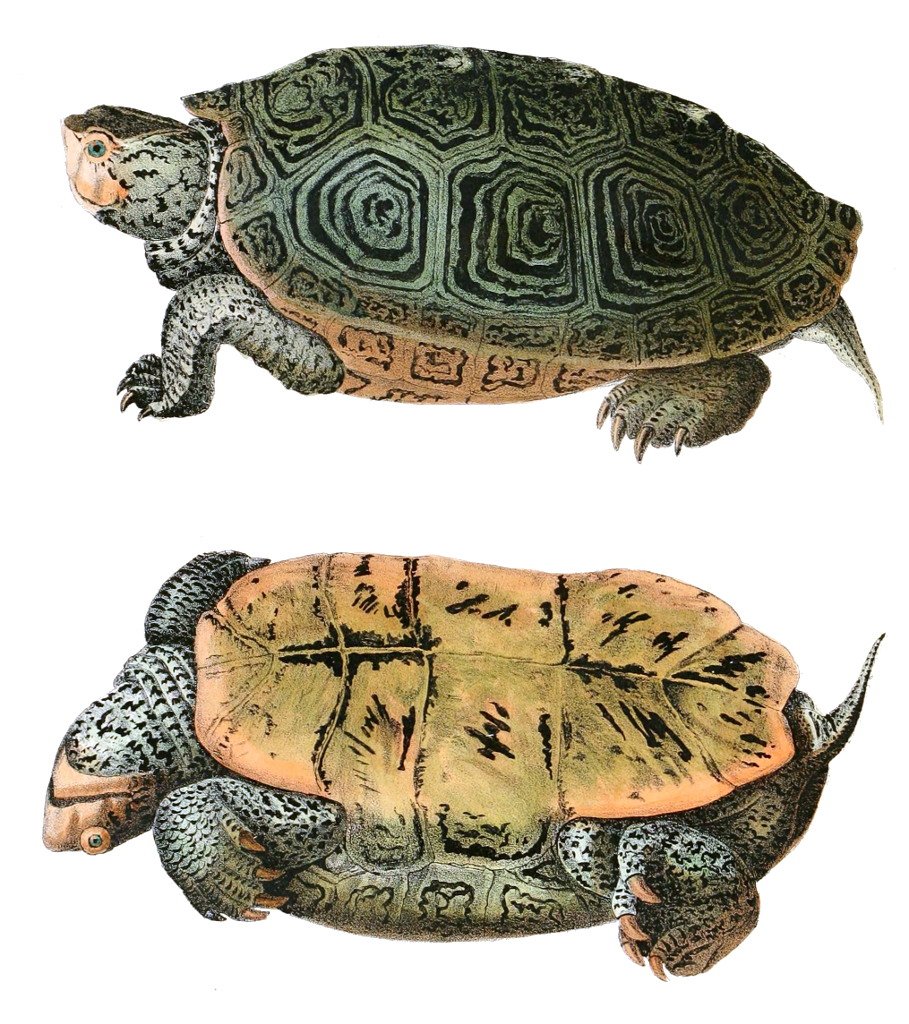
Turtles & tortoises · Difficulty: Intermediate
Key facts and care guidance for Diamondback terrapin (Malaclemys terrapin) (origin: The Atlantic and Gulf coasts of the USA (Cape Cod to Texas); a brackish and salt-water coastal species). Adult size around males 10–14 cm, females 20–24 cm (a strong size dimorphism). Life expectancy 25–40+ years. The values below are carefully researched guidance.
Short answers
Diamondback terrapin: How big does the enclosure need to be?
120×60×60 cm for 1–2 females (water ~50 cm); adult males from ~100 cm.
Diamondback terrapin: What temperature does it need?
Daytime water 26–28 °C (summer), basking spot 30–35 °C, at night 20–24 °C.
Diamondback terrapin: Does it need UVB lighting?
UVB: UVB needed (basks a lot, Ferguson zone 2–3).
Diamondback terrapin: How long do they live?
Life expectancy: 25–40+ years.
Diamondback terrapin: Is it suitable for beginners?
Rather not – it is considered an intermediate species (difficulty: Intermediate).
Climate
- Daytime temperature
- water 26–28 °C (summer)
- Night temperature
- 20–24 °C
- Basking spot
- 30–35 °C
- Humidity
- — (aquatic)
- UVB
- UVB needed (basks a lot, Ferguson zone 2–3)
Enclosure
- Minimum size
- 120×60×60 cm for 1–2 females (water ~50 cm); adult males from ~100 cm
- Substrate
- Usually bare-bottomed; a sand land section for egg-laying (females); a cork island as a basking spot
Feeding
- Food
- Carnivorous: snails, mussels, crustaceans, fish, worms, insects; always offer a cuttlebone or calcium
- Feeding interval
- adults 2–3×/week, juveniles daily at first, then ~4×/week
Key facts
- Adult size
- males 10–14 cm, females 20–24 cm (a strong size dimorphism)
- Life expectancy
- 25–40+ years
- Origin
- The Atlantic and Gulf coasts of the USA (Cape Cod to Texas); a brackish and salt-water coastal species
- Protection status
- CITES Appendix II / EU Annex B – registration required, proof of origin. IUCN: Vulnerable.
- Brumation
- Yes – for animals of northern origin a winter rest from about December to March at 7–10 °C.
- Cohabitation
- Solitary housing is the least stressful option. In large tanks all-female groups or a trio (one male, several females) are also possible; males harass the much larger females during courtship and become aggressive towards each other, so never keep several males together.
Notes
A peculiarity: naturally an inhabitant of brackish and salt water. If an animal is kept in brackish or salt water from the start, this has to be continued permanently (otherwise skin and shell damage); captive-bred animals are often kept in fresh water. It needs a calcium source (cuttlebone). A common mistake: moving wild-caught animals into fresh water.
Do you keep this species?
Add your animal to Reptoria – Reptoria reminds you about feeding and shedding. Add your animal for free →
Look for Diamondback terrapin (Malaclemys terrapin) in the marketplace →
Related species
- Balkan terrapin (Mauremys rivulata) – Intermediate
- European pond turtle (Emys orbicularis) – Intermediate
- Ligurian pond turtle (Emys orbicularis galloitalica) – Intermediate
- Mediterranean pond turtle (Mauremys leprosa) – Intermediate
- Bog turtle (Glyptemys muhlenbergii) – Expert
- Sicilian pond turtle (Emys trinacris) – Intermediate
- Spotted turtle (Clemmys guttata) – Intermediate
- Wood turtle (Glyptemys insculpta) – Intermediate
What you need to start
To keep Diamondback terrapin (Malaclemys terrapin) you typically need: a suitable enclosure (120×60×60 cm for 1–2 females (water ~50 cm); adult males from ~100 cm), substrate (Usually bare-bottomed; a sand land section for egg-laying (females); a cork island as a basking spot), a heat source with a thermostat, UVB lighting, thermometer and hygrometer, a water dish and hides. You will find equipment in the Reptoria marketplace.
The complete, interactive care database is in the Reptoria app.
Last updated: 30 October 2026 · Editor: Reptoria editorial team · Sources include: https://en.wikipedia.org/wiki/Diamondback_terrapin, https://reptile-database.reptarium.cz/species?genus=Malaclemys&species=terrapin, https://theturtlesource.com/diamondback-terrapin-care-sheet/
All values are non-binding guidance and do not replace expert advice. Research thoroughly from several sources before acquiring and keeping an animal, and observe the applicable law (species and animal protection in particular).