Sicilian pond turtle (Emys trinacris)
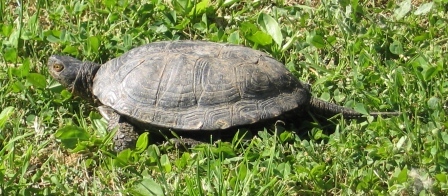
Turtles & tortoises · Difficulty: Intermediate
Key facts and care guidance for Sicilian pond turtle (Emys trinacris) (origin: Endemic to Sicily (ponds, lakes, slow rivers, marshes)). Adult size around ~14–17 cm shell length (females larger). Life expectancy 40–60+ years (long-lived, comparable to Emys orbicularis). The values below are carefully researched guidance.
Short answers
Sicilian pond turtle: How big does the enclosure need to be?
~100–120×50×50 cm aqua-terrarium with a basking spot plus a sandy land section for egg-laying.
Sicilian pond turtle: What temperature does it need?
Daytime water 22–26 °C (summer), basking spot 30–35 °C, at night 18–20 °C.
Sicilian pond turtle: Does it need UVB lighting?
UVB: UVB needed (Ferguson zone 2–3, UV index 2–4).
Sicilian pond turtle: How long do they live?
Life expectancy: 40–60+ years (long-lived, comparable to Emys orbicularis).
Sicilian pond turtle: Is it suitable for beginners?
Rather not – it is considered an intermediate species (difficulty: Intermediate).
Climate
- Daytime temperature
- water 22–26 °C (summer)
- Night temperature
- 18–20 °C
- Basking spot
- 30–35 °C
- Humidity
- — (aquatic)
- UVB
- UVB needed (Ferguson zone 2–3, UV index 2–4)
Enclosure
- Minimum size
- ~100–120×50×50 cm aqua-terrarium with a basking spot plus a sandy land section for egg-laying
- Substrate
- Sand or fine gravel, planted; a land section with sand for egg-laying
Feeding
- Food
- Mainly carnivorous: insects, worms, snails, fish, tadpoles; a few water plants
- Feeding interval
- adults 2–3×/week, juveniles more often
Key facts
- Adult size
- ~14–17 cm shell length (females larger)
- Life expectancy
- 40–60+ years (long-lived, comparable to Emys orbicularis)
- Origin
- Endemic to Sicily (ponds, lakes, slow rivers, marshes)
- Protection status
- Strictly protected: endemic to Sicily; Bern Convention; protected under Italian and EU law (as for Emys orbicularis, Habitats Directive Ann. II/IV). Taking from the wild is prohibited – only captive-bred animals with proof.
- Brumation
- Yes – brumation from about October or November to March at ~4–8 °C (Mediterranean, up to six months).
- Cohabitation
- Keep them singly, or a group of females in a large enclosure; territorial, and the males are aggressive and harass the females – never two males.
Notes
Split off as a species of its own in 2005; the care is derived from Emys orbicularis (barely any species-specific data). An endemic with a high need for protection, and illegal wild collection is a problem. The temperature figures are set conservatively at Mediterranean levels.
Do you keep this species?
Add your animal to Reptoria – Reptoria reminds you about feeding and shedding. Add your animal for free →
Look for Sicilian pond turtle (Emys trinacris) in the marketplace →
Related species
- European pond turtle (Emys orbicularis) – Intermediate
- Ligurian pond turtle (Emys orbicularis galloitalica) – Intermediate
- Balkan terrapin (Mauremys rivulata) – Intermediate
- Diamondback terrapin (Malaclemys terrapin) – Intermediate
- Mediterranean pond turtle (Mauremys leprosa) – Intermediate
- Bog turtle (Glyptemys muhlenbergii) – Expert
- Spotted turtle (Clemmys guttata) – Intermediate
- Wood turtle (Glyptemys insculpta) – Intermediate
What you need to start
To keep Sicilian pond turtle (Emys trinacris) you typically need: a suitable enclosure (~100–120×50×50 cm aqua-terrarium with a basking spot plus a sandy land section for egg-laying), substrate (Sand or fine gravel, planted; a land section with sand for egg-laying), a heat source with a thermostat, UVB lighting, thermometer and hygrometer, a water dish and hides. You will find equipment in the Reptoria marketplace.
The complete, interactive care database is in the Reptoria app.
Last updated: 30 October 2026 · Editor: Reptoria editorial team · Sources include: https://de.wikipedia.org/wiki/Sizilianische_Sumpfschildkr%C3%B6te, https://reptile-database.reptarium.cz/species?genus=Emys&species=trinacris
All values are non-binding guidance and do not replace expert advice. Research thoroughly from several sources before acquiring and keeping an animal, and observe the applicable law (species and animal protection in particular).