Spotted turtle (Clemmys guttata)
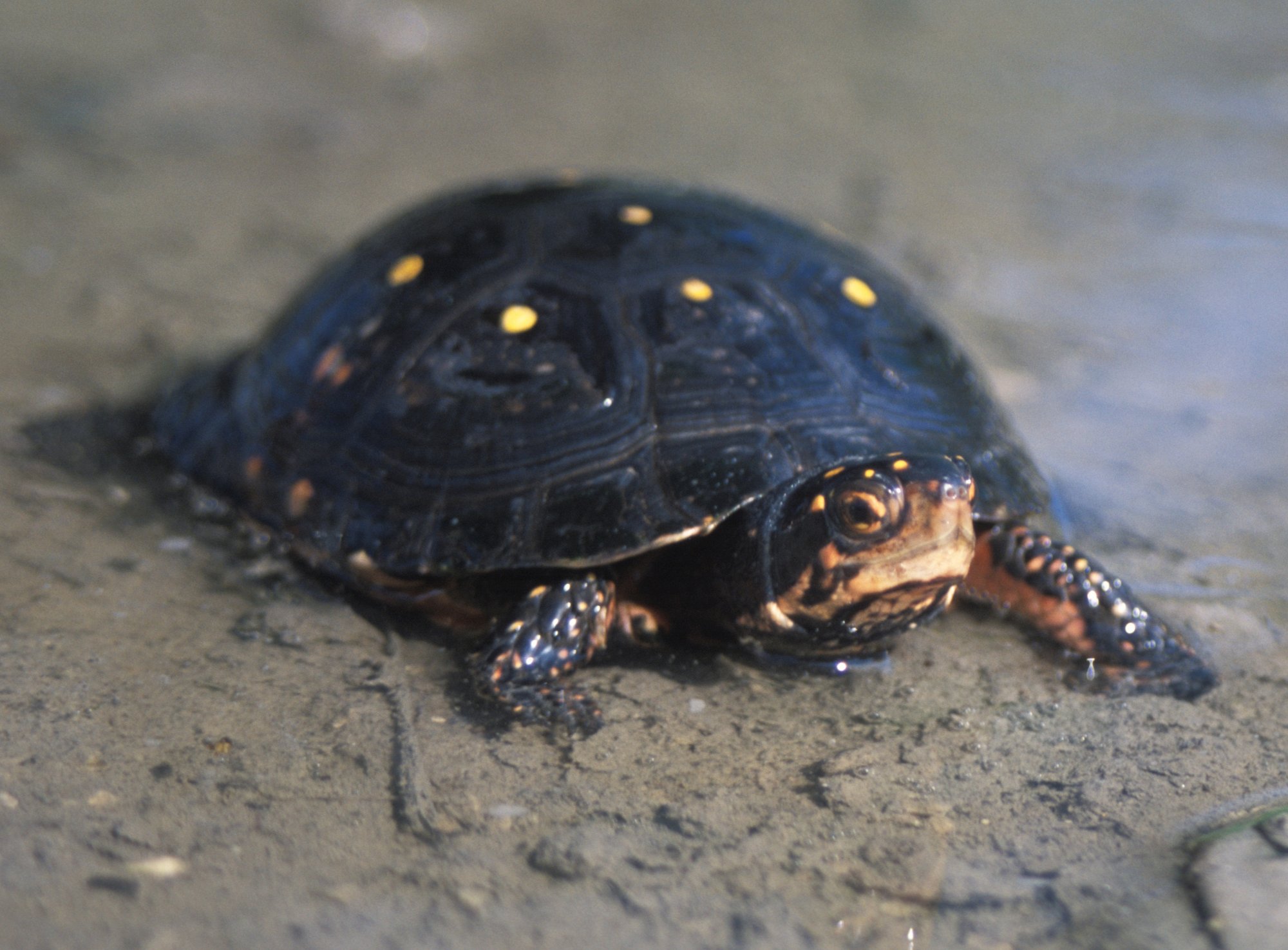
Turtles & tortoises · Difficulty: Intermediate
Key facts and care guidance for Spotted turtle (Clemmys guttata) (origin: Eastern North America (south-eastern Canada to Florida); shallow, cool waters). Adult size around 10–14 cm (a small species, females somewhat larger). Life expectancy very long-lived – usually 30–50, potentially up to 100+ years. The values below are carefully researched guidance.
Short answers
Spotted turtle: How big does the enclosure need to be?
~80×50×50 cm for one animal, shallow water (~20 cm) plus a land and basking spot.
Spotted turtle: What temperature does it need?
Daytime water 18–24 °C (cool, avoids heat), basking spot 28–32 °C, at night 15–18 °C.
Spotted turtle: Does it need UVB lighting?
UVB: UVB needed (Ferguson zone 2–3).
Spotted turtle: How long do they live?
Life expectancy: very long-lived – usually 30–50, potentially up to 100+ years.
Spotted turtle: Is it suitable for beginners?
Rather not – it is considered an intermediate species (difficulty: Intermediate).
Climate
- Daytime temperature
- water 18–24 °C (cool, avoids heat)
- Night temperature
- 15–18 °C
- Basking spot
- 28–32 °C
- Humidity
- — (aquatic)
- UVB
- UVB needed (Ferguson zone 2–3)
Enclosure
- Minimum size
- ~80×50×50 cm for one animal, shallow water (~20 cm) plus a land and basking spot
- Substrate
- Sand or soil, densely planted; shallow, still water
Feeding
- Food
- Omnivorous: worms, snails, insects, small fish, water plants and greens
- Feeding interval
- adults 2–3×/week, juveniles more often
Key facts
- Adult size
- 10–14 cm (a small species, females somewhat larger)
- Life expectancy
- very long-lived – usually 30–50, potentially up to 100+ years
- Origin
- Eastern North America (south-eastern Canada to Florida); shallow, cool waters
- Protection status
- CITES Appendix II / EU Annex B – registration required, proof of origin. IUCN: Endangered; protected in several US states.
- Brumation
- Yes – brumation of 8–12 weeks at ~4–7 °C; in addition they may aestivate in the heat of midsummer.
- Cohabitation
- Single housing. Both care sheets advise keeping only one animal per enclosure; males may fight in the wild, and females are harassed in the mating season. A pair or small group is only conceivable in very large, structured set-ups and ponds; the drawback is that males harass the females and several males fight each other.
Notes
A small, cool-loving species – NO tropical temperatures! Excessive warmth is a common and dangerous keeping mistake. A weak swimmer; it needs shallow water. An annual winter rest matters for health and reproduction.
Do you keep this species?
Add your animal to Reptoria – Reptoria reminds you about feeding and shedding. Add your animal for free →
Look for Spotted turtle (Clemmys guttata) in the marketplace →
Related species
- Balkan terrapin (Mauremys rivulata) – Intermediate
- Diamondback terrapin (Malaclemys terrapin) – Intermediate
- European pond turtle (Emys orbicularis) – Intermediate
- Ligurian pond turtle (Emys orbicularis galloitalica) – Intermediate
- Mediterranean pond turtle (Mauremys leprosa) – Intermediate
- Bog turtle (Glyptemys muhlenbergii) – Expert
- Sicilian pond turtle (Emys trinacris) – Intermediate
- Wood turtle (Glyptemys insculpta) – Intermediate
What you need to start
To keep Spotted turtle (Clemmys guttata) you typically need: a suitable enclosure (~80×50×50 cm for one animal, shallow water (~20 cm) plus a land and basking spot), substrate (Sand or soil, densely planted; shallow, still water), a heat source with a thermostat, UVB lighting, thermometer and hygrometer, a water dish and hides. You will find equipment in the Reptoria marketplace.
The complete, interactive care database is in the Reptoria app.
Last updated: 7 November 2026 · Editor: Reptoria editorial team · Sources include: Wikipedia: Spotted turtle – Inkubation 70–83 Tage – https://en.wikipedia.org/wiki/Spotted_turtle, Reptile Database: Clemmys guttata – oviparous, TSD (Cornejo-Páramo et al. 2020) – https://reptile-database.reptarium.cz/species?genus=Clemmys&species=guttata, https://animaldiversity.org/accounts/Clemmys_guttata/, https://dubiaroaches.com/blogs/turtle-care/spotted-turtle-care-sheet, https://en.wikipedia.org/wiki/Spotted_turtle
All values are non-binding guidance and do not replace expert advice. Research thoroughly from several sources before acquiring and keeping an animal, and observe the applicable law (species and animal protection in particular).