Fiji banded iguana (Brachylophus fasciatus)
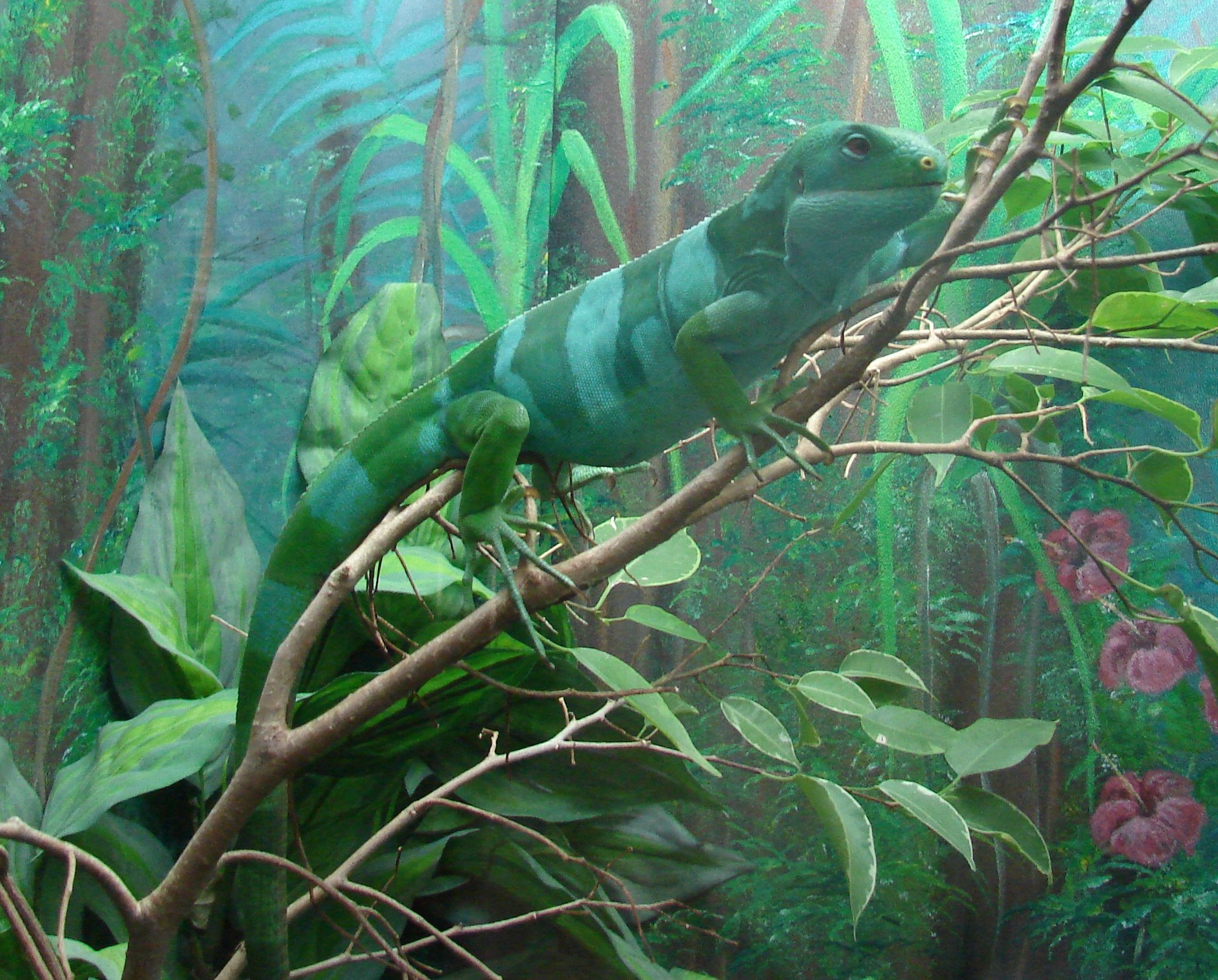
Iguanas · Difficulty: Expert
Key facts and care guidance for Fiji banded iguana (Brachylophus fasciatus) (origin: The Fiji Islands (Viti Levu, Vanua Levu), Tonga). Adult size around 60–75 cm total length including the tail (SVL 15–20 cm). Life expectancy 10–25 years. The values below are carefully researched guidance.
Short answers
Fiji banded iguana: How big does the enclosure need to be?
120×80×120 cm for one adult animal; a pair from 200×80×120 cm.
Fiji banded iguana: What temperature does it need?
Daytime 28–32 °C, basking spot 35–40 °C, at night 20–22 °C (not permanently below 15 °C).
Fiji banded iguana: Does it need UVB lighting?
UVB: UVB essential (an arboreal sun species, Ferguson zone 2–3).
Fiji banded iguana: How long do they live?
Life expectancy: 10–25 years.
Fiji banded iguana: Is it suitable for beginners?
No – better suited to experienced keepers (difficulty: Expert).
Climate
- Daytime temperature
- 28–32 °C
- Night temperature
- 20–22 °C (not permanently below 15 °C)
- Basking spot
- 35–40 °C
- Humidity
- 60–80 % by day, 75–95 % at night
- UVB
- UVB essential (an arboreal sun species, Ferguson zone 2–3)
Enclosure
- Minimum size
- 120×80×120 cm for one adult animal; a pair from 200×80×120 cm
- Substrate
- A dry to slightly damp quartz sand and soil mix (10–15 cm); no peat (risk of mould)
Feeding
- Food
- Mostly plant-based (leaves, flowers, herbs, a little fruit), supplemented with insects (crickets, locusts)
- Feeding interval
- green food 6–7×/week (optionally one fasting day), insects 2–3×/week
Key facts
- Adult size
- 60–75 cm total length including the tail (SVL 15–20 cm)
- Life expectancy
- 10–25 years
- Origin
- The Fiji Islands (Viti Levu, Vanua Levu), Tonga
- Protection status
- CITES Appendix I / EU Regulation Annex A – strictly protected. Proof of origin (a CITES or EC certificate) plus commercial-use and registration duties with the authority. Only documented EU captive-bred animals are legal
- Brumation
- No real winter rest; a slight seasonal drop in temperature is possible
- Cohabitation
- Housed singly or, where established, in pairs (1.1); males are extremely territorial and must never be kept together, and can sometimes be aggressive even towards their own female - sight barriers and retreats are essential.
Notes
Strictly protected, very rare, and for specialists only. Arboreal → a tall terrarium with rough branches. CITES and authority paperwork is essential; without documentation it is illegal.
Do you keep this species?
Add your animal to Reptoria – Reptoria reminds you about feeding and shedding. Add your animal for free →
Look for Fiji banded iguana (Brachylophus fasciatus) in the marketplace →
Related species
- Anegada ground iguana (Cyclura pinguis) – Expert
- Grand Cayman blue iguana (Cyclura lewisi) – Expert
- Common chuckwalla (Sauromalus ater) – Intermediate
- Cape spiny-tailed iguana (Ctenosaura hemilopha) – Intermediate
- Green iguana (Iguana iguana) – Intermediate to expert
- Guatemalan spiny-tailed iguana (Ctenosaura palearis) – Expert
- Helmeted iguana (Corytophanes cristatus) – Expert
- Jamaican iguana (Cyclura collei) – Expert
What you need to start
To keep Fiji banded iguana (Brachylophus fasciatus) you typically need: a suitable enclosure (120×80×120 cm for one adult animal; a pair from 200×80×120 cm), substrate (A dry to slightly damp quartz sand and soil mix (10–15 cm); no peat (risk of mould)), a heat source with a thermostat, UVB lighting, thermometer and hygrometer, a water dish and hides. You will find equipment in the Reptoria marketplace.
The complete, interactive care database is in the Reptoria app.
Last updated: 30 October 2026 · Editor: Reptoria editorial team · Sources include: https://en.wikipedia.org/wiki/Lau_banded_iguana, https://reptile-database.reptarium.cz/species?genus=Brachylophus&species=fasciatus
All values are non-binding guidance and do not replace expert advice. Research thoroughly from several sources before acquiring and keeping an animal, and observe the applicable law (species and animal protection in particular).