Helmeted iguana (Corytophanes cristatus)
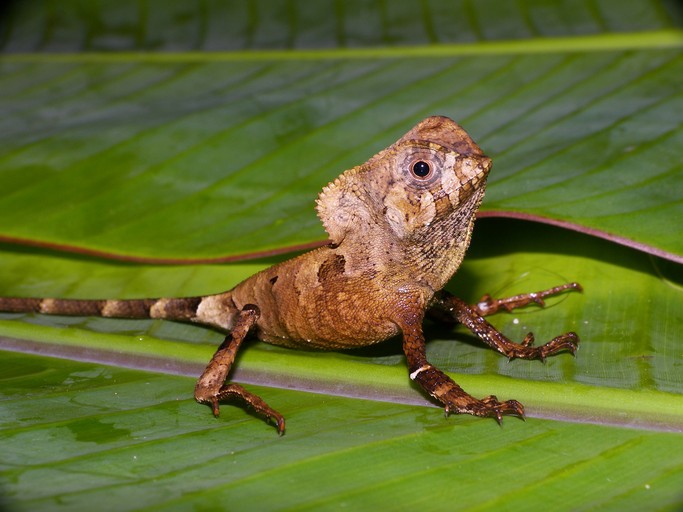
Iguanas · Difficulty: Expert
Key facts and care guidance for Helmeted iguana (Corytophanes cristatus) (origin: Central America, near the rainforest floor (southern Mexico to Colombia and Ecuador)). Adult size around approx. 30–35 cm total length (mostly tail). Life expectancy uncertain; in captivity often only a few years (mainly wild-caught animals). The values below are carefully researched guidance.
Short answers
Helmeted iguana: How big does the enclosure need to be?
45×45×90 cm (tall format) for one animal, densely planted; larger is better.
Helmeted iguana: What temperature does it need?
Daytime 24–28 °C (relatively cool; holds its body temperature around ~26 °C), basking spot 30–32 °C (only a weak basking spot, avoids strong heat), at night 20–23 °C.
Helmeted iguana: Does it need UVB lighting?
UVB: Low to medium UVB recommended (a shade and ground dweller, Ferguson zone 1).
Helmeted iguana: How long do they live?
Life expectancy: uncertain; in captivity often only a few years (mainly wild-caught animals).
Helmeted iguana: Is it suitable for beginners?
No – better suited to experienced keepers (difficulty: Expert).
Climate
- Daytime temperature
- 24–28 °C (relatively cool; holds its body temperature around ~26 °C)
- Night temperature
- 20–23 °C
- Basking spot
- 30–32 °C (only a weak basking spot, avoids strong heat)
- Humidity
- 70–90 %, with good ventilation required
- UVB
- Low to medium UVB recommended (a shade and ground dweller, Ferguson zone 1)
Enclosure
- Minimum size
- 45×45×90 cm (tall format) for one animal, densely planted; larger is better
- Substrate
- A deep, damp forest-floor and coco humus mix with leaf litter (a moisture store)
Feeding
- Food
- Insects, preferably large slow prey (roaches, locusts, worms), occasionally small lizards
- Feeding interval
- adults every other day or 2–3×/week, juveniles daily
Key facts
- Adult size
- approx. 30–35 cm total length (mostly tail)
- Life expectancy
- uncertain; in captivity often only a few years (mainly wild-caught animals)
- Origin
- Central America, near the rainforest floor (southern Mexico to Colombia and Ecuador)
- Protection status
- Not listed under CITES; mostly wild-caught animals in the trade
- Brumation
- None; a slight seasonal change in photoperiod (about 13 h in summer / 11 h in winter)
- Cohabitation
- Single housing; territorial and highly stress-prone. The reason is territory: two animals will not voluntarily share a basking spot or a hiding place. They fight until one is seriously injured or permanently confined to a corner — and that second animal then eats worse, without showing any visible wound.
Notes
A sit-and-wait ambush hunter, slow and extremely prone to stress; often a food refuser (frequently taking only live prey). Usually imported as a wild-caught animal → high loss rates, unsuitable for beginners, and not an animal for handling. It needs high humidity AND air movement at the same time (otherwise shedding problems). The husbandry data are inconsistent across sources.
Do you keep this species?
Add your animal to Reptoria – Reptoria reminds you about feeding and shedding. Add your animal for free →
Look for Helmeted iguana (Corytophanes cristatus) in the marketplace →
Related species
- Hernandez's helmeted basilisk (Corytophanes hernandesii) – Expert
- Anegada ground iguana (Cyclura pinguis) – Expert
- Grand Cayman blue iguana (Cyclura lewisi) – Expert
- Common chuckwalla (Sauromalus ater) – Intermediate
- Cape spiny-tailed iguana (Ctenosaura hemilopha) – Intermediate
- Fiji banded iguana (Brachylophus fasciatus) – Expert
- Green iguana (Iguana iguana) – Intermediate to expert
- Guatemalan spiny-tailed iguana (Ctenosaura palearis) – Expert
What you need to start
To keep Helmeted iguana (Corytophanes cristatus) you typically need: a suitable enclosure (45×45×90 cm (tall format) for one animal, densely planted; larger is better), substrate (A deep, damp forest-floor and coco humus mix with leaf litter (a moisture store)), a heat source with a thermostat, UVB lighting, thermometer and hygrometer, a water dish and hides. You will find equipment in the Reptoria marketplace.
The complete, interactive care database is in the Reptoria app.
Last updated: 2 November 2026 · Editor: Reptoria editorial team · Sources include: https://en.wikipedia.org/wiki/Smooth_helmeted_iguana, https://reptile-database.reptarium.cz/species?genus=Corytophanes&species=cristatus
All values are non-binding guidance and do not replace expert advice. Research thoroughly from several sources before acquiring and keeping an animal, and observe the applicable law (species and animal protection in particular).