Green iguana (Iguana iguana)
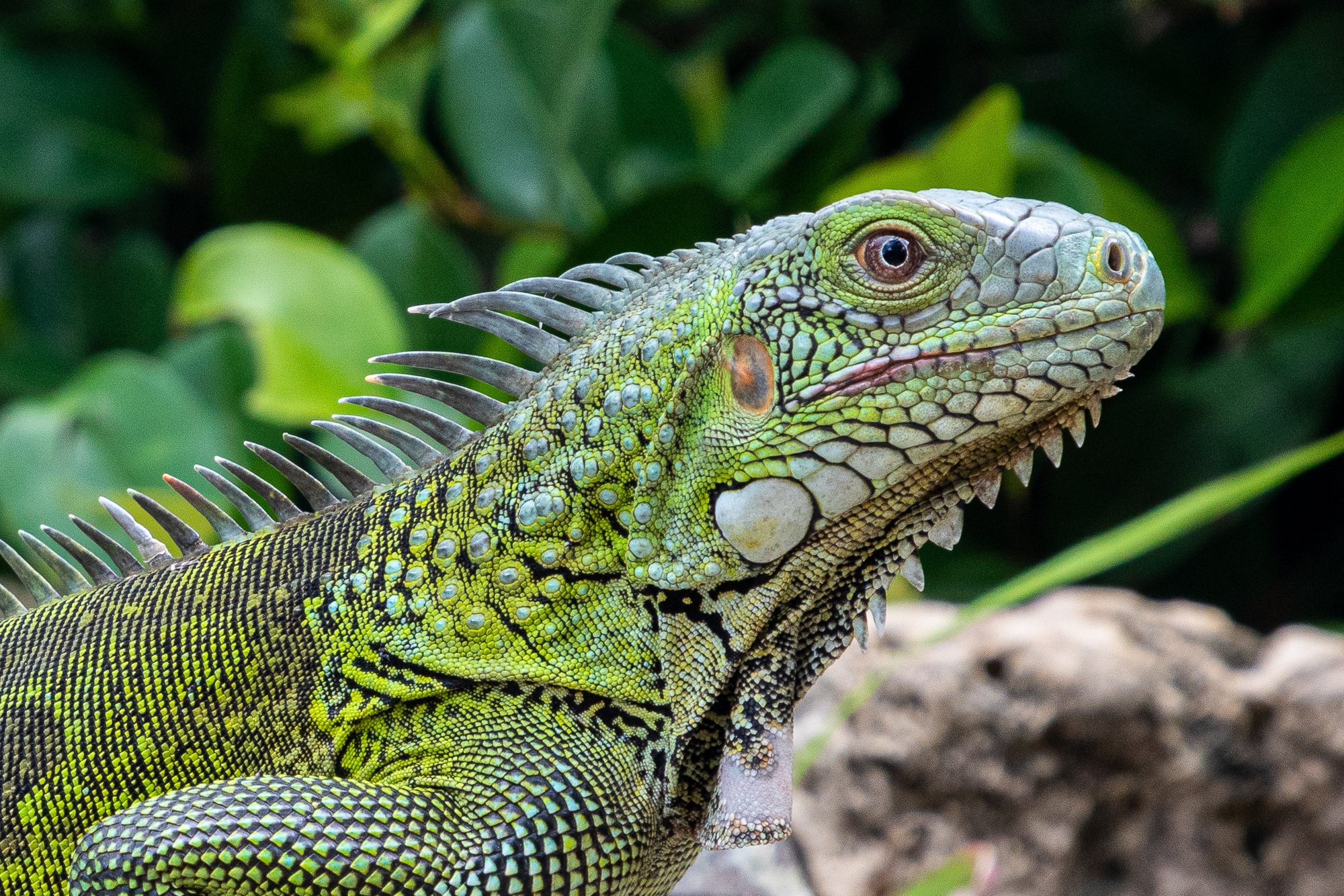
Iguanas · Difficulty: Intermediate to expert
Key facts and care guidance for Green iguana (Iguana iguana) (origin: Central and South America (tropical)). Adult size around 1.5–2.2 m total length (males; females usually stay under 1.5 m), snout–vent length 40–50 cm. Life expectancy 12–20 years. The values below are carefully researched guidance.
Short answers
Green iguana: How big does the enclosure need to be?
A dedicated room or room-sized enclosure — at least 300×200×200 cm for an adult animal; per the BMEL expert report, at least 4 × 3 × 5 times snout–vent length, with height capped at 2.0 m.
Green iguana: What temperature does it need?
Daytime 25–30 °C with a gradient (cooler zone not below 24 °C), basking spot 40–45 °C basking spot, at night 22–24 °C.
Green iguana: Does it need UVB lighting?
UVB: Essential: UV index 3–4 at the basking spot (UVB output 5–10%), plus UVA; replace tubes annually.
Green iguana: How long do they live?
Life expectancy: 12–20 years.
Green iguana: Is it suitable for beginners?
No – better suited to experienced keepers (difficulty: Intermediate to expert).
Climate
- Daytime temperature
- 25–30 °C with a gradient (cooler zone not below 24 °C)
- Night temperature
- 22–24 °C
- Basking spot
- 40–45 °C basking spot
- Humidity
- day 60–80 %, higher at night (up to ~90 %)
- UVB
- Essential: UV index 3–4 at the basking spot (UVB output 5–10%), plus UVA; replace tubes annually
Enclosure
- Minimum size
- a dedicated room or room-sized enclosure — at least 300×200×200 cm for an adult animal; per the BMEL expert report, at least 4 × 3 × 5 times snout–vent length, with height capped at 2.0 m
- Substrate
- Moisture-retaining; stable climbing branches, a large water basin
Feeding
- Food
- Purely plant-based (leaves, vegetables, herbs) – herbivorous!
- Feeding interval
- fresh green food daily
Key facts
- Adult size
- 1.5–2.2 m total length (males; females usually stay under 1.5 m), snout–vent length 40–50 cm
- Life expectancy
- 12–20 years
- Origin
- Central and South America (tropical)
- Protection status
- CITES Appendix II / EU Annex B – registration required, proof of origin needed
- Brumation
- None
- Cohabitation
- Single housing; males are very territorial and aggressive (especially in the breeding season). The reason: several males fight over territory and the basking spot until one is injured or sits permanently in a corner. Females usually get along, but each needs its own basking and hiding spots; feed separately if sizes differ.
Notes
It grows very large and powerful, is strictly plant-eating (no animal protein!) and needs a whole room. A frequent mistaken purchase – not one for beginners.
Do you keep this species?
Add your animal to Reptoria – Reptoria reminds you about feeding and shedding. Add your animal for free →
Related species
- Lesser Antillean iguana (Iguana delicatissima) – Expert
- Anegada ground iguana (Cyclura pinguis) – Expert
- Grand Cayman blue iguana (Cyclura lewisi) – Expert
- Common chuckwalla (Sauromalus ater) – Intermediate
- Cape spiny-tailed iguana (Ctenosaura hemilopha) – Intermediate
- Fiji banded iguana (Brachylophus fasciatus) – Expert
- Guatemalan spiny-tailed iguana (Ctenosaura palearis) – Expert
- Helmeted iguana (Corytophanes cristatus) – Expert
What you need to start
To keep Green iguana (Iguana iguana) you typically need: a suitable enclosure (a dedicated room or room-sized enclosure — at least 300×200×200 cm for an adult animal; per the BMEL expert report, at least 4 × 3 × 5 times snout–vent length, with height capped at 2.0 m), substrate (Moisture-retaining; stable climbing branches, a large water basin), a heat source with a thermostat, UVB lighting, thermometer and hygrometer, a water dish and hides. You will find equipment in the Reptoria marketplace.
The complete, interactive care database is in the Reptoria app.
Last updated: 9 October 2026 · Editor: Reptoria editorial team · Sources include: einrichtungsbeispiele.de, reptifiles.com, bmleh.de, dahmstierleben.de, drta-archiv.de
All values are non-binding guidance and do not replace expert advice. Research thoroughly from several sources before acquiring and keeping an animal, and observe the applicable law (species and animal protection in particular).