Golden poison frog (Phyllobates terribilis)
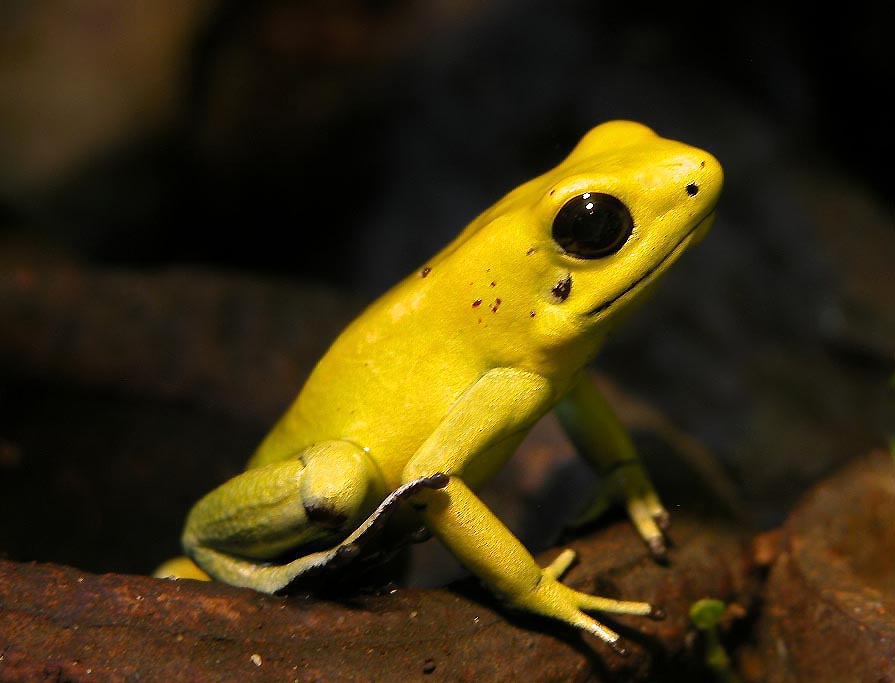
Amphibians · Difficulty: Beginner to intermediate
Key facts and care guidance for Golden poison frog (Phyllobates terribilis) (origin: The Pacific coast of Colombia (rainforest)). Adult size around approx. 4.5–5 cm. Life expectancy up to ~20 years. The values below are carefully researched guidance.
Short answers
Golden poison frog: How big does the enclosure need to be?
50 × 50 × 50 cm for a pair, around 400 cm² more floor space per additional animal; from about 80 × 40 × 60 cm for a group.
Golden poison frog: What temperature does it need?
Daytime 25–28 °C, at night 20–23 °C (night-time drop of ~5 °C).
Golden poison frog: Does it need UVB lighting?
UVB: Optional (weak UVB).
Golden poison frog: How long do they live?
Life expectancy: up to ~20 years.
Golden poison frog: Is it suitable for beginners?
Partly – manageable with some prior knowledge (difficulty: Beginner to intermediate).
Climate
- Daytime temperature
- 25–28 °C
- Night temperature
- 20–23 °C (night-time drop of ~5 °C)
- Basking spot
- —
- Humidity
- 80–95 % by day, ~100 % at night
- UVB
- Optional (weak UVB)
Enclosure
- Minimum size
- 50 × 50 × 50 cm for a pair, around 400 cm² more floor space per additional animal; from about 80 × 40 × 60 cm for a group
- Substrate
- Drainage plus rainforest substrate or pine bark, moss, leaf litter, bromeliads, a water spot
Feeding
- Food
- Fruit flies (Drosophila), springtails, small house crickets, bean weevils
- Feeding interval
- daily to every other day, dusted with vitamins and calcium
Key facts
- Adult size
- approx. 4.5–5 cm
- Life expectancy
- up to ~20 years
- Origin
- The Pacific coast of Colombia (rainforest)
- Protection status
- CITES Appendix II / EU Annex B — registration required, proof of origin
- Brumation
- None
- Cohabitation
- Groups are possible, as are pairs; do not mix with other species. Only keep animals of the same species and roughly the same size together, so that smaller animals do not miss out on food. If you want to breed them, be aware that adult females in a group eat each other’s clutches, which is why breeders often keep adults in pairs. Provide enough hiding places so every animal can get out of the way.
Notes
In the wild one of the most toxic frogs there is (batrachotoxin) — terrarium-bred animals are non-toxic because of their diet. Buy captive-bred animals only.
Do you keep this species?
Add your animal to Reptoria – Reptoria reminds you about feeding and shedding. Add your animal for free →
Look for Golden poison frog (Phyllobates terribilis) in the marketplace →
Related species
- Lovely poison frog (Phyllobates lugubris) – Intermediate
- Golfodulcean poison frog (Phyllobates vittatus) – Beginner
- Kokoe poison frog (Phyllobates aurotaenia) – Intermediate
- Black-legged poison frog (Phyllobates bicolor) – Intermediate
- Yellow-bellied poison frog (Ameerega hahneli) – Intermediate
- Anthony's poison frog (Hyloxalus nexipus) – Intermediate
- Bassler's poison frog (Ameerega bassleri) – Intermediate
- Poison frogs (Ranitomeya amazonica) – Intermediate
What you need to start
To keep Golden poison frog (Phyllobates terribilis) you typically need: a suitable enclosure (50 × 50 × 50 cm for a pair, around 400 cm² more floor space per additional animal; from about 80 × 40 × 60 cm for a group), substrate (Drainage plus rainforest substrate or pine bark, moss, leaf litter, bromeliads, a water spot), a heat source with a thermostat, UVB lighting, thermometer and hygrometer, a water dish and hides. You will find equipment in the Reptoria marketplace.
The complete, interactive care database is in the Reptoria app.
Last updated: 9 October 2026 · Editor: Reptoria editorial team · Sources include: einrichtungsbeispiele.de, eur-lex.europa.eu, megazoo-nord.de, pfeilgiftfrosch.info, terraristikladen.de
All values are non-binding guidance and do not replace expert advice. Research thoroughly from several sources before acquiring and keeping an animal, and observe the applicable law (species and animal protection in particular).