Kokoe poison frog (Phyllobates aurotaenia)
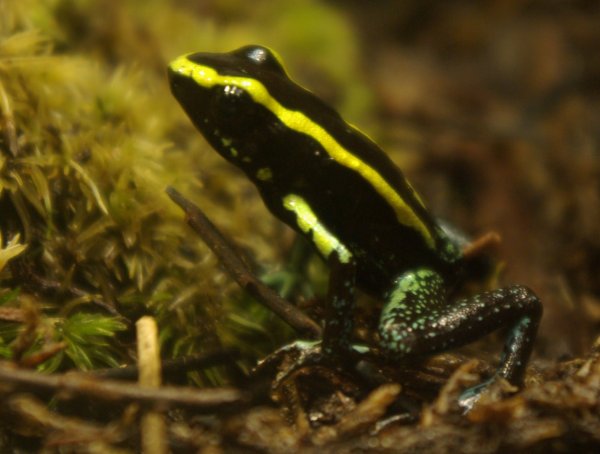
Amphibians · Difficulty: Intermediate
Key facts and care guidance for Kokoe poison frog (Phyllobates aurotaenia) (origin: Western Colombia – the Chocó). Adult size around 3–3,5 cm. Life expectancy 10–15 years. The values below are carefully researched guidance.
Short answers
Kokoe poison frog: How big does the enclosure need to be?
60×45×50 cm.
Kokoe poison frog: What temperature does it need?
Daytime 22–27 °C, basking spot No basking spot, at night 19–22 °C.
Kokoe poison frog: Does it need UVB lighting?
UVB: Recommended (UVB 2 %).
Kokoe poison frog: How long do they live?
Life expectancy: 10–15 years.
Kokoe poison frog: Is it suitable for beginners?
Rather not – it is considered an intermediate species (difficulty: Intermediate).
Climate
- Daytime temperature
- 22–27 °C
- Night temperature
- 19–22 °C
- Basking spot
- No basking spot
- Humidity
- 80–90 %
- UVB
- Recommended (UVB 2 %)
Enclosure
- Minimum size
- 60×45×50 cm
- Substrate
- Coco humus, a thick layer of leaf litter, roots, a shallow water spot
Feeding
- Food
- Fruit flies, springtails, micro crickets
- Feeding interval
- daily
Key facts
- Adult size
- 3–3,5 cm
- Life expectancy
- 10–15 years
- Origin
- Western Colombia – the Chocó
- Protection status
- CITES II
- Brumation
- None
- Cohabitation
- Keeping a pair (1.1) is the easiest to oversee. A small mixed group works well because the species is social and males sing rather than fight; drawback: you have to watch whether one frog is pushed away from the food. Raise juveniles apart from the adults so they do not lose out at feeding time. Never keep it with other Phyllobates species, as they hybridise.
Notes
One of the three species whose skin toxin was traditionally used on blowpipe darts. Terrarium animals do not produce the toxin for want of the food source – wild-caught animals, by contrast, are highly toxic and do not belong in private hands.
Do you keep this species?
Add your animal to Reptoria – Reptoria reminds you about feeding and shedding. Add your animal for free →
Look for Kokoe poison frog (Phyllobates aurotaenia) in the marketplace →
Related species
- Lovely poison frog (Phyllobates lugubris) – Intermediate
- Golden poison frog (Phyllobates terribilis) – Beginner to intermediate
- Golfodulcean poison frog (Phyllobates vittatus) – Beginner
- Black-legged poison frog (Phyllobates bicolor) – Intermediate
- Yellow-bellied poison frog (Ameerega hahneli) – Intermediate
- Anthony's poison frog (Hyloxalus nexipus) – Intermediate
- Bassler's poison frog (Ameerega bassleri) – Intermediate
- Poison frogs (Ranitomeya amazonica) – Intermediate
What you need to start
To keep Kokoe poison frog (Phyllobates aurotaenia) you typically need: a suitable enclosure (60×45×50 cm), substrate (Coco humus, a thick layer of leaf litter, roots, a shallow water spot), a heat source with a thermostat, UVB lighting, thermometer and hygrometer, a water dish and hides. You will find equipment in the Reptoria marketplace.
The complete, interactive care database is in the Reptoria app.
Last updated: 9 October 2026 · Editor: Reptoria editorial team · Sources include: https://citizen-conservation.org/wp-content/uploads/2024/10/CC-Breeding-Guidelines_Phyllobates-terribilis_07-2024.pdf, https://de.wikipedia.org/wiki/Phyllobates_aurotaenia, https://en.wikipedia.org/wiki/Phyllobates_aurotaenia
All values are non-binding guidance and do not replace expert advice. Research thoroughly from several sources before acquiring and keeping an animal, and observe the applicable law (species and animal protection in particular).