Russian tortoise (Testudo horsfieldii)
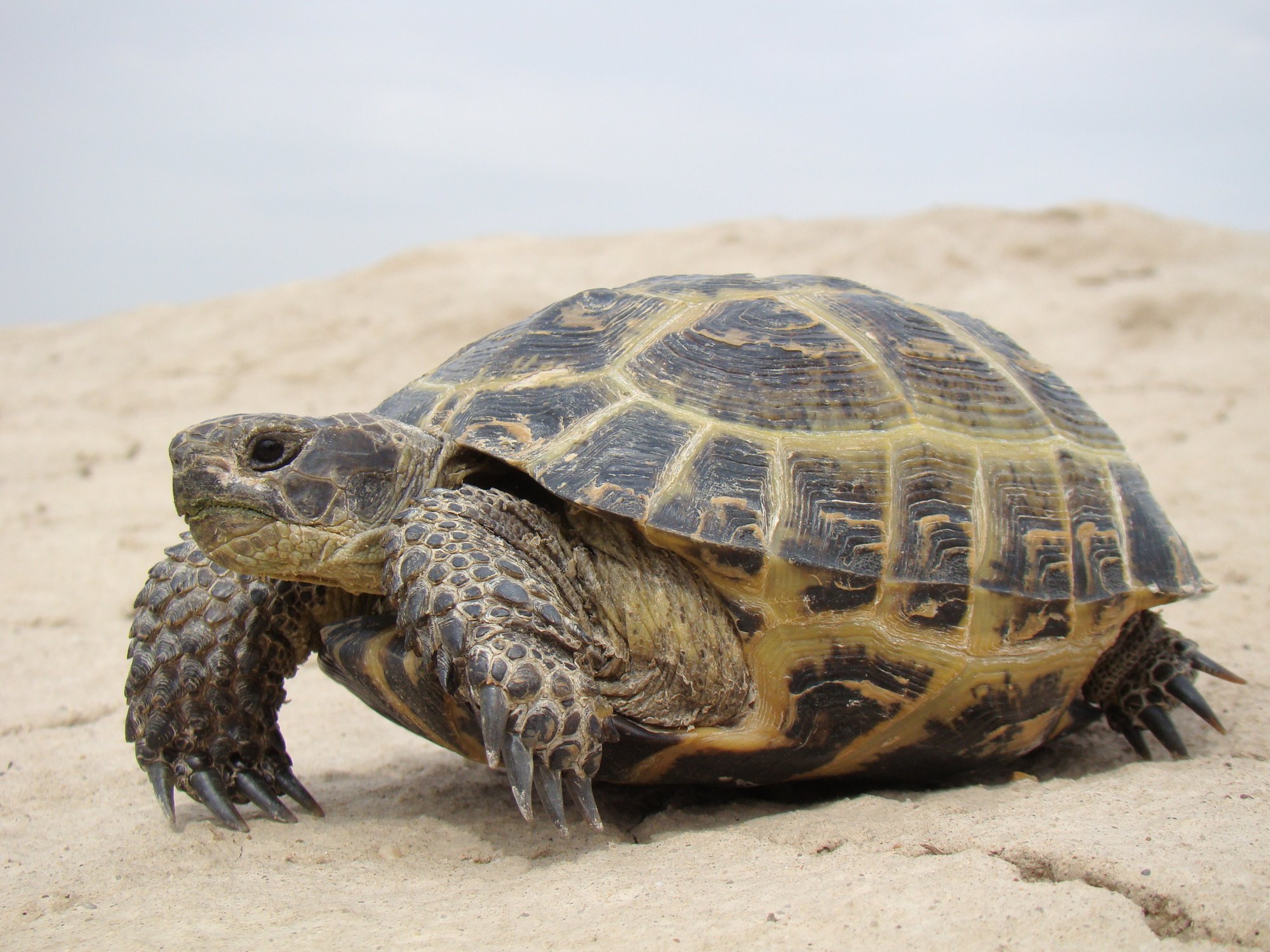
Turtles & tortoises · Difficulty: Beginner
Key facts and care guidance for Russian tortoise (Testudo horsfieldii) (origin: Central Asia: Afghanistan, eastern Iran, Kazakhstan, Turkmenistan, Uzbekistan, Tajikistan, north-western Pakistan, western China). Adult size around 15–22 cm (females up to ~25 cm, males ~15–18 cm), with a flatter, rounder shell. Life expectancy 40–60 years, individual animals older. The values below are carefully researched guidance.
Short answers
Russian tortoise: How big does the enclosure need to be?
Outdoor/cold-frame keeping from 10 m² for an adult animal, better 15 m²; a keen digger — deep, diggable substrate and a border sunk at least 30 cm into the ground (it climbs and digs); keeping it purely in a terrarium is not appropriate.
Russian tortoise: What temperature does it need?
Daytime 22–28 °C (outdoors / cold frame), basking spot 40–45 °C (basking spot under a heat emitter), at night 15–20 °C (night-time drop).
Russian tortoise: Does it need UVB lighting?
UVB: UVB essential when kept indoors (Ferguson zone 3, UV index 3–5); outdoors the sun covers it.
Russian tortoise: How long do they live?
Life expectancy: 40–60 years, individual animals older.
Russian tortoise: Is it suitable for beginners?
Yes – it is considered suitable for beginners (difficulty: Beginner).
Climate
- Daytime temperature
- 22–28 °C (outdoors / cold frame)
- Night temperature
- 15–20 °C (night-time drop)
- Basking spot
- 40–45 °C (basking spot under a heat emitter)
- Humidity
- 40–55 % (rather dry; juveniles need a more humid microclimate)
- UVB
- UVB essential when kept indoors (Ferguson zone 3, UV index 3–5); outdoors the sun covers it
Enclosure
- Minimum size
- Outdoor/cold-frame keeping from 10 m² for an adult animal, better 15 m²; a keen digger — deep, diggable substrate and a border sunk at least 30 cm into the ground (it climbs and digs); keeping it purely in a terrarium is not appropriate
- Substrate
- A sand, loam and soil mix, deep and diggable (it makes deep tunnels)
Feeding
- Food
- Strictly herbivorous: fibre-rich wild herbs, flowers, dried herbs or hay; no fruit and no animal protein; calcium (cuttlebone)
- Feeding interval
- wild herbs freely available every day, no overfeeding; juveniles daily
Key facts
- Adult size
- 15–22 cm (females up to ~25 cm, males ~15–18 cm), with a flatter, rounder shell
- Life expectancy
- 40–60 years, individual animals older
- Origin
- Central Asia: Afghanistan, eastern Iran, Kazakhstan, Turkmenistan, Uzbekistan, Tajikistan, north-western Pakistan, western China
- Protection status
- CITES Appendix II / EU Annex B (an exception among the European tortoises): proof of origin plus registration required, but no marking duty or yellow certificate
- Brumation
- Yes — winter dormancy 4–5 months at 2–5 °C (November to March) AND additionally a summer rest/aestivation of 4–8 weeks during heat and drought — part of this species' natural annual cycle
- Cohabitation
- A single-species group is possible, but the males are aggressive and territorial. Keeping them singly, or one male with several females given plenty of space, is best; never two males
Notes
Extremely active at digging – build the enclosure escape-proof and secure against tunnelling. A short activity period (a steppe climate), with a summer and a winter rest in between. A common mistake: kept too damp or too warm, with no summer rest. Do not mix it with other Testudo species.
Do you keep this species?
Add your animal to Reptoria – Reptoria reminds you about feeding and shedding. Add your animal for free →
Look for Russian tortoise (Testudo horsfieldii) in the marketplace →
Related species
- Egyptian tortoise (Testudo kleinmanni) – Intermediate to expert
- Marginated tortoise (Testudo marginata) – Beginner to intermediate
- Hermann's tortoise – Dalmatian (Testudo hermanni hercegovinensis) – Beginner
- Hermann's tortoise – eastern (Testudo hermanni boettgeri) – Beginner
- Hermann's tortoise – western (Testudo hermanni hermanni) – Beginner to intermediate
- Hermann's tortoise (Testudo hermanni) – Beginner
- Spur-thighed tortoise – Armenian (Testudo graeca armeniaca) – Intermediate
- Spur-thighed tortoise – Golan (Testudo graeca terrestris) – Intermediate
What you need to start
To keep Russian tortoise (Testudo horsfieldii) you typically need: a suitable enclosure (Outdoor/cold-frame keeping from 10 m² for an adult animal, better 15 m²; a keen digger — deep, diggable substrate and a border sunk at least 30 cm into the ground (it climbs and digs); keeping it purely in a terrarium is not appropriate), substrate (A sand, loam and soil mix, deep and diggable (it makes deep tunnels)), a heat source with a thermostat, UVB lighting, thermometer and hygrometer, a water dish and hides. You will find equipment in the Reptoria marketplace.
The complete, interactive care database is in the Reptoria app.
Last updated: 5 November 2026 · Editor: Reptoria editorial team · Sources include: bmleh.de, einrichtungsbeispiele.de, landschildkroeten.de, schildkroete.net, schildkroeten-farm.de
All values are non-binding guidance and do not replace expert advice. Research thoroughly from several sources before acquiring and keeping an animal, and observe the applicable law (species and animal protection in particular).