Campbell's dwarf hamster (Phodopus campbelli)
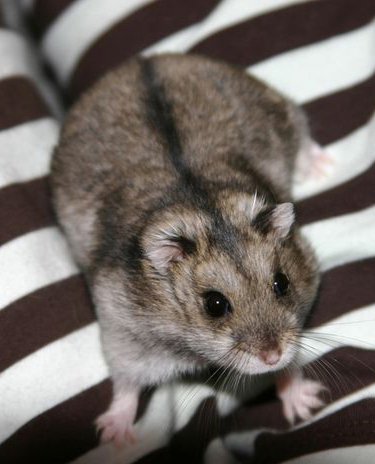
Small mammals · Difficulty: Beginner
Key facts and care guidance for Campbell's dwarf hamster (Phodopus campbelli) (origin: Steppes and semi-deserts of Mongolia, north-eastern China and southern Siberia (Altai, Tuva, Dauria).). Adult size around Head-body length 8–10 cm, tail 0.4–1.4 cm; weight about 30–50 g.. Life expectancy 2–3 years.. The values below are carefully researched guidance.
Short answers
Campbell's dwarf hamster: How big does the enclosure need to be?
From 120×50×50 cm (recommended size per the Kaninchenwiese small mammal overview 2025; bmt hamster leaflet 2025: the enclosure must not be smaller than 100×50×50 cm, TVT leaflet no. 162 dwarf hamsters 2025). Bigger is better; the Austrian legal minimum is only 60×30×40 cm. Wheel at least 25 cm (Roborovski at least 20 cm) with a solid running surface.
Campbell's dwarf hamster: What temperature does it need?
Daytime 18–24 °C room temperature (bmt hamster leaflet 2025); in the cold activity drops to near immobility, above 26 °C heat stress is likely.
Campbell's dwarf hamster: Does it need UVB lighting?
UVB: Not needed – nocturnal mammal; normal daylight in the room with a regular day-night rhythm is enough; do not place the enclosure in direct sun.
Campbell's dwarf hamster: How long do they live?
Life expectancy: 2–3 years.
Campbell's dwarf hamster: Is it suitable for beginners?
Yes – it is considered suitable for beginners (difficulty: Beginner).
Climate
- Daytime temperature
- 18–24 °C room temperature (bmt hamster leaflet 2025); in the cold activity drops to near immobility, above 26 °C heat stress is likely.
- Humidity
- 40–60 % (normal indoor air, no extra humidification).
- UVB
- Not needed – nocturnal mammal; normal daylight in the room with a regular day-night rhythm is enough; do not place the enclosure in direct sun.
Enclosure
- Minimum size
- from 120×50×50 cm (recommended size per the Kaninchenwiese small mammal overview 2025; bmt hamster leaflet 2025: the enclosure must not be smaller than 100×50×50 cm, TVT leaflet no. 162 dwarf hamsters 2025). Bigger is better; the Austrian legal minimum is only 60×30×40 cm. Wheel at least 25 cm (Roborovski at least 20 cm) with a solid running surface.
- Substrate
- At least 20 cm, ideally 30–40 cm deep bedding of small-animal litter with hay and straw for digging, plus a sand bath with low-dust chinchilla sand (essential for coat care). Do not place heavy objects on the deep bedding – risk of collapse.
Feeding
- Food
- Dwarf hamster mix of fine seeds, grass seeds and dried herbs (sugar-free and low in grain), hay, a little fresh food daily such as herbs, lettuce or cucumber, gnawing branches. Several times a week a small amount of animal protein (dried insects, mealworms, low-fat quark). No fruit and no sweet treats.
- Feeding interval
- Feed daily in the early evening and scatter the food; remove fresh leftovers the next morning.
Key facts
- Adult size
- Head-body length 8–10 cm, tail 0.4–1.4 cm; weight about 30–50 g.
- Life expectancy
- 2–3 years.
- Origin
- Steppes and semi-deserts of Mongolia, north-eastern China and southern Siberia (Altai, Tuva, Dauria).
- Protection status
- No wildlife-protection papers needed, not on the EU invasive species list; not threatened according to the IUCN.
- Brumation
- None – keep at a steady room temperature indoors. Short torpor in cold and short days is possible but undesirable for pets.
- Cohabitation
- Solitary. According to the bmt leaflet, dwarf hamsters should only be kept alone; pairs and groups often get along for a long time and then suddenly escalate with serious injuries. Austria allows pairs, but solitary housing is the less stressful option.
Notes
Often crossed with the Djungarian hamster; hybrids and Campbell's are considered especially prone to diabetes – feed low in sugar. Digs relatively little and often builds only a nest chamber. Recent taxonomy places the species in the genus Cricetiscus.
Do you keep this species?
Add your animal to Reptoria – Reptoria reminds you about feeding and shedding. Add your animal for free →
Look for Campbell's dwarf hamster (Phodopus campbelli) in the marketplace →
Related species
- Djungarian hamster (winter white dwarf hamster) (Phodopus sungorus) – Beginner
- Roborovski dwarf hamster (Phodopus roborovskii) – Beginner (purely an animal to watch)
- Chinese hamster (Chinese striped hamster) (Cricetulus griseus) – Beginner
- Golden hamster (Syrian hamster) (Mesocricetus auratus) – Beginner (but not for children under about 12 – nocturnal)
- Fancy mouse (Mus musculus) – Beginner
- Fancy rat (Rattus norvegicus) – Beginner
- Mongolian gerbil (Meriones unguiculatus) – Beginner
- African pygmy mouse (Mus minutoides) – Intermediate
What you need to start
To keep Campbell's dwarf hamster (Phodopus campbelli) you typically need: a suitable enclosure (from 120×50×50 cm (recommended size per the Kaninchenwiese small mammal overview 2025; bmt hamster leaflet 2025: the enclosure must not be smaller than 100×50×50 cm, TVT leaflet no. 162 dwarf hamsters 2025). Bigger is better; the Austrian legal minimum is only 60×30×40 cm. Wheel at least 25 cm (Roborovski at least 20 cm) with a solid running surface.), substrate (At least 20 cm, ideally 30–40 cm deep bedding of small-animal litter with hay and straw for digging, plus a sand bath with low-dust chinchilla sand (essential for coat care). Do not place heavy objects on the deep bedding – risk of collapse.), a heat source with a thermostat, thermometer and hygrometer, a water dish and hides. You will find equipment in the Reptoria marketplace.
The complete, interactive care database is in the Reptoria app.
Last updated: 30 October 2026 · Editor: Reptoria editorial team · Sources include: bmt e. V., Flyer „Hamster als Haustiere“ (2025) – Zwerghamster ausschließlich einzeln, Gehege nicht unter 100×50×50 cm, Chinesischer Zwerghamster mind. 120 cm Länge, Sandbad, hohe Einstreu, 18–24 °C – https://bmt-tierschutz.bmtev.de/lib_dateien/Flyer_Hamster_2025.pdf, MSD Veterinary Manual, Disorders and Diseases of Hamsters – Durchfall, Milben, Tumoren, Atemwegserkrankungen – https://www.msdvetmanual.com/all-other-pets/hamsters/disorders-and-diseases-of-hamsters, BArtSchV Anlage 1 – Phodopus/Cricetulus nicht gelistet, Mammalia spp. nur heimische Arten – https://www.gesetze-im-internet.de/bartschv_2005/anlage_1.html, Durchführungs-VO (EU) 2025/1422 (Unionsliste) – Art nicht enthalten – https://umwelt-online.de/recht/eu/25c/25c_1422.htm, VO (EG) 338/97 Anhänge (konsolidiert) – Cricetidae nicht in Anhang A–D – https://www.legislation.gov.uk/eur/1997/338/annex/2020-12-31
All values are non-binding guidance and do not replace expert advice. Research thoroughly from several sources before acquiring and keeping an animal, and observe the applicable law (species and animal protection in particular).