African pygmy mouse (Mus minutoides)
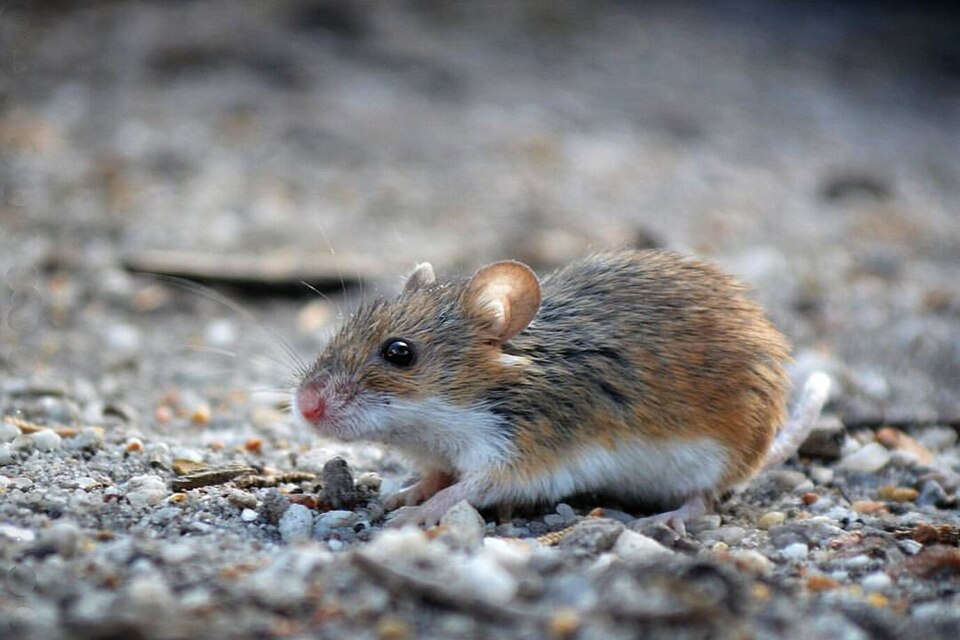
Small mammals · Difficulty: Intermediate
Key facts and care guidance for African pygmy mouse (Mus minutoides) (origin: Sub-Saharan Africa, especially grassland, bush steppe and fynbos; always near water.). Adult size around Head-body about 5–7 cm, tail 4–6 cm; only 3–8 g – one of the smallest rodents.. Life expectancy Usually about 2 years, with good care individual animals 3–4 years.. The values below are carefully researched guidance.
Short answers
African pygmy mouse: How big does the enclosure need to be?
From 80×50×50 cm (for a group of 4–6 animals; no species-specific official standard – floor area as in TVT leaflet no. 158 'Mice', which asks 80×50 cm for the genus Mus; height can be lower because the species lives mainly on the ground). Escape-proof terrarium with fine mesh lid – they jump up to 50 cm and squeeze through the tiniest gaps, ordinary mouse cages are unsuitable. Structure densely with hay, grass tufts, cork tubes and small houses; running wheel from 15 cm.
African pygmy mouse: What temperature does it need?
Daytime 20–25 °C room temperature; these tiny animals lose heat quickly – avoid draughts and cold rooms., at night Not below 18 °C at night.
African pygmy mouse: Does it need UVB lighting?
UVB: Not needed – daylight in the room is enough.
African pygmy mouse: How long do they live?
Life expectancy: Usually about 2 years, with good care individual animals 3–4 years.
African pygmy mouse: Is it suitable for beginners?
Rather not – it is considered an intermediate species (difficulty: Intermediate).
Climate
- Daytime temperature
- 20–25 °C room temperature; these tiny animals lose heat quickly – avoid draughts and cold rooms.
- Night temperature
- Not below 18 °C at night.
- Humidity
- 40–60 % (normal room air; good ventilation, no waterlogging)
- UVB
- Not needed – daylight in the room is enough.
Enclosure
- Minimum size
- from 80×50×50 cm (for a group of 4–6 animals; no species-specific official standard – floor area as in TVT leaflet no. 158 'Mice', which asks 80×50 cm for the genus Mus; height can be lower because the species lives mainly on the ground). Escape-proof terrarium with fine mesh lid – they jump up to 50 cm and squeeze through the tiniest gaps, ordinary mouse cages are unsuitable. Structure densely with hay, grass tufts, cork tubes and small houses; running wheel from 15 cm.
- Substrate
- 8–10 cm of fine, low-dust small-animal bedding or wood shavings with plenty of hay in which they make runs; hay and kitchen paper for nesting.
Feeding
- Food
- Fine seed mix (millet, grass seeds, budgie or finch food), some greens and herbs, small insects (mini crickets, pieces of mealworm) or some egg several times a week. Millet sprays for enrichment, water in a shallow dish with stones or a rodent drinker.
- Feeding interval
- Daily in the evening; because of their fast metabolism some food must always be available.
Key facts
- Adult size
- Head-body about 5–7 cm, tail 4–6 cm; only 3–8 g – one of the smallest rodents.
- Life expectancy
- Usually about 2 years, with good care individual animals 3–4 years.
- Origin
- Sub-Saharan Africa, especially grassland, bush steppe and fynbos; always near water.
- Protection status
- Not protected: not on the EU invasive species list, not in the German BArtSchV, the EU wildlife trade regulation or CITES. Keeping in Germany is allowed without papers. (In the Netherlands the species is not on the positive list for pets; breeding and import are no longer allowed there.)
- Brumation
- None – keep evenly warm all year.
- Cohabitation
- Group. Social animals, never keep alone; low-stress setups are female groups or one male with several females. Only add new animals after rearranging the enclosure and ideally several at once, otherwise there will be fights.
Notes
Purely animals to watch. Biological peculiarity: in this species many animals with a male chromosome set (XY) are nevertheless fertile females – so treat sexing at purchase with caution.
Do you keep this species?
Add your animal to Reptoria – Reptoria reminds you about feeding and shedding. Add your animal for free →
Look for African pygmy mouse (Mus minutoides) in the marketplace →
Related species
- Fancy mouse (Mus musculus) – Beginner
- Eurasian harvest mouse (Micromys minutus) – Expert
- Cairo spiny mouse (Acomys cahirinus) – Intermediate
- Natal multimammate mouse (Mastomys natalensis) – Intermediate
- Barbary striped grass mouse (Lemniscomys barbarus) – Intermediate
- Four-toed hedgehog (African pygmy hedgehog) (Atelerix albiventris) – Intermediate
- Chinchilla (long-tailed chinchilla) (Chinchilla lanigera) – Intermediate
- Common degu (Octodon degus) – Intermediate
What you need to start
To keep African pygmy mouse (Mus minutoides) you typically need: a suitable enclosure (from 80×50×50 cm (for a group of 4–6 animals; no species-specific official standard – floor area as in TVT leaflet no. 158 'Mice', which asks 80×50 cm for the genus Mus; height can be lower because the species lives mainly on the ground). Escape-proof terrarium with fine mesh lid – they jump up to 50 cm and squeeze through the tiniest gaps, ordinary mouse cages are unsuitable. Structure densely with hay, grass tufts, cork tubes and small houses; running wheel from 15 cm.), substrate (8–10 cm of fine, low-dust small-animal bedding or wood shavings with plenty of hay in which they make runs; hay and kitchen paper for nesting.), a heat source with a thermostat, thermometer and hygrometer, a water dish and hides. You will find equipment in the Reptoria marketplace.
The complete, interactive care database is in the Reptoria app.
Last updated: 30 October 2026 · Editor: Reptoria editorial team · Sources include: Fernkloof Nature Reserve „Pygmy mouse“ – Nahrung grüne Pflanzenteile, Samen, Insekten; nachtaktiv; Gewicht 5–6 g – https://www.fernkloof.org.za/index.php/ecology/mammals/item/pygmy-mouse, Wikipedia „African pygmy mouse“ – XY-Weibchen, Steinstapel als Tautränke, Sprünge bis 50 cm, Paare/Kolonien, Tragzeit ~20 Tage, Lebensdauer – https://en.wikipedia.org/wiki/African_pygmy_mouse, BArtSchV Anlage 1 – nur heimische Säugetiere als Sammeleintrag, Mus minutoides nicht genannt – https://www.gesetze-im-internet.de/bartschv_2005/anlage_1.html, Durchführungsverordnung (EU) 2025/1422 – Unionsliste, keine Mus-Art – https://umwelt-online.de/recht/eu/25c/25c_1422.htm, RVO (Niederlande) „Afrikaanse dwergmuis“ – Art nicht auf der niederländischen Heim- und Hobbytierliste – https://www.rvo.nl/huis-en-hobbydieren/afrikaanse-dwergmuis
All values are non-binding guidance and do not replace expert advice. Research thoroughly from several sources before acquiring and keeping an animal, and observe the applicable law (species and animal protection in particular).