Eurasian harvest mouse (Micromys minutus)
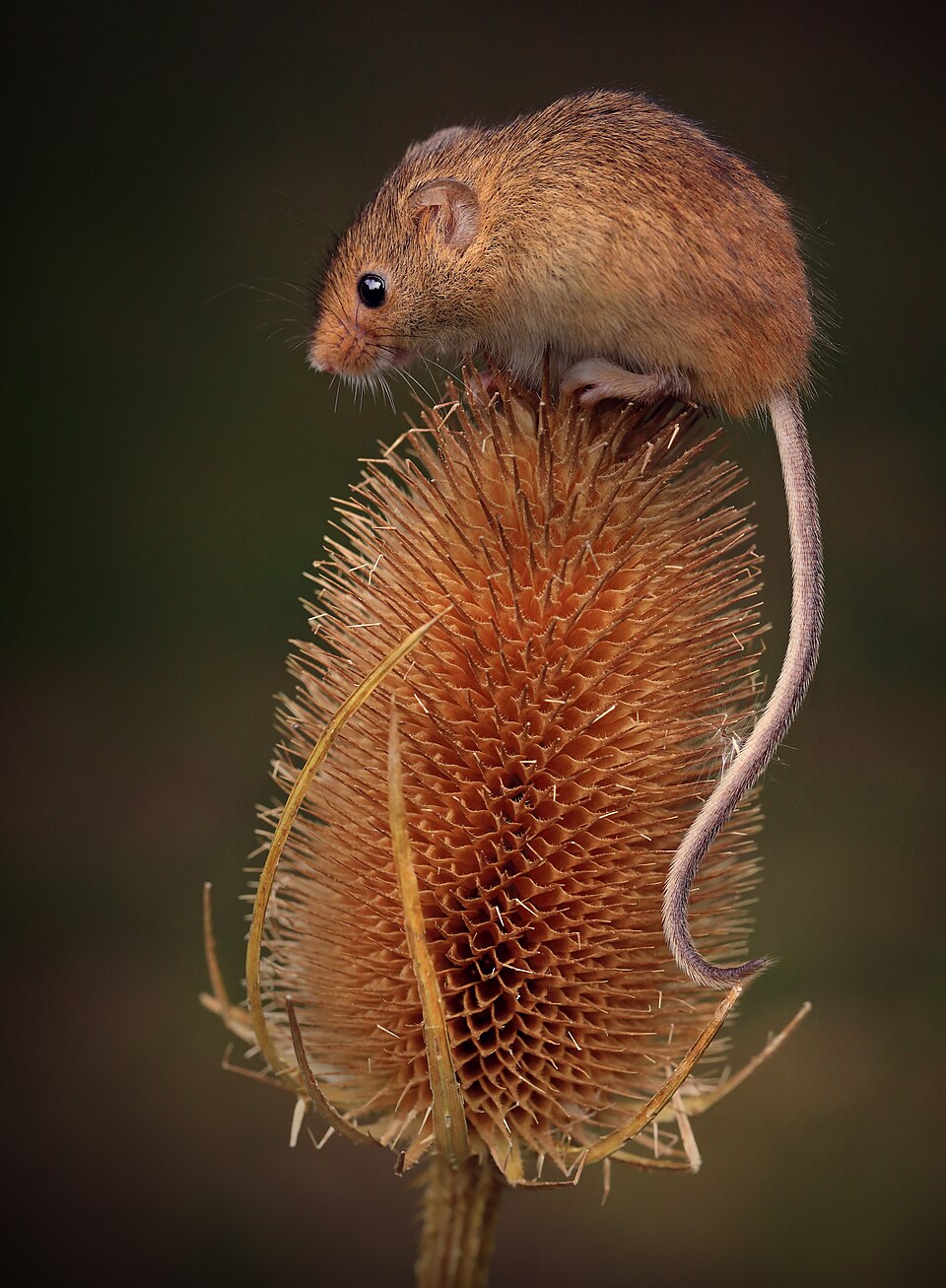
Small mammals · Difficulty: Expert
Key facts and care guidance for Eurasian harvest mouse (Micromys minutus) (origin: Europe and Asia to Japan; native in Germany in reed beds, tall grass and tall-herb vegetation, wet meadows and fallow land.). Adult size around Head-body 5–8 cm, tail 5–7 cm (prehensile); 6–12 g – one of Europe's smallest rodents.. Life expectancy In the wild usually under 1.5 years; in human care often 2–3 years, maximum around 4–5 years.. The values below are carefully researched guidance.
Short answers
Eurasian harvest mouse: How big does the enclosure need to be?
From 80×50×80 cm (for a small group; no official standard – floor area based on TVT leaflet no. 158 'Mice', height especially important because the species climbs stems up to about 80 cm high). Well-ventilated, escape-proof terrarium with fine mesh (the animals fit through gaps of a few millimetres), densely filled with reed and grass stems, bamboo canes, branches, hay and leaves in which they weave their ball nests.
Eurasian harvest mouse: What temperature does it need?
Daytime 16–22 °C room temperature; as a native species no extra heat is needed, avoid heat above 26 °C and direct sun., at night A slight drop at night is natural; not below about 12 °C.
Eurasian harvest mouse: Does it need UVB lighting?
UVB: Not needed – a bright spot with a natural day-night cycle.
Eurasian harvest mouse: How long do they live?
Life expectancy: In the wild usually under 1.5 years; in human care often 2–3 years, maximum around 4–5 years.
Eurasian harvest mouse: Is it suitable for beginners?
No – better suited to experienced keepers (difficulty: Expert).
Climate
- Daytime temperature
- 16–22 °C room temperature; as a native species no extra heat is needed, avoid heat above 26 °C and direct sun.
- Night temperature
- A slight drop at night is natural; not below about 12 °C.
- Humidity
- 50–70 % (normal to slightly more humid room air, fresh grasses; no waterlogging)
- UVB
- Not needed – a bright spot with a natural day-night cycle.
Enclosure
- Minimum size
- from 80×50×80 cm (for a small group; no official standard – floor area based on TVT leaflet no. 158 'Mice', height especially important because the species climbs stems up to about 80 cm high). Well-ventilated, escape-proof terrarium with fine mesh (the animals fit through gaps of a few millimetres), densely filled with reed and grass stems, bamboo canes, branches, hay and leaves in which they weave their ball nests.
- Substrate
- 5–10 cm of small-animal bedding or a soil-leaf mix with a thick layer of hay; add fresh grasses and stems regularly.
Feeding
- Food
- Fine seeds and grass seeds (millet, canary seed, wild seeds), half-ripe grass and grain ears, some fruit and berries; in summer plenty of insects (crickets, caterpillars) as protein. Water in a shallow dish, also mist the grasses.
- Feeding interval
- Fresh daily; the animals eat every few hours around the clock, so food must always be available.
Key facts
- Adult size
- Head-body 5–8 cm, tail 5–7 cm (prehensile); 6–12 g – one of Europe's smallest rodents.
- Life expectancy
- In the wild usually under 1.5 years; in human care often 2–3 years, maximum around 4–5 years.
- Origin
- Europe and Asia to Japan; native in Germany in reed beds, tall grass and tall-herb vegetation, wet meadows and fallow land.
- Protection status
- Specially protected (German BArtSchV annex 1, all native mammals except the species excluded there). Red List Germany 2020: near threatened (warning list); Red List Bavaria 2017: vulnerable. Catching wild animals is prohibited (§ 44(1) BNatSchG, also § 39 BNatSchG) – only keep animals demonstrably bred in the EU. Keep proof of origin (§ 46 BNatSchG); keeping must be reported to the local nature conservation authority (§ 7(2) BArtSchV).
- Brumation
- None – the species does not hibernate even in the wild; in winter a cool room temperature with plenty of nesting material is enough.
- Cohabitation
- Group. Least stressful are small groups of females (littermates); males fight each other fiercely, and females often drive males away after mating. Separate immediately if there is unrest or injury.
Notes
Only keep captive-bred animals: wild-caught animals are prohibited, and 'rescued' animals from the wild may not be kept either. When buying, ask for and keep written proof of origin (breeder, date, number); register the keeping with the local nature conservation authority. Because of the protection rules, their sensitivity and tiny size, rather something for experienced keepers.
Do you keep this species?
Add your animal to Reptoria – Reptoria reminds you about feeding and shedding. Add your animal for free →
Look for Eurasian harvest mouse (Micromys minutus) in the marketplace →
Related species
- African pygmy mouse (Mus minutoides) – Intermediate
- Fancy mouse (Mus musculus) – Beginner
- Cairo spiny mouse (Acomys cahirinus) – Intermediate
- Natal multimammate mouse (Mastomys natalensis) – Intermediate
- Barbary striped grass mouse (Lemniscomys barbarus) – Intermediate
- Four-toed hedgehog (African pygmy hedgehog) (Atelerix albiventris) – Intermediate
- Campbell's dwarf hamster (Phodopus campbelli) – Beginner
- Chinchilla (long-tailed chinchilla) (Chinchilla lanigera) – Intermediate
What you need to start
To keep Eurasian harvest mouse (Micromys minutus) you typically need: a suitable enclosure (from 80×50×80 cm (for a small group; no official standard – floor area based on TVT leaflet no. 158 'Mice', height especially important because the species climbs stems up to about 80 cm high). Well-ventilated, escape-proof terrarium with fine mesh (the animals fit through gaps of a few millimetres), densely filled with reed and grass stems, bamboo canes, branches, hay and leaves in which they weave their ball nests.), substrate (5–10 cm of small-animal bedding or a soil-leaf mix with a thick layer of hay; add fresh grasses and stems regularly.), a heat source with a thermostat, thermometer and hygrometer, a water dish and hides. You will find equipment in the Reptoria marketplace.
The complete, interactive care database is in the Reptoria app.
Last updated: 30 October 2026 · Editor: Reptoria editorial team · Sources include: BNatSchG § 45 Abs. 1 – Ausnahme vom Besitzverbot für in der EU rechtmäßig gezüchtete Tiere – https://www.gesetze-im-internet.de/bnatschg_2009/__45.html, Bayerisches Landesamt für Umwelt „Zwergmaus“ – Größe 5–7 cm, 7–12 g, Greifschwanz, Kugelnester 20 cm–2 m Höhe, Lebensraum, Rote Liste Bayern 2017 gefährdet – https://www.lfu.bayern.de/natur/kleinsaeuger/untersuchungen/zwergmaus/index.htm, BArtSchV § 7 – Haltungsvoraussetzungen und Anzeigepflicht für Wirbeltiere besonders geschützter Arten, außer Anlage 5 – https://www.gesetze-im-internet.de/bartschv_2005/__7.html, BArtSchV Anlage 1, Sammeleintrag Mammalia spp. – alle heimischen Säugetiere besonders geschützt außer u. a. Hausmaus, Feldmaus, Wanderratte (Zwergmaus nicht ausgenommen) – https://www.gesetze-im-internet.de/bartschv_2005/anlage_1.html, BArtSchV Anlage 5 – enthält keine Säugetiere, Zwergmaus also nicht von der Anzeigepflicht befreit – https://www.gesetze-im-internet.de/bartschv_2005/anlage_5.html
All values are non-binding guidance and do not replace expert advice. Research thoroughly from several sources before acquiring and keeping an animal, and observe the applicable law (species and animal protection in particular).