Four-toed hedgehog (African pygmy hedgehog) (Atelerix albiventris)
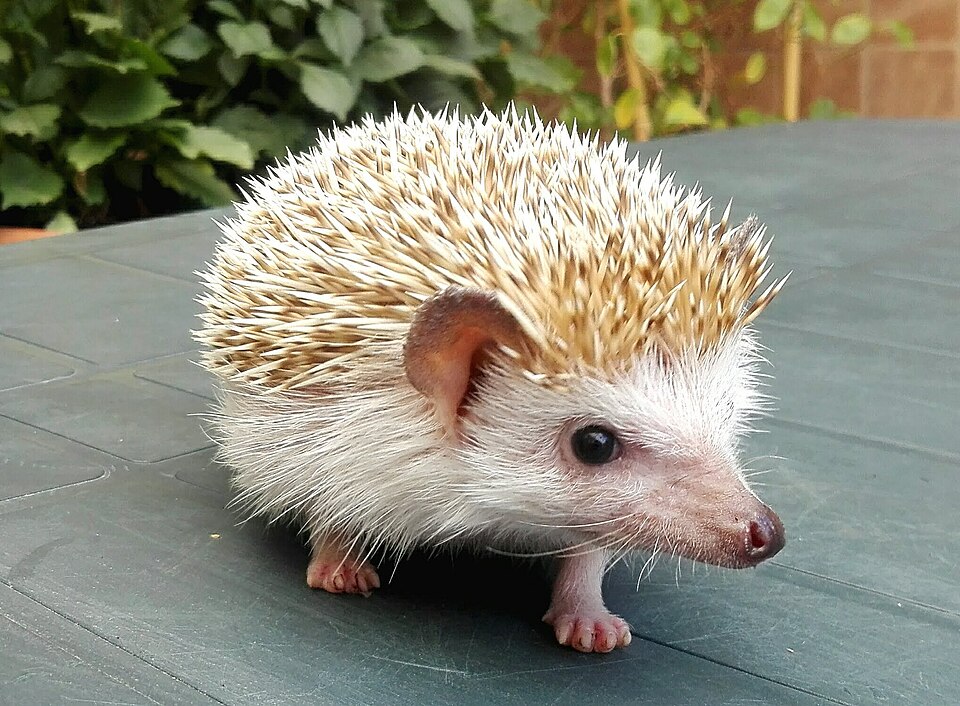
Small mammals · Difficulty: Intermediate
Key facts and care guidance for Four-toed hedgehog (African pygmy hedgehog) (Atelerix albiventris) (origin: Dry savannahs and steppes of sub-Saharan Africa, from Senegal to Sudan, East Africa and Zambia.). Adult size around Head-body length 14–25 cm, tail 1–1.6 cm; weight 300–600 g, males heavier.. Life expectancy 4–6 years, up to 8 years.. The values below are carefully researched guidance.
Short answers
Four-toed hedgehog (African pygmy hedgehog): How big does the enclosure need to be?
From 200×100×60 cm (at least 2 m² of floor space per animal according to the Thieme pet info and Austrian regulation point 7.3.1, +10 % per additional animal); levels with ramps and fall protection count extra. Escape-proof and well ventilated, running disc or solid wheel from about 30 cm.
Four-toed hedgehog (African pygmy hedgehog): What temperature does it need?
Daytime 24–30 °C in the enclosure (Vet Times); room temperature alone is usually not enough – a heat source with thermostat is needed; never let it fall below about 20 °C. A warm spot under a heat lamp is mandatory according to Thieme., at night Keep above 22 °C at night as well – the animals are active at night; a drop leads to dangerous torpor.
Four-toed hedgehog (African pygmy hedgehog): Does it need UVB lighting?
UVB: Not needed – nocturnal; room light with a fixed 12-hour day-night rhythm, no direct sun.
Four-toed hedgehog (African pygmy hedgehog): How long do they live?
Life expectancy: 4–6 years, up to 8 years.
Four-toed hedgehog (African pygmy hedgehog): Is it suitable for beginners?
Rather not – it is considered an intermediate species (difficulty: Intermediate).
Climate
- Daytime temperature
- 24–30 °C in the enclosure (Vet Times); room temperature alone is usually not enough – a heat source with thermostat is needed; never let it fall below about 20 °C. A warm spot under a heat lamp is mandatory according to Thieme.
- Night temperature
- Keep above 22 °C at night as well – the animals are active at night; a drop leads to dangerous torpor.
- Humidity
- Below 40 % (Thieme) up to about 50 % – dry indoor air, do not place the enclosure in damp rooms.
- UVB
- Not needed – nocturnal; room light with a fixed 12-hour day-night rhythm, no direct sun.
Enclosure
- Minimum size
- from 200×100×60 cm (at least 2 m² of floor space per animal according to the Thieme pet info and Austrian regulation point 7.3.1, +10 % per additional animal); levels with ramps and fall protection count extra. Escape-proof and well ventilated, running disc or solid wheel from about 30 cm.
- Substrate
- 5–10 cm of small-animal litter, hemp bedding or paper shreds (no fine sawdust), plus areas with a soil-sand mix for rooting and a sand bath; several hides.
Feeding
- Food
- High-quality special hedgehog food with 30–50 % protein and 10–20 % fat as the base (cat food only as a supplement, as it easily causes obesity), supplemented by insects such as crickets, cockroaches and locusts (dusted with a vitamin-mineral powder), occasionally boiled egg or lean cooked meat and some vegetables. Feed at night and remove leftovers in the morning – obesity is common.
- Feeding interval
- A measured portion every evening; insects as a supplement two to three times a week, and check the weight regularly.
Key facts
- Adult size
- Head-body length 14–25 cm, tail 1–1.6 cm; weight 300–600 g, males heavier.
- Life expectancy
- 4–6 years, up to 8 years.
- Origin
- Dry savannahs and steppes of sub-Saharan Africa, from Senegal to Sudan, East Africa and Zambia.
- Protection status
- No papers needed for the four-toed hedgehog. Important: the native European hedgehog (Erinaceus europaeus) is specially protected and may not be caught, kept or traded – only animals in need may be cared for temporarily and must be released afterwards.
- Brumation
- None – hibernation must not be allowed. In the cold, four-toed hedgehogs fall into torpor, which weakens the immune system and can be fatal. 24–30 °C all year; a cool, limp hedgehog must be warmed slowly and examined by a vet.
- Cohabitation
- Solitary. Four-toed hedgehogs are territorial loners and should be kept alone to avoid fights (Vet Times, Thieme); pairs only briefly for breeding.
Notes
Animal welfare organisations such as Pro Wildlife consider proper private keeping hardly possible; animals in the trade are partly wild-caught – only take captive-bred animals of traceable origin. Salmonella can be transmitted to humans: wash hands after contact.
Do you keep this species?
Add your animal to Reptoria – Reptoria reminds you about feeding and shedding. Add your animal for free →
Look for Four-toed hedgehog (African pygmy hedgehog) (Atelerix albiventris) in the marketplace →
Related species
- Gray short-tailed opossum (Monodelphis domestica) – Intermediate
- African pygmy mouse (Mus minutoides) – Intermediate
- Chinchilla (long-tailed chinchilla) (Chinchilla lanigera) – Intermediate
- Common degu (Octodon degus) – Intermediate
- Fat-tailed gerbil (Pachyuromys duprasi) – Intermediate
- Cairo spiny mouse (Acomys cahirinus) – Intermediate
- Natal multimammate mouse (Mastomys natalensis) – Intermediate
- Barbary striped grass mouse (Lemniscomys barbarus) – Intermediate
What you need to start
To keep Four-toed hedgehog (African pygmy hedgehog) (Atelerix albiventris) you typically need: a suitable enclosure (from 200×100×60 cm (at least 2 m² of floor space per animal according to the Thieme pet info and Austrian regulation point 7.3.1, +10 % per additional animal); levels with ramps and fall protection count extra. Escape-proof and well ventilated, running disc or solid wheel from about 30 cm.), substrate (5–10 cm of small-animal litter, hemp bedding or paper shreds (no fine sawdust), plus areas with a soil-sand mix for rooting and a sand bath; several hides.), a heat source with a thermostat, thermometer and hygrometer, a water dish and hides. You will find equipment in the Reptoria marketplace.
The complete, interactive care database is in the Reptoria app.
Last updated: 30 October 2026 · Editor: Reptoria editorial team · Sources include: Wikipedia (de) „Weißbauchigel“ – 14–25 cm, Verbreitung, bis 10 Jahre in Menschenobhut, Wildfang-Problematik, Pro Wildlife-Kritik – https://de.wikipedia.org/wiki/Wei%C3%9Fbauchigel, Stadt Münster, Artenschutz – Igel als besonders geschützte heimische Säugetiere nach BNatSchG/BArtSchV – https://www.stadt-muenster.de/gruen/naturschutz/artenschutz, BArtSchV Anlage 1 – Mammalia spp.: alle heimischen Arten besonders geschützt (umfasst Erinaceus europaeus), Atelerix nicht gelistet – https://www.gesetze-im-internet.de/bartschv_2005/anlage_1.html, Durchführungs-VO (EU) 2025/1422 (Unionsliste) – Art nicht enthalten – https://umwelt-online.de/recht/eu/25c/25c_1422.htm, VO (EG) 338/97 Anhänge (konsolidiert) – Erinaceidae nicht in Anhang A–D – https://www.legislation.gov.uk/eur/1997/338/annex/2020-12-31
All values are non-binding guidance and do not replace expert advice. Research thoroughly from several sources before acquiring and keeping an animal, and observe the applicable law (species and animal protection in particular).