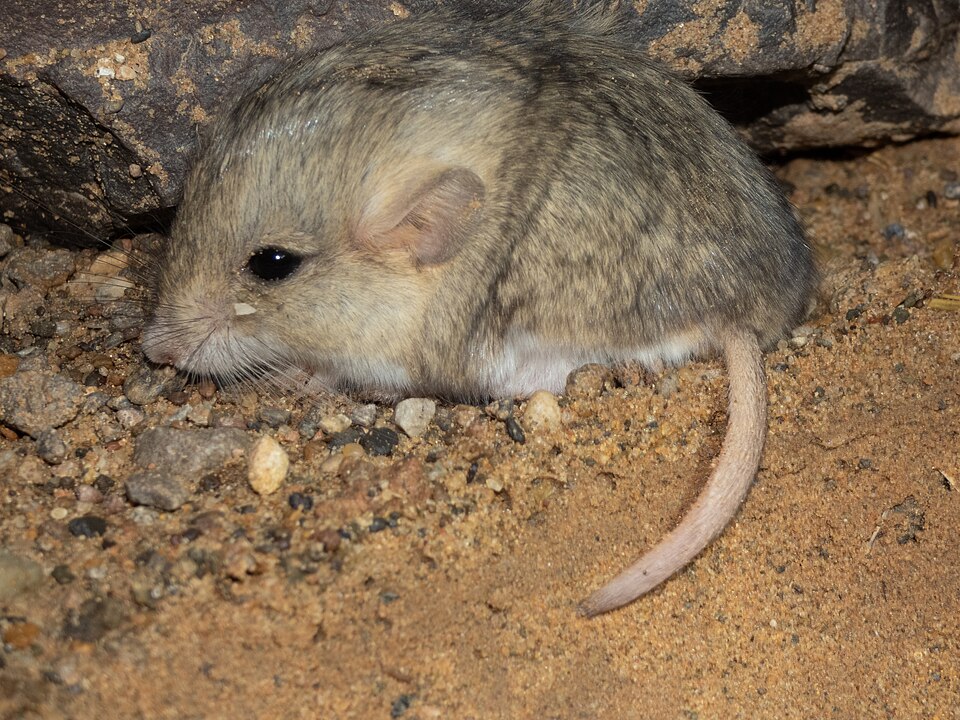
Fat-tailed gerbil (Pachyuromys duprasi)
Small mammals · Difficulty: Intermediate
Key facts and care guidance for Fat-tailed gerbil (Pachyuromys duprasi) (origin: Northern Sahara from Morocco and Algeria via Tunisia and Libya to Egypt; sparsely vegetated semi-desert with firm sand or gravel ground.). Adult size around Head-body 9–12 cm, short club-shaped thickened tail of about 5–6 cm; 40–80 g in human care.. Life expectancy Usually 2–4 years; individual animals have lived over 5 years.. The values below are carefully researched guidance.
Short answers
Fat-tailed gerbil: How big does the enclosure need to be?
From 100×50×50 cm (for 1–2 animals; no species-specific official standard – based on the gerbil figures of TVT and the Swiss animal welfare ordinance of 0.5 m²; more floor space is better, height is secondary because the species climbs poorly and hardly jumps). Well-ventilated tank with mesh cover, several caves of clay, cork or wood, a sand bath and a large solid wheel (from 28 cm).
Fat-tailed gerbil: What temperature does it need?
Daytime 20–26 °C room temperature; as desert animals they like warmth, avoid cool and damp rooms., at night Not below about 18 °C at night.
Fat-tailed gerbil: Does it need UVB lighting?
UVB: Not needed – daylight in the room is enough.
Fat-tailed gerbil: How long do they live?
Life expectancy: Usually 2–4 years; individual animals have lived over 5 years.
Fat-tailed gerbil: Is it suitable for beginners?
Rather not – it is considered an intermediate species (difficulty: Intermediate).
Climate
- Daytime temperature
- 20–26 °C room temperature; as desert animals they like warmth, avoid cool and damp rooms.
- Night temperature
- Not below about 18 °C at night.
- Humidity
- 30–50 % (dry room air; too much moisture – also in food – causes diarrhoea)
- UVB
- Not needed – daylight in the room is enough.
Enclosure
- Minimum size
- from 100×50×50 cm (for 1–2 animals; no species-specific official standard – based on the gerbil figures of TVT and the Swiss animal welfare ordinance of 0.5 m²; more floor space is better, height is secondary because the species climbs poorly and hardly jumps). Well-ventilated tank with mesh cover, several caves of clay, cork or wood, a sand bath and a large solid wheel (from 28 cm).
- Substrate
- 15–25 cm of diggable bedding of small-animal litter and hay, ideally partly with a firm sand-loam mix in which tunnels hold; always add a sand bath with chinchilla sand (prevents a greasy coat).
Feeding
- Food
- Gerbil or hamster food as a base, plus regular insects (crickets, mealworms) as an important protein source – in the wild the species feeds mainly on insects. Some hay, herbs and greens, but little watery vegetables and fruit. Water in a bowl.
- Feeding interval
- Once a day in the evening; insects several times a week.
Key facts
- Adult size
- Head-body 9–12 cm, short club-shaped thickened tail of about 5–6 cm; 40–80 g in human care.
- Life expectancy
- Usually 2–4 years; individual animals have lived over 5 years.
- Origin
- Northern Sahara from Morocco and Algeria via Tunisia and Libya to Egypt; sparsely vegetated semi-desert with firm sand or gravel ground.
- Protection status
- Not protected: not on the EU invasive species list, not in the German BArtSchV, the EU wildlife trade regulation or CITES. Keeping is allowed without papers.
- Brumation
- None – keep warm all year.
- Cohabitation
- Solitary. Mostly solitary in the wild; pairs or siblings can get along, but fights often break out suddenly (bites to the tail). Anyone trying it needs plenty of space, several caves and a spare enclosure for immediate separation.
Notes
The thick tail stores fat and water and is a good health indicator: if it becomes thin, something is wrong. The species has only been in the pet trade for a few decades; find a vet with exotic experience beforehand. Breeding pairs often stay without young, and disturbed females occasionally eat their young.
Do you keep this species?
Add your animal to Reptoria – Reptoria reminds you about feeding and shedding. Add your animal for free →
Look for Fat-tailed gerbil (Pachyuromys duprasi) in the marketplace →
Related species
- Mongolian gerbil (Meriones unguiculatus) – Beginner
- African pygmy mouse (Mus minutoides) – Intermediate
- Four-toed hedgehog (African pygmy hedgehog) (Atelerix albiventris) – Intermediate
- Chinchilla (long-tailed chinchilla) (Chinchilla lanigera) – Intermediate
- Common degu (Octodon degus) – Intermediate
- Gray short-tailed opossum (Monodelphis domestica) – Intermediate
- Cairo spiny mouse (Acomys cahirinus) – Intermediate
- Natal multimammate mouse (Mastomys natalensis) – Intermediate
What you need to start
To keep Fat-tailed gerbil (Pachyuromys duprasi) you typically need: a suitable enclosure (from 100×50×50 cm (for 1–2 animals; no species-specific official standard – based on the gerbil figures of TVT and the Swiss animal welfare ordinance of 0.5 m²; more floor space is better, height is secondary because the species climbs poorly and hardly jumps). Well-ventilated tank with mesh cover, several caves of clay, cork or wood, a sand bath and a large solid wheel (from 28 cm).), substrate (15–25 cm of diggable bedding of small-animal litter and hay, ideally partly with a firm sand-loam mix in which tunnels hold; always add a sand bath with chinchilla sand (prevents a greasy coat).), a heat source with a thermostat, thermometer and hygrometer, a water dish and hides. You will find equipment in the Reptoria marketplace.
The complete, interactive care database is in the Reptoria app.
Last updated: 30 October 2026 · Editor: Reptoria editorial team · Sources include: Wikipedia „Fat-tailed gerbil“ – Fettspeicher im Schwanz, 22–45 g wild / 55–82 g in Menschenobhut, dämmerungsaktiv, überwiegend insektivor, meist solitär, Lebensdauer 2–4 Jahre – https://en.wikipedia.org/wiki/Fat-tailed_gerbil, Crittery (UK-Halterseite) „Duprasi“ – Paare möglich, Streit kommt plötzlich, oft besser einzeln; viel Grundfläche, Sandbad, Einstreu, Feuchtigkeit → Durchfall, Schwanz als Gesundheitsanzeiger – https://www.crittery.co.uk/species-list/duprasi, BArtSchV Anlage 1 – nur heimische Säugetiere als Sammeleintrag, Pachyuromys nicht genannt – https://www.gesetze-im-internet.de/bartschv_2005/anlage_1.html, Durchführungsverordnung (EU) 2025/1422 – Unionsliste, keine Pachyuromys-Art – https://umwelt-online.de/recht/eu/25c/25c_1422.htm, Species+ (UNEP-WCMC), Abfrage Pachyuromys 29.10.2026 – kein Eintrag (nicht CITES, nicht EU-Anhang A–D) – https://speciesplus.net/api/v1/auto_complete_taxon_concepts?taxonomy=CITES&taxon_concept_query=Pachyuromys
All values are non-binding guidance and do not replace expert advice. Research thoroughly from several sources before acquiring and keeping an animal, and observe the applicable law (species and animal protection in particular).